She was sprawled out on the sidewalk, screaming bloody murder. The bike - a garage sale special (meaning there was no padding on the all-metal seat) - was still somehow attached to her.
She and I lived close to each other, and were about the same age, but I had no real interest in bikes when I was six. I wanted her to play dolls with me, but no. She was a tomboy through and through. And she really wanted to learn how to ride a bike.
Her parents bought her this scrap metal bike with what little money they had, took it home, cleaned it up with a bit of red spray paint, and after letting it dry, gave it to her.
She wasted no time. She hopped on (no training wheels), and took off down the neighborhood. I lived at the end of the street, so most of the kids used our house as the turnaround. I waited for her there.
She was no stranger to bikes. Most of the neighborhood kids had them and let her ride when parents weren't looking. Some with training wheels, some without. When this little girl climbed on her very own bike, she was a natural.
Until...
Still straddling the metal heap of a bicycle, but flat on her back, the girl was screaming bloody murder. Apparently, she hit a sidewalk bump where the concrete was broken up and the metal seat jammed her... in the... well, you know.
She lost control, the bike fell over, and she was sort of tangled up in it.
So much screaming. So much crying. I kept looking for blood, but didn't see any. Maybe she broke her leg or something. I thought for sure her folks were going to end up taking her to the hospital. Even her brother - who normally ignored his baby sister - set out to figure out if she was okay... or at least get the kid to stop crying and screaming.
Once they calmed her down, they realized that beyond the need for a padded seat, the only thing that was really bruised was her pride. So her father, in all his infinite wisdom, encouraged her to "stop crying like a baby and get back on the damn bike."
The little girl obediently climbed back on - after setting the bike back up and giving it a firm kick to show it who was boss. This time, instead of riding up and down the street, she practiced in my gravel driveway. She practiced turning, braking, and navigating the bike on "a bumpy road" as she called it. She even managed to teach herself to ride "standing up" so that the seat didn't get the best of her again.
She fell a few more times (gravel wipeouts - OUCH!), but under the watchful eye of her parents, she managed to get back up without shedding a single tear.
By dinnertime, she was racing one of the neighbor kids, giggling and playing as if she was a cycling pro.
Eat your heart out, Lance Armstrong!
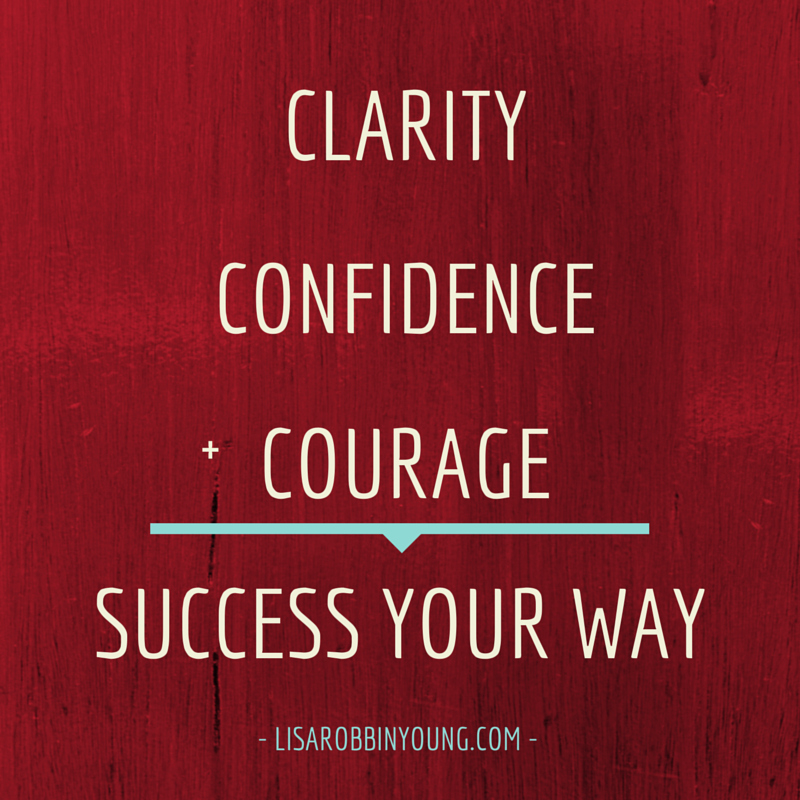
A colleague of mine once shared a similar equation with me. She was using it to talk about the power of irresistible presence, and how, when these three elements are combined, you are more able to show up in a magnetic and authentic way.
The more I looked at her equation, the more truth I saw.
Success in anything can ONLY come when we have these three elements in proper measure. Without all three, you'll fall short in some way. Don't believe me? Let's look and see:
One of the most important things I've ever done for myself was develop The PEACE System. It helps me have crystal clarity on my priorities for any given day. Coupled with my Dreamblazing program, I've created my perfect solution to knowing exactly what matters most in any given moment. I have total CLARITY on what to do, and why.
After she fell, that little girl had clarity that her bike had a few issues, and that she needed more practice riding with it before she took it out onto the broken sidewalks of our ghetto neighborhood.
But clarity alone only helps you see the bicycle. It doesn't give you insight into how to actually ride it. Clarity says "I need to learn how to ride the bike." Confidence says "This is how one rides a bike."
Big difference.
You know what that means right? No? Here's the Urban Dictionary definition. CONFIDENCE comes from this space of knowing. When you've got clarity, you can make some decisions about what to do, and what not to do. You can even help other people make decisions based on what you know. As a coach, I am lucky enough to work with clients that need to make changes in their lives and business, but if all I did was spout off my knowledge, or tell them what to do, I'd be nothing more than a "sexual intellectual" that no one wants to work with. What's more, if I left my clients in that space, they'd never make any forward progress.
Confidence is the by-product of practice. Practice can only happen in a safe space. Like learning to ride a bike, there's always a fear of falling down, but training wheels and a steady hand on the back of the seat can make all the difference between riding down the street and never getting on the bike in the first place.
Confidence is built when the action you take is positively reinforced. When that little girl got back up on the bike, her parents stood by (safe space) and encouraged her progress. When her progress was reinforced, it gave her the confidence to know that she could ride this bike.
That little girl knew she could ride a bike - she'd done it before. She just needed to figure out how to handle the particular quirks of this bike. She quickly realized the seat would be an issue, so she needed to learn how to ride standing up. That would pretty much solve her "cushion" problem.
But knowing is only half the battle (GI Joe!)... or in this case a third of the battle. Because all the clarity & confidence in the world won't help you if you don't have the courage to do something with what you know.
For most people, if you've got courage, you've got confidence. COURAGE is the active piece to the "knowing" of Confidence. But sadly, people act with "courageous stupidity" all the time. You hear stories about someone accidentally setting their house on fire because they tried to kill a spider with a torch. Crazed drivers struck by road rage who speed up as someone tries to pass them - only to find out that person was a cop.
We all have something we're fighting for, something we believe in, something that in our bones we know to be true (that we'll defend to the bitter end). But without clarity (of what an appropriate response would be, for example), our courageous acts come off just plain arrogant or stupid.
This little girl could have thrown the bike to the ground in disgust and refused to ride it. After all, she "knew" she could ride a bike, and this one wasn't behaving properly. But because she also had clarity that this was the only bike her parents could afford, if she really wanted her very own bike to ride, she'd have to act differently.
Clarity says "I need to learn how to ride the bike." Confidence says "This is how one rides a bike." Courage says "This is me, riding this damn bike."
I'm leading a free workshop on Saturday March 14, 2015 to help you have more clarity, confidence, and courage in your life and business. If you're ready to learn how to create your own safe space to develop confidence and courage in your life and work, I hope you'll join me for this special, one-time-0nly workshop. You can learn more and register here. I'll also be sharing more about my Creative Freedom Apprenticeship and telling you how you could earn a scholarship to attend at no cost to you.
Every hero has values to which he clings. Superman had "truth, justice, and the American way" while MacGyver believed his mind was more effective than guns for solving problems. Some values are more honorable than others, but you can't be a hero without values worth dying for.
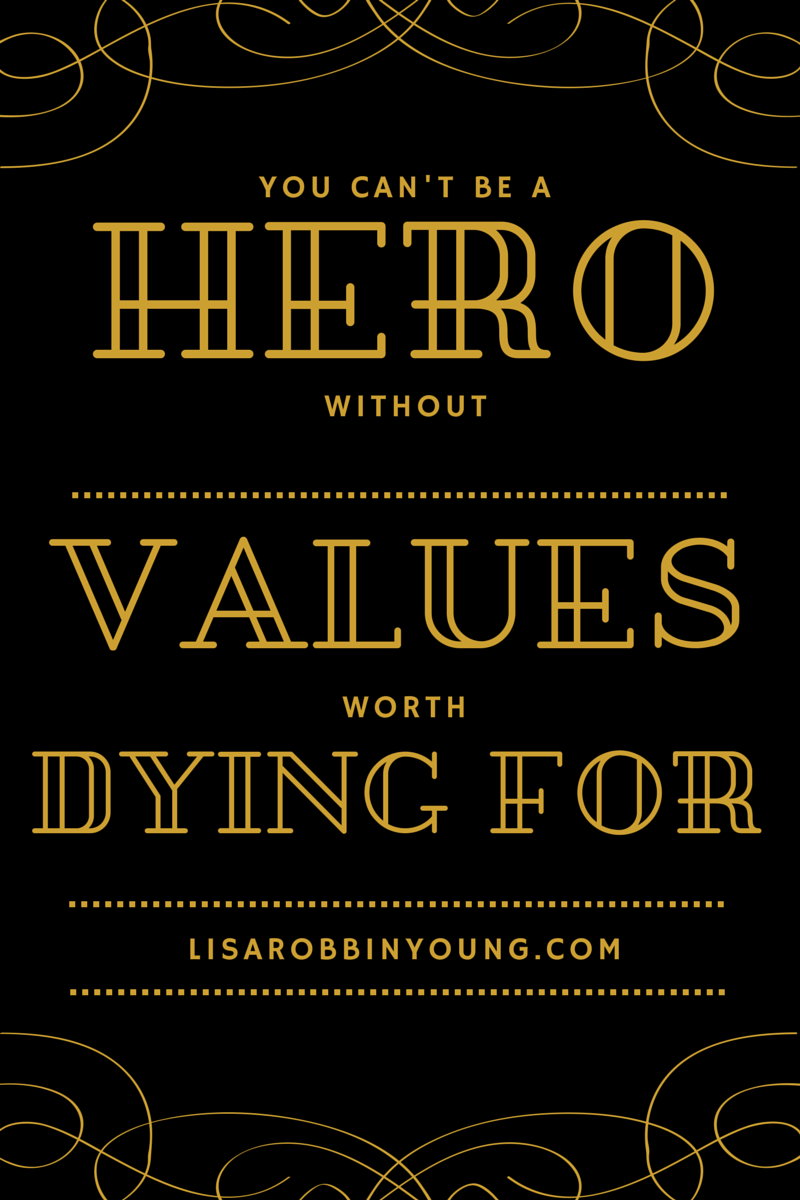 Not a concept that's widely embraced in the business world. Not too many corporations that I'm aware of would lay down their lives for the work they do (or the workers that do it). The very nature of a corporation is to generate a profit for shareholders - and sometimes doing what's right may mean NOT generating profit for shareholders.
So is it possible to be heroic in business? Absolutely. Because doing the right thing is always in style, even if the shareholders disagree.
Men and women of action always have a choice. We can choose to value principles over profit, people above things, and not be a martyr in the process. We can do what's right, knowing that the long-term reward is far greater.
And no, I'm not talking about "eternal rewards" or heaven here. I'm talking about the tough decision to close a business segment that's losing money, and shifting those people and resources into areas where better work can be done. I'm talking about the tough decision to NOT fire good people if they can be used elsewhere, even if it means a short term cashflow pinch (not crisis, mind you. That's different.).
I'm talking about having values worth dying for.
When "the world" tells you how things "should" be, even thought your gut tells you otherwise, and your values guide you in a different direction, do you cave? Or do you choose to be the action hero?
Will you take a short term beating for a long term gain?
So many people will do anything to avoid even the slightest amount of pain. Yet, pain is a part of growth. Discomfort & uncertainty abound in entrepreneurial circles. You can't avoid it if you want to grow. And yet, time and again I see people take what appears to be an "easy" way out, only to find themselves stuck in "the fire swamp" because they didn't trust their gut.
Remember, heroes are not above getting bloodied up a bit - so long as the fight is in alignment with their values.
As you examine your own business, think about these questions:
If you can't answer these questions, you've got your work cut out for you. It would be nice if you could stop and get absolute clarity on this before you do anything else. However, I recognize that's not always practical.
Remember, this isn't about issuing a "vision statement" or some other piece of equally benign paper. Show, don't tell. "Be the change you want to see" and all that.
Take a few minutes to share with me (via email or as a comment on this post) any/all of the following:
A. What do YOU value in life and business?
B. What did you learn when you asked others what they think you value?
C. Based on what you know about me, what do you think I value?
I'm sharing my results in a later post. I'm looking forward to seeing what happens!
A couple of weeks ago we started the studio/office rearrange when the new lighting came. I still haven't been able to fit everything in, but this new video gives you an idea of where we're heading.
It's also the start of a new format for the weekly songs. I wanted to do something that was a little more inspirational AND educational, so that they didn't just come across as a bunch of cover tunes for no apparent reason. When I started the 300 songs project, it was about getting practice and learning how to operate the equipment in the studio. Over time, however, I've been blessed to have built a cozy following of people who actually enjoy watching the videos, not just listening to the rehearsal concepts.
We've even done a couple of virtual concerts featuring some of those tunes. During those shows, I always try to tie the songs back to an important moment in my journey or a "teachable moment" of some sort, because I believe that music can be educational as well as inspirational (remind me to tell you how the music of Billy Joel helped me win the city quiz bowl tournament in high school).
To that end, I'm launching this new format featuring the song "Hide" made popular by Joy Williams. Whenever I feel "not enough" in any respect, this song kicks my butt and reminds me I'm awesome. I hope it does the same for you. If nothing else, you'll get to see a rare moment of me wearing makeup!
You don't have to hide!
It's time for you to shine and show the world how awesome YOU really are. (Click to tweet)
Subscribe to Lisa’s YouTube Channel | More from the 300 Songs Project | Front Row Sessions Replays
I don't know a single entrepreneur that didn't start their business with some type of do-it-yourself (DIY) approach. Most of us begin with more time than money, and it makes sense to capitalize on that resource. In fact, I tell would-be clients all the time that the less money you have, the more you need to rely on "other resources" - friends, colleagues, connections, skill-sets, and other means of getting the job done without cash. In the direct sales world, I see a LOT of new consultants relying on family and friends to keep their business afloat (if that's your problem, you can fix it with a little Direct Sales 101).
For other entrepreneurs we often get a little too good at doing everything ourselves, and that creates a problem.
 That's the point where income and time are roughly equivalent. It's not generally a lingering point, because responsibilities typically rise in correlation to our income. I'm not sure I agree with Upamanyu Chatterjee when he said, "the more money you have, the more hassles," but you get the idea. When things are roughly equivalent, we have to get ruthlessly honest about where we're investing (or spending) our time and money. Eventually, though, things ease up and we once again have either more time or more money.
Once we have more money than time, it makes sense to start liberating our time with some of our money. Yet, in the last couple of years, I've noticed that people are killing themselves (some quite literally) trying to do too much. I've mentioned Jon Morrow's story before, but his is not an uncommon tale. When the financial meltdown started rippling through my client's lives, I saw many folks tightening belts and even going dark to "ride out" the economic storm. Yet, history tells us that the companies that fare best are the ones that keep showing up and keep sharing their message even during hard times.
So how can you tell if DIY is still the way to go? There are several questions that bear exploring:
You've probably heard the old saw "everyone's a genius in a bull market" - right? Essentially, anyone with a website could slap up a paypal link and sell their stuff like hotcakes during the earliest days of this century. There were info product "gurus" hawking their schlock for $997 - and it was a pdf copy of a 3rd generation photocopy of a 75 page "report" that was poorly edited, and an MP3 of said guru reading the PDF aloud (I'm not joking). There might have been a few gems in there, but you had to dig through so much crap that it almost wasn't worth your time. The prevailing logic at the time was that if one gem could turn your business around, then who cares if it looks like crap? That was the advent of the "fail fast and fail often/good is good enough" mentality that swept the internet.
The problem was that it wasn't even good, let alone good enough. Stuff like that doesn't pass muster anymore. The bar continues to rise. Videos I filmed three years ago don't measure up to the new HD footage I can shoot with my webcam (my WEBCAM, people!). If there's more sizzle than steak, word gets out, and people stop buying. So if you've got inferior offers, it's no wonder your business is killing you. Maybe you need to invest in a team that will turn your offer into something people actually want to buy - or invest in a few beta testers to get feedback before you launch. Either get help or get out of the offering.
I truly believe you can make a living doing what you love (and in many cases a VERY GOOD living). If a grown-ass man can make money on youtube unboxing and talking about Transformers or doing video game walk-throughs, then I have no doubt in my mind there's an audience for whatever you love doing. But you can't offer crap or people won't keep showing up.
When responsibilities rise to meet income, many entrepreneurs forget about profit until the end of the year. They see profit as an event (income minus expenses, right? WRONG.) They just keep watching the dollar bills roll in... until they stop rolling in. Then they look at their business, start cutting costs, and scrambling to "stay afloat" - when they're already sunk.
You need a profit plan, and you need to follow that plan during the feast and the inevitable famine. Business, like so many things, is cyclical. If you're overspending when money is abundant, you'll be in the hole faster than Alice and the White Rabbit once the money dries up.
Look at more than just your income and outgo. Consider your long-term growth plans. No business can continue to grow indefinitely. Tastes change, markets change, and entrepreneurs have to be willing to pivot, shift, and serve their markets in meaningful ways. A profitable business today may not be profitable in future years (Blockbuster Video, anyone?), and a smart business owner keeps pace with the changes. If that takes up too much of your time, then a coach, an accountant, or another financial professional can help you keep your finger on the pulse of your business.
This is where it all comes down. You can work like a dog and have a profitable business, but have no life to speak of. Likewise, if you're constantly "re-investing" into the company, then you're not creating something sustainable. You're blue-balling your business (yes, I said it) - stringing it along and keeping it from really performing.
I had a client that owned a screen-printing company. The company was recognized for doing great work and the employees liked working there. My client was an investor, he didn't work in the business. His good friend was the owner, and wasn't particularly responsible with the income. So my client had stepped in as an "investor" to make sure payroll would be met on a consistent basis. Year after year my client plowed money into the company to keep it afloat, but when we looked at the books, the company wasn't sustaining itself. It wasn't profitable, but he didn't mind plowing the money into the company because it kept his friends in jobs. I told him he was blue-balling the company and that they needed to sit down and get real about their revenue plan. I told him he needed to have this conversation with his friend sooner, rather than later, because the company wasn't really a business!
He told me he didn't have time to have that conversation because he was busy with his own job (where all the "investment " money was coming from). Plus, he didn't want to "get into it" with his buddy. So the company hobbled along for a few more years before his buddy finally bailed on the business. Now, he's got a solid business manager in there running things. Hopefully, he'll be able to turn the ship around and create a profitable, sustainable business.
You can pump all your time or all your money back into your venture, but that doesn't mean you have a business. It's certainly not sustainable. If you can't walk away from your business to practice some self-care, or take some time to "just be" then something's amiss.
If your business can't run for a time without you, then you're the problem, not the solution. (Tweet this)
Hire someone to look at the numbers and give you some ruthless honesty. Give yourself permission to get support in creating or delivering your offering. Maybe you're lousy at writing sales copy - get a copywriter. Maybe your training style doesn't resonate with your team, hire a pro. Don't force yourself to be everything to your company, or your company can't survive without you. The day you get sick (or worse) is the day the company goes under. That's not a profitable sustainable business. That's just crazypants.
How have you set yourself up for success? What are you doing to ensure that you're not the bottleneck in your business? Share what's working for you in the comments below so we can all learn from one another.
At this point in the new year, more than 25% of Americans have already given up on our New Year's resolutions -that is, if we even made them in the first place. By the end of the month, that number climbs to nearly 35% of Americans (more resolution-related stats here).
Some folks (and businesses) are just getting started. I'm still seeing people offering courses on setting up your budget and/or income plan for 2015... that don't start until February!
I hate to break it to you, but you can't get a "jump start" on 2015 if the year is already rolling along!
One of the common problems I see for entrepreneurs stems from income or revenue planning. In fact, if your business is new (less than 5 years old, or making a market transition in the past 2 years), it's not always easy to predict where the money's going to come from in your business.
For many entrepreneurs, the first couple of years feel like throwing spaghetti on the wall to see what will stick. You make offers, do some research, hone your product or service, make more offers, and see who bites. You keep what sells, and table the rest. Sometimes you resurrect that stuff, and sometimes it's gone forever. In my own business, I've had a resurgence of interest in products that I wasn't actively promoting. I had essentially tabled these offerings, so I didn't include them in my revenue planning for this year.
Big mistake. If you've got an offering available, it should always be included in your revenue plan - even if you don't sell many of them during the year.
That got me to thinking about other mistakes I've seen when it comes to planning out your income, so I figured I'd conjure a post to help save you from making the same mistakes in your business.
Your budget and your income plan are not the same thing. Because a lot of creative types feel hemmed in by the word "budget" it's become common for coaches and trainers to use a different word (abundance plan, income plan, spending plan, etc.). A budget tells you how you project you'll spend/invest the money you earn. The income plan tells you how you project you'll earn the money in the first place.
I remember one of my early years in business, I created a budget with roughly $50,000 in line item expenses. I had no income plan. Sure enough, about two months into the year, I was pulling my hair out because the income wasn't keeping up with the expenses. I had no idea HOW I was going to earn the money, I had just put down the income of my dreams with no real plan of attack on how to make that income happen. In short order, I quickly reduced my "budget" to align with the realities of the income of my business.
Budgets are often wishful thinking. Income planning is where the rubber meets the road. If you can't figure out how to earn the income, you shouldn't be creating a budget to spend money you don't have.
A direct sales client of mine was struggling to get ahead of the curve in her business. She had come to me with an income plan that included very tight margins and little "wiggle room" in case something happened.
Of course, something happened, and her husband was unable to work for an extended period of time. She was panicking about how to make ends meet. After she took a breath, we looked at where she could leverage her existing offers, find better clients and increase her average ticket sale. Then, I illustrated the need to plan for more than just "the minimums" because there's always something for which you can't possibly plan.
Rates go up and "life happens" - yet time and again I see entrepreneurs build a budget and project income based on that budget, without any realistic expectations around the "what if" scenarios of business. What if your current supplier dries up? What if your web host goes out of business or raises their rates in order to stay in business? Most companies give you a 30-day lead time on rate increases, which means you could get hit at the worst possible time of the year if you're not prepared.
 One of my previous clients relied heavily each year on the income from one particular offering. Last year, they found themselves scrambling for most of the year to make up for the lost income when they had fewer enrollments than they budgeted for. It wasn't really "lost" income, though, because they never had it to lose! They had put too much reliance on a single source of income. It came back to bite them when they didn't have a plan in place to generate more income with some of their other offerings.
If this is your first year in business, then it makes sense to focus on one thing, get really good at it, and sell the heck out of it. But once you've been working with clients, listening to customers (you are listening to them, right?), and doing your research, you'll see other offers that you can provide to some if not all of your market. Facebook started as a connecting point for college grads (of particular schools), and only after they got good at that did they expand. Now, they've got Instagram, partnered with Google for advertising, and have their fingers in a bunch of pies. That doesn't mean you have to offer auto parts and jewelry (like Murrays Discount Auto Stores used to). If you're seeing an opening to serve your clients (and you are looking, right?), then it's more than likely you'll have more than one source of income over the years.
What if what you're doing today becomes illegal tomorrow? How can you shift and remain profitable?
This year's VAT regulations for international buyers created a firestorm of resistance, but it still went through. And international vendors of digital goods have to deal with the fallout - at a price. If all your eggs are in one basket and that basket is locked down, you're not in business anymore. On the other hand, if you've got more than one source of income, you'll stand a better chance of weathering the storm (I'm moving my "digital only" products to a platform that handles the VAT for me so I don't have to deal with it).
 Technically, this could be construed as a budget item, but the reality is that I see a lot of entrepreneurs planning to make all kinds of money, without any kind of support behind it - whether that's a coach, learning a new skill set, or some other type of professional development. Your budget needs to include these items and so does your income plan. As you scale, costs change. You may hire a VA to handle things that you used to do yourself. If you're planning on earning more than six figured, you can pretty much guarantee that you'll need some kind of support. Your income plan needs to cover the costs of that support. Don't assume that you'll be able to cover it with the growth of the business, because, as I've already said "life happens" and you may find yourself in need before the cash-flow comes in to support it. Which brings me to mistake #5.
 I can't tell you how many entrepreneurs I've talked to that tell me they made "six figures" in the last year - only to find out the company may have taken in six figures, but they didn't pay themselves a salary.
Say what?
That means that not only did YOU not make six figures, but the company probably didn't either! There's a difference between income and profit. And no, your salary is not profit. If you're not paying yourself, then you're lying to yourself about the actual profitability (and viability) of your business.
You can bet that Donald Trump, Warren Buffett, and Oprah don't work for free. They have large businesses and each draw a salary that's part of the company expenses. Profit is money that's not allocated to covering expenses. Most businesses erroneously think profit is what's left over after covering expenses. I'll show you why that's wrong in a minute. Regardless, you need to be sure that your income plan is built to cover a salary and savings for emergencies.
Financial guru Dave Ramsey reminds us that it's not a question of if, but when emergencies will happen. The printer dies, the laptop gets dropped, the external hard drive crashes... and those are just the minor emergencies. If your income plan (and yes, budget) doesn't include a line-item for savings, you'll find yourself scrambling. What if your tax bill's higher than you budgeted? That's where savings can be a blessing.
Regardless of what you sell - or how much of it gets sold - it's imperative that you have a profit plan. If you sell even 20 cents worth of products or services this year, you need a plan in place to ensure that your company derives a profit.
Okay, twenty cents might be a little ridiculous, but maybe not.
Mike Michalowicz, author of "Profit First" says that profit needs to be a habit - not an event - in your business. Instead of making profit an afterthought (profit = income - expenses, like most businesses expect), Mike says pay your business first and set aside a portion of your income so that you always have profit in the business. I recently led a webcast to explain the Profit First approach and help you get a handle on making sure your business is always profitable.
Whether or not you come to the webinar, it's important to see profit with fresh eyes. You don't have to build your business on the "leftovers" - which, if you're anything like most entrepreneurs I know, there aren't many leftovers to begin with. Instead, you can make an intentional step toward building a solid profit plan - and income plan (and budget) - that's built realistically around what you need to accomplish in the next 12 months (and beyond).
I'd love to hear what mistakes you've made in your budgeting/income planning process. What did you learn and how did you recover? Let's learn from one another in the comments!
 This week I successfully completed all my planning for January! Woo hoo! I know many entrepreneurs who are still shuffling papers and won't solidify their plans until sometime in the middle of the month - after they've given up on more than half their New Year's resolutions. I've been that person, and over the last couple of years, I've finally managed to hammer out a process for planning that works for me.
That's part of the struggle if you're a creative entrepreneur. There's no one plan that seems to cover everything. If you're a personality-based business owner, it's even harder. You've got to include your personal plans with your business plans, because they tend to overlap. Short of my own Dreamblazing program, I've yet to see a planning system that does that well, if at all.
Yes, finding a groove and getting the planning process down is a hurdle, but once you've got that process down, there are still a few mistakes I consistently see entrepreneurs make when planning their new year. I've even done them myself! Here are five of the big ones:
In my Dreamblazing program, I talk about "pumpkin" goals and "radish" goals. Pumpkins take all year to mature, while radishes only take 20-40 day. Having all your harvest come in at the end of the year makes it difficult to manage - and you can starve the rest of the year. Radish-sized goals give you some bite-sized results that you can manage throughout the year. Those radish goals can be milestones toward your bigger pumpkin goals, too.
Just be sure you don't have (more…)
I think it was Jesus that said a prophet has no honor in his own home town, with his own family, or even in his own house.
It's one of the big reasons I first built my business online - away from the prying eyes and judgmental insinuations of my own family and friends.
Don't get me wrong, on the whole I've managed to remove myself from the toxic relationships of my younger days, but there are still a few lingering reminders that only serve to affirm the wisdom of Jesus.
I've been a musician and performing artist for decades. I'm glad to be able to offer my services for a lot of different kinds of events. A family member once asked me to perform for a public event she was facilitating. She needed a strong singer to lead the music for the event. Naturally, I accepted. She's family, and it was for a worthy cause.
And of course, I didn't ask to be compensated, because it was a charity event, I had close ties to the organization, and I wanted the opportunity to perform, share my gifts, and serve on a larger scale.
That was all well and good until I realized I had "served" my way out of my own value.
 The day of the event arrived, and as I was rehearsing with the other musicians, she came over and paid the pianist an undisclosed sum for his services. I didn't even get a thank-you card.
It was then that the words of Jesus rang in my head. More and more, I'm hearing stories from clients about doing "spec" work, or free work just for the exposure, only to discover there really isn't a real exposure opportunity. Or they're taking crappy-paying work because, hey, at least it pays something.
I'm here to tell you that you're crippling your business - and possibly your health and well-being. If you're saying yes to anything that comes along, you're not giving yourself room to do the work you really enjoy. Then, when the "good stuff" comes up, you're already booked! Let my example be your shortcut to sanity and more profitability. Here are three ways you can get more of the right people to value your work.
On one level, I was livid that my family member didn't see the value of the work I contributed to the event. I had to learn dozens of songs, rehearse them, and then perform them without errors - just like the other musicians. I also emceed the event, introduced the music, and was the "personality" for the event. Those are also elements of a performance that must be practiced. For as easy as it looks, I don't just show up and "wing it" for an audience. Even my improvisational work at murder mystery dinners comes from years of practice.
She didn't see enough value in my work to even give me any token of appreciation.
That's partly her fault, and partly mine. Had I done my job in the first place, and educated her about the value of my work, chances are good she would have at least given me a thank-you card or some small sign of appreciation.
If you leave it to chance, and just trust that people will recognize the value of who you are and what you do, you'll often be disappointed. It's one reason why I've heard so many people say "the marketing is more important than the mastery." That's not true, of course, because you don't want to be marketing crap, but at the same time, if you're not marketing at all, you're leaving money on the table and missing out on opportunities that could otherwise be coming your way.
And by "marketing" I mean educating your market about the value of who you are and what you do. Until they understand why you are good at your craft, until they understand why your prices are what they are, it's easy for them to price-shop - or worse, ask you to work for free.
I talk with a lot of entrepreneurs who understand the value of their offering - the work they do, the product or service the provide - but they don't value themselves enough to be paid. Hollywood writer Harlan Ellison and creative firm owner Mike Monteiro both speak out about the importance of not taking YOURSELF for granted in the business of doing business (warning: both videos have adult language). Plumbers and doctors can assert a value in the market for their services because of the results they provide. "I'll fix your pipes, and it'll cost you X." There's a clear outcome. But when we start looking at what we think are more nebulous or intangible "results" we discount the value that we bring to the table.
In truth, YOU are the reason that the offer has value in the first place. I say it a LOT - as a personality-based business, you are the most important product that your company has to offer. When I work with direct sellers, it's important they grasp this concept. They are one in perhaps a million other people selling the exact same product for the exact same price out of the exact same catalog. What makes their business the one to choose? People choose to work with a particular direct seller because of who they are, not what they offer.
If you don't value the contribution that you make, why should anyone else?
My grandfather was a carpenter. He once charged a guy $50 to hang a picture in his office. He walked in, tapped on the wall, then drove a nail with two deft strokes. He hung the frame and handed the guy the bill. Outraged, the guy wanted to know why he charged $50 to drive a nail. My grandfather took back the invoice, scribbled something on it and returned it to him. It now read:
Driving one nail: $10
Knowing where to drive that nail: $40
Total due: $50
I make singing look easy because of the thousands of hours in my life I've already spent learning music, performing, and honing my craft. I've got hundreds of youtube videos of me speaking or performing in some way. That's all "free" work I've been doing for years. Lots of practice!
Where have you invested in your life in ways that improve your craft? Value that investment. (Tweet this)
Sometimes, you can educate people until you (and they) are blue in the face, but if you're singing show tunes in a honky tonk, you're going to get booed off the stage no matter how good you are.
When you're first starting out in business, it's a seductive trap to take whatever business comes along - anyone who can fog up a mirror or anyone who pays, regardless of whether or not they're a good fit for you. Ultimately, it means you don't have a business, but rather that you're a whore willing to dish it out to anyone willing to pay you. Sorry to be so blunt, but it's true. Although, my friend and colleague, Sydney Barrows, would probably argue with me. She's the former madam that ran Cache' - a high-end "escort service" back in the 80's. She had a very clear idea of her target audience, and didn't waver. If a client was a jerk, they were fired. Her clients were A-list-ers and her "girls" were expected to provide a quality experience - with a price tag to match.
If it works for the escort business, it most certainly can work for you.
You're wasting your time if you're trying to justify your existence to everyone - friends and family included. I had to back away from people who didn't get me, people who didn't understand what I was all about. I had to find "my people". I've been in various mastermind-type groups over the years, and a year and a half ago I came to roost with a group of local women - all authors - who are some of my strongest supporters and encouragers. They understand me. They help me get some clarity. They even hold me accountable when I ask. I've got other supporters, too. People who see the real me (and love me anyway), like my coaches and colleagues (like Sydney). You'll notice I didn't include my spouse. I love my hubby, and I learned many moons ago that he doesn't get what I do. He's starting to understand a little, but we've been married for almost 10 years now. I had to stop holding my breath, and only share with him the stuff that he understands. The rest, I save for "my peeps."
Whether you're a direct seller, a shop clerk, or a performing artist, you've got to know who you're here to serve. Again, it makes no sense to sing show tunes in a honky tonk - even if they had an opening and it's great exposure. Sometimes you get lucky and the audience knows clearly what it wants - like a local barbecue joint that only plays blues music. Blues and barbecue go together easily. But most of the time, it's up to you to hone in on who you're here to serve.
As a business coach, I focus on growing businesses - specifically those where the business owner is the face of the company. That means I work with a lot of direct sellers, solo-preneurs, authors, speakers, and performing artists. It's a wide variety of people, yet they all share the commonality of being the face of their business. Why? Because I am a personality-based business owner. I am "the singing business coach" - a musician and performing artist who helps other people like me grow a profitable, sustainable business. I understand the particular issues these folks have in balancing personal and professional commitments. We don't have traditional "work hours" because our face is always "on". There are unique concerns that these businesses face that major corporations don't. I understand that intimately because it's the life I've lived for decades now.
That is my professional audience. What's yours? Who do you most resonate with? Who are the people you get the best results with or most enjoy working with? What do they have in common? Those are the threads that help you define your professional audience. Once you've defined it, speak directly to them. Stop trying to win everyone else over. A lot of people won't get you. That's okay. Focus on serving the ones who do.
Once you value the role you play in the work you do, and can educate your right people about that value, it's easier to command the prices (and respect) that you deserve.
How have you experienced this feeling of not being valued for the work you do? How did you handle it? Please share your comments below!
Here in the U.S., it's almost Thanksgiving, which means, black friday, cyber monday, and a whole lot of campy, cheesy, in-your-face marketing to ply you into buying more "stuff" to make your holiday complete.
Blech.
It's one of the reasons I do an annual give-back campaign each November around the anniversary of my launch of The Secret Watch. Last year, we gave away over 1000 books. This year, we're doing a week-long event, so I can't wait to see how it all shakes out on December 1. You can learn more about the give-back event here (there are a few cool prizes I'm giving away, too!).
It's one way I stay top-of mind with my audience without the crazy "sell. Sell! SELL!" of the holidays. But this kind of marketing madness can happen any time of year, as this week's post proves. I managed to contrive a "reason" for having a crazy sale for every month of the year... and one heart-centered approach that works all year long.
The best marketing, regardless of the season, is caring for your clients. (click to tweet)
Side note: For St. Patrick's Day, I was trying to point out my green shirt, not my boobs. *sigh*
I hope you get a kick out of this fun little video. After you've watched it, I'd love to hear your ideas for heart-centered marketing during the holidays (at any time of year). Share your ideas in the comments so we can all learn a thing or two about marketing done right.
Subscribe to Lisa’s YouTube Channel | More from the 300 Songs Project | Buy The Show Replay
Ever have one of those moments where you think you know how something is going to go, and then it turns out completely differently, but it still works to your favor?
That was my experience last week when I asked my facebook connections to vote on a video topic for a contest I'm entering. I asked them to choose between these two topics:
Hands down, the winner was #1 - in all but one group where the vote was evenly split. For whatever reason, people I know can really relate to the struggle of showing up fully as themselves - a malady I can SO relate with.
But here's the thing... both topics are really about the same thing.
It almost sounds like a dangerous idea, right? I mean, there are "blueprints" and "formulas" galore in the world. There are gurus, guides, and coaches who want nothing more than to sell you their 'proven system' to help you be "successful" in some area or another of your life or work.
Heck, I'm a mentor myself. I have systems and tools that I use and offer to others, so it stands to reason I could lump myself in that category, too, right?
I wouldn't blame you if you did.
The thing that I hope sets me apart is that I detest the one-size-fits-all approach that so many leaders laud. A lot of people tread that path, and in my experience that's where the mediocre are. Back in my direct sales days, there was a "technique" that was touted as a sure-fire way to get business: pass out your business card to everyone with a pulse. Does it work? Sure. Eventually. But it's painful, awkward, and gives you a bad reputation.
Cookie cutter "blueprints" have their place. Like making cookies, or building houses. You want to know, before you invest your resources, a reasonable idea of what the end result will be. But you can take one blueprint and build two "identical" houses and they won't even be close to the same. Why? Location, interior decoration, and other considerations that have nothing to do with the blueprint itself. Likewise, three people can take the exact same cookie recipe and have three dramatically different results. Why? Again, lots of considerations that have nothing to do with the recipe itself.
The difference in the house and the cookies lays squarely with the owner. Who's the one doing the building, the decorating, the baking? That's what's really going to dictate how things shake out. That's something most coaches and gurus don't take into account in their blueprints.
Frameworks are helpful, but you can't expect to duplicate someone else's success because you are not that person! Believe me. I've invested my share of cash into training, blueprints, and frameworks. Any time they're a step-by-step "here's what I did to be successful" approach, it falls flat. Because I'm not them! I've been coaching and training for almost 10 years, and while there are some common themes, every client is different. There are no two people, no two businesses that are exactly alike. Even in direct sales, where every consultant is selling the exact same product from the exact same catalog, the results are markedly different because of WHO is doing the selling and HOW they are doing it.
A blueprint or a framework can show you how, but it may not work for who you are. It's the underlying principles, the concepts, and the WHY this worked that matters. Once you know WHY something works, you can figure out HOW to apply it to your situation in a way that works for WHO you are.
It was my very first tagline and it's still true. You are the most important piece of the puzzle in growing a profitable, sustainable business. Without you, it's just another product, another service, another offering. You are what makes it special. But if you're spending all your time, money, and energy trying to fit yourself into the mold of someone else, you're missing out on your biggest opportunity for success.
Showing up as yourself more completely means being willing to own your shadow and your light. None of us - not even the well-paid gurus and muckety mucks of the world are perfect. No matter how much spit and polish they put on. We all have bad days, make poor choices, and then have to live with the consequences. Being willing to admit your imperfections takes courage, and a little vulnerability, it's true. What I've learned, though, is that when I am willing to show up as myself - warts, sparkles and all - it gives the people around me permission to show up as themselves, too. It's an upward spiral that perpetuates itself.
When I finish speaking in front of an audience, I usually hear two comments. The first is usually about my energy and enthusiasm. The second is about how refreshing it is to see me be so "real" on the stage. They appreciate that I speak without talking down, insulting their intelligence, or making them feel inferior. They appreciate that I'm not afraid to tell the messy stories of my life. It gives them confidence to share their stories - sometimes just with me, but often with a larger audience they've been nervous to talk to.
From my perspective, life is messy. We all know that, yet so many people try to pretend otherwise. Embrace your mess, maybe even love it a little, since that's where the juicy stories come from. That's what makes you relatable.
Don't be afraid to be yourself. It's a job no one else is equipped to do. (click to tweet)
That doesn't mean you have to air all your dirty laundry. I do my best to share my stories in ways that are helpful to others. I'm one of those people who believes that if you can learn from my mistakes, then you won't have to repeat them. I also believe that every choice I've made (for better or worse) has led me to this moment. That if there's something from my journey that can help you on yours, then I want to he able to share it.
We've all put on the brave face, the happy face, the facade that says everything's okay when it's not. But I'm talking about something deeper. You've heard me talk about "The Pretender" and "The Coward" before. One mask protects you from the world, the other protects the world from you. Yet, neither serves your highest good. You have to take off your masks to risk being truly seen.
When you know who you are, you aren’t afraid to admit who you are not. I'm not a scientist. That's my husband. When the kids come home with math homework, I quickly remind them I was a music major in college, so I can count to 12 and divide by 7, but that's about it. I know my limitations there. But it's easy for me to forget those limitations when I slip on the mask of what a good mom is "supposed" to be. I'm pretending. It's frustrating. And it's just digging my hole deeper.
Once you start wearing a mask, it becomes risky to remove it. Showing up as yourself means letting people see what you don't know, what you can't do, what you aren't capable of in this moment. That's scary stuff.
But it also means showing people what you do know, what you can do, and what you are truly capable of in this moment. That is sometimes even more scary.
I grew up in a "gifted" program full of smarty pants kids. We were all too smart for our own good and socially awkward. Most of us had one or two things that we really knew - we were smarter than even the smart kids! But if we dared to show our intelligence in that area, we were quickly brought down a peg by someone who was smart in another area - just to show us that we didn't know everything.
Sadly, that attitude doesn't leave us when we're adults. So being seen as smarter, faster, or better than someone else can become an equally heavy burden and scary proposal.
Masks, to me, are like McDonald's. Once you've seen it, you know what to expect. When you walk into a McDonald's you pretty much know what's on the menu, where the bathroom is, and how competent the counter help will be. On those rare occasions when they're offering a special menu item (remember McDonald's pizza?) it throws you off. Now you're not sure what to expect. That could be good or bad, but either way, you're thrown for a loop for a minute while you get your bearings.
Masks become a cultural shorthand. The problem is that humans grow and change, and masks don't fit forever. Try taking a picture of yourself when you were a child and wearing it around during the day. Unless it's Halloween, people are going to be thrown off. Why is this grown-ass person wearing the face of a small child? What are they hiding? Why are they hiding?
Peeling off the masks is a must-do. How can we fall in love with you if we can't see who you are? If you're wearing a mask, we're not falling in love with you, we're falling in love with the mask, and that creates all kinds of internal backlash and self-loathing. It's a vicious downward spiral that keeps us trying on different masks, hoping that one will eventually fit.
It takes guts, and tremendous amounts of courage to be true to what really matters to you. Lady Gaga takes a risk every time she steps out in public in one of her crazy ensembles. Yet, it's far less of a risk than playing small and not owning her outlandishness. If you fell in love with "small-playing" Lady Gaga, you just might have a heart attack watching her tramp around in some of her crazier get-ups. Her outspoken, outlandish appearance is part and parcel to who she really is.
To deny any part of you is to deny all of you.
You can't say "that's not my hand" when it's clearly connected to your body. If you deny the hand, you deny the body. Likewise to deny what's important to you (family, faith, travel, relationships, etc.), is to deny YOU. You can't deny a part of you. You're denying your whole self, because that "part" is woven into the very tapestry of your existence. It's a meaningful thread of who you are... whether it's a piece from your past, your present, or your future, it's every bit as important as every other part of you.
In the next few days, I'll be sharing a special gift with my subscribers to help remind them to remove their masks and show up more consistently as themselves. If you'd like to get it, be sure you're subscribed above. In the comments below, I'd love to hear your stories. When did you recognize you were wearing a mask? Did you choose to take it off? Why? What happened as a result? It's in sharing your stories that we lift each other up.
I chuckle now as I look back on my collegiate career. Convinced that I was "too poor" to be able to afford to hire a band, a graphic designer, or a business manager, I learned how to do all those things myself. I took classes in business, law, graphic design, and music. My first album (recorded during my time in college) features no other instrumentalists. Every track was laid down electronically. I mixed my own vocals, designed my own cover. I did have a friend shoot the pictures, but that was only because he had a camera and was willing to help.
Can you imagine the comic nature of me trying to set up a shot, run around to the back of the camera, set a timer, and run into the shot again? Don't laugh. I found myself doing exactly that in a recent photo shoot for The Sweet Browns - a vocal group I'm working with locally. I think we ended up taking that shot 4 or 5 times before I got situated in time for the flash.
In my family, it somehow meant we're weak, that we can't do "it" on our own... whatever "it" happens to be. I grew up in a family of strong, independent women, and had a pretty stubborn lineage of men in my life as well. We simply didn't ask for help. The downside to all that independence is that you pass it on. I watch my boys (8 and almost 18) think they have to have it all figured out. That they simply can't ask for help. They either have to wait for it to be offered, or they have to struggle through the frustration on their own.
(more…)"Dreams without goals are just dreams that ultimately fuel disappointment." - Denzel Washington
You know what SMART goals are, right? It's a helpful little acronym that breaks your goals into something that's:
So many people use SMART goals - and for a lot of people that works. But not me. Not for a lot of big dreamers I know. It's too hard to wrap a big dream into the SMART package.
Sometimes, it's a challenge to get clear on the specifics of a goal. Take, for example, my desire to win a Grammy. It's a real dream of mine. But right now, my music doesn't easily fall into a category. It's not really pop music. It's not blues or jazz per se - although if the category still exists in a few years, it could be construed as contemporary pop. And someone recently reminded me that I'm also a speaker, so it's possible that my Grammy might come in the spoken word category - or even the comedy category, since I can be a bit humorous from time to time.
So while I have the desire to win a Grammy, it's not easy to get more specific than that.
Sometimes, big dreams are difficult to measure. In the case of a Grammy, it's not so hard: when I have it, I have it. Until then, I don't. But in the case of wanting to leave a positive impact in the world (or a dent in the universe as Steve Jobs put it). Setting a goal to sell a hundred, a thousand, or even a million copies of my book is measurable and specific, but will that really change lives? I won't know until someone reaches out and tells me that my book made a difference to them.
Then there's that whole "is this really attainable?" thing. Who really knows what's attainable? Some of our greatest inventions came by accident and curiosity. Sir Richard Branson cracked an April Fool's joke about a product that would one day become reality. Now, millions of people own MP3 players of some sort. Nobody believed it was attainable. Now, it's commonplace.
I think of Columbus and the debate over whether the world was flat or round. Sometimes, you don't know if it's attainable until you try. Sometimes you fail, but the attainability of a goal, in my mind, shouldn't be a qualifier on whether or not you give it a try. There are lots of failed attempts that ultimately led to success. Light bulbs, anyone? The original inventor couldn't figure out how to get his filament to burn more than a few seconds. FAILURE!
But Edison and his crew stepped in and worked over and over and over until they found a way to make it work. Voila! Electric light - and ultimately electricity in every home gives me the ability to send this message to you anywhere in the world.
Which ties into the whole realistic thing. Who really thought it was realistic 100 years ago to have little video screens in every home? You can watch moving pictures from the comfort of your living room couch! Back in 1914, We were embroiled in survival struggles. Wars. That kind of thing. It wasn't until 1926 that the first broadcast of moving pictures even happened - and they were crappy compared to today's standards. Heck, we were still watching silent movies until 1927! It wasn't until 1939 that the first experimental broadcast network was set up in the US - and color TV didn't come on the scene until the 50's - but most homes didn't see it until the 60's.
So until about 50 years ago, it was pretty unrealistic to think that you'd be able to watch "talkies" in your living room... with a push of a button.. or downloaded off this thing called the Internet.
So much for "realistic" eh?
Who really knows how long it will take for a big dream to materialize? It took Christopher Plummer most of his life to win an Oscar. The Oscar is one of the highest honors an actor can receive. While I'm sure he wasn't acting for the sake of earning an Oscar (a sure-fire way to NOT win one, I'm told), the look on his face when he held that statuette and said "Where have you been all my life?" only illustrated further that a time-bound goal can be a little limiting. So what if it takes your whole life to achieve a goal? I guess, in that respect, it is time-bound. But would you turn it away, too little too late, if you didn't achieve it until after you died? Remember some of our greatest artists didn't know success in their lifetime, yet their legacy impacts the lives of countless people hundreds of years after their death.
Does "eternity" count as time-bound? 🙂
So when it comes to big dreams, SMART goals leave me cold. There are those that would say that you could still use SMART goals on the smaller sub-set of steps you need to take in order to achieve those big goals, and I agree. It also makes it a lot easier to lose sight of the goal itself and get lost in the minutiae of the every day steps that may or may not ultimately lead you to your goal.
Take the Grammy for example. There are some things I need to do: join the Academy, for example. Those are more tasks then goals, though. I need to have a project -an album, a song, a something that could be submitted for consideration by the Academy. But what? An album of songs? A single song? Design a package for a project (they give Grammys for design, too). Or maybe a video? Hmmm... see how easy it is to get lost in the minutiae?
Lately, I've been working on "DUMB" goals - even a few of my clients and colleagues admit that the DUMB approach is actually very helpful.
Here's how it works. DUMB goals are:
D - Doable
U - Understandable
M - Meaningful
B - Believable
Is this something that, with the existing resources and technologies available or known to you, can be done? Television was an extension of ideas that had been developed back in the 1800's. So it was most likely do-able, they just needed access to the resources. Radio waves were already transmitting across the country, so broadcast technology existed, they just needed to figure out how to tweak those waves to send images as well as sound.
Everything they needed was available, just not all in one place. It required some testing, experimenting and putting those pieces together - like a jigsaw puzzle, trying to make the pieces fit together.
So while it seemed unrealistic, it was, in fact, very doable.
"1000 songs in your pocket." Nothing could have been easier to understand when Steve Jobs uttered those words about a device that no one had believed was even possible. Funny enough, MP3 players existed before the Ipod. They were clunky, unsexy, and relegated to the realm of nerds and technophiles. MP3s had been around for quite a while, so it really wasn't a stretch to create a disc drive that would hold them and play them. The technology existed, so it was doable, but how to you explain what these little boxes do in a way that gets you move a million units?
1000 songs in your pocket is a very understandable goal.
There are a lot of folks that think I'm nuts, wanting to go for a Grammy. But it is meaningful to me. There's an aura of prestige around those little gramophone statuettes (Prestige is one of my triggers), it's also a symbol of recognition and acceptance from a field of my peers. Those things are meaningful to me. Maybe not to you, but because they are to me, I'm willing to do the work to achieve the goal.
If you set goals that aren't meaningful to you, why are you setting them at all? (Click to tweet)
To those that say I'm deluding myself into thinking I can win a Grammy, I say you don't have to believe it's possible. Only I do.
Owning dreams that are believable is one of the biggest mistakes I see people make. "I want to make a million dollars" someone will say to me, but when I take them through the threshold of belief exercise, they don't even believe it's possible for them to do so.
So many people believed the world was flat. They fought about it. But someone believed - and a few were willing enough to believe that they loaned some boats and supplies so this Columbus kid could go cavorting to the "edge of the world". Worst case scenario, they wouldn't get the boats back and there'd be one less weirdo on the planet.
Turns out that willingness is a big piece to allowing space for believability. If you're not sure you can believe in the possibility of your dream, are you at least willing to try to believe it? Are you willing to hold space that someone else might believe in it (and you)? Because I believe in you. If you're reading this right now, I'm cheering for you. I know you've got something special, and if you want it to happen, I want it for you.
So that's how I handle goal setting now. Forget SMART goals, I'm all about DUMB goals. Goals that are do-able, understandable, meaningful and believable to me. Forget what the rest of the world thinks! DUMB goals are a great idea.
There are those that would say it's a negative approach, but I've found it actually plays into a sort of "reverse psychology" - when people criticize your goals, call them dumb or whatever, you can say "Yep. They're DUMB alright. And I'm going to GO for it!"
My clients get it, and since it doesn't force them to reprogram their thoughts, it becomes a more effortless way to own your dreams.
So what say you? This is the first time I've really been transparent about my goal setting process. You may already be familiar with how I prioritize things (using The PEACE System), but this is the first time I've ever shared publicly my DUMB goal setting technique. I'd love to hear your thoughts and ideas about it.
About a year ago, my husband and I bought a Porsche. We call it "The Time Machine" because it's really a blast from the past.
When we bought it, we got the expected commentary from friends and family:
"A Porsche? Really? How can you afford that?"
"What are you going to do with a Porsche? It's way too small for your family."
"Mom, can I have it when I graduate from high school?"
... and on and on.
When they found out it was a Porsche 924 - a classic from 1977 - and we only paid about $1500 for it, the comments took a different turn:
"What are you going to do with an old beat up car?"
"Forget it! I don't want my friends seeing me in an OLD car!"
"That's $1500 more than I would have paid."
"Does it have seatbelts?"
"Regular or unleaded gas?"
... and my favorite: "Can you even fit in that thing?"
One guy I used to know - who owns a limited edition Porsche Panamera (valued around $75k) - liked to poke fun and ask me when we were going to get a real Porsche. He'd say to me "Don't you want to see yourself someday in a new Porsche?"
I wonder if he'd say that to his wife - who is about 20 years his junior. 🙂
Last summer was a rough one for us. After two years of trying to keep a failing business venture afloat, and some personal financial issues around the health of our kids, we made a tough decision (more…)
It took Bart Howard well over 20 years.
Bart was a piano player in the Blue Angel cabaret, working on his own music, in the hopes of one day working with his idol, Cole Porter.
Most musicians know the name Cole Porter. Very few know the name Bart Howard. But this one song is his legacy.
Bart wrote dozens of tunes, but none were as popular as "Fly Me To The Moon".
Bart was asked by a publisher for something simple, and in 20 minutes he cranked out this cabaret waltz. The publisher asked him to change the lyrics, but Bart refused - a move that could have jeopardized his opportunity to have this song produced. But Bart held his ground on his song. Since then, "Fly Me To The Moon" has been covered, re-arranged, and even had the time signature changed when Quincy Jones arranged a version for Frank Sinatra.
Originally titled "In Other Words," Peggy Lee recorded and later performed the song on national television. As it grew in popularity, Peggy convinced Bart to change the name to it's well known opening line.
For Bart, it was this song. The success of "Fly Me To The Moon" was such that he continued to live off the residuals of that one song for the rest of his life. It's considered a "Towering Song" in the history of contemporary popular music. In 2004, 50 years from when he wrote that tune, Bart died.
This week's song is a request from @PattyKogutek on Twitter. Thanks, Patty! It was a joy to learn this story and be able to share it with everyone.
Just one step. Just one song. Just one moment. That's all it takes to make history. What will you do?
Subscribe to Lisa’s YouTube Channel | More from the 300 Songs Project
"I am enjoying showing up as myself more completely."
That was the nugget of gold I rendered from my weekend intensive with my coach this past weekend. Once a quarter I sojourn in Minnesota for a few days to do deeper work to heal my "stuff" and open up blocks around my mindset. Because I'm a coach myself, I know the value of having a different perspective to help me open my eyes to my own hangups about success and how my life "should" be at this point in time.
This revelation came as a surprise as much as it came as a soothing realization. There's ease in showing up as myself - without worry or self-censorship. Granted, there are times when a little tact is recommended, but to just be myself fully - warts, sparkles, and all - is a gift I'm learning to give myself (and the world) more regularly.
Comparisonitis is a dreadful condition. It's a horrible inflammation of the ego, causing immense discomfort about who you are, and overall dissatisfaction with anything you've accomplished. When you suffer from Comparisonitis, everyone else is always farther along, doing better, making more money, living the life you believe "should" be yours. There's no sense of satisfaction, and often you feel guilt - like there's something wrong with you, or you need to be doing more.
Comparisonitis is fear in disuise. Instead of doing what we can where we're at, we're constantly comparing ourselves to every Tom, Dick, and Jane out there that appears to be in a better position than us.
One of my first (and admittedly worst) cases of Comparisonitis was with a contemporary colleague of mine. It was around 2008, and another coach was having what appeared to be way more success and making way more money than me. We both launched our businesses about the same time, and I was frustrated at how much exposure she was getting, how many "big name" people were talking her up, and how she looked like she was on the fast track to success.
What I didn't know was that all that surface shine came at a great cost to her personal life. She had taken out a second mortgage on her home so she could invest in all the programs that those "big names" were offering, which came with a promise of promoting her stuff to their audience. Ultimately, she ended up divorcing her husband and starting over on a much smaller scale. She tried to leapfrog and wasn't ready for the hard landing that comes from such a high jump.
You don't know what's going on in someone else's world. Stop comparing your success to theirs. (click to tweet)
There's a difference between Comparisonitis and benchmarking - which I'll get to in a minute - but for now, realize that your first step in moving beyond Comparisonitis is to stop "shoulding" on yourself.
I forget where I first heard the phrase, but if you've worked with me for any length of time, you've heard me use it. We get so caught up in the "shoulds" - instead of accepting (and maybe even embracing) where we are now. I think Mark Silver over at Heart of Business said it to me best:
"As long as you are in comparison, you are rejecting what is true [for yourself], and you are not able to be present to what is... People make up stories to protect themselves from having to surrender to what is currently true for them."
- Mark Silver"
When we're not focused on what is, we're focused on what we think should be happening, what we should be doing, what we should be experiencing. All that does is create more anxiety, more guilt, and more frustration about where we are not, instead of appreciating where we are.
Yet, if we stop comparing ourselves to anyone (except our past selves), we can see how far we've come in our lifetime, despite the obstacles, trials, fear, worry, doubt, and pressure to be something other than who and what we are.
When I look back on my life (instead of comparing that life to someone else), I'm really proud of what I've accomplished, who I've become, and what's on the radar for my future. I get a chance to appreciate my own awesomeness (without arrogance), instead of poo-pooing and downplaying my life because it's not "enough" compared to someone else.
My coach has helped me practice what she calls "AWOJAWA" - awareness without judgement, awareness with acceptance. We often think that pain, discomfort and other feelings of that ilk are "bad" and to be avoided. While it's true that I wouldn't want to live there all the time, sometimes pain can be a powerful tool for recognizing a need to change. Fear can be a powerful motivator to get stuff done. It's not good or bad, it just is.
Likewise, we think that happiness, pride, peace, joy and other feelings of that ilk are "good" and to be sought after. Yet, how much happiness is there in chasing joy? How healthy is it to be peacefully blissed out and completely unaware of the 8 year old setting fire to your kitchen?
It's not good or bad, it just is. We are the ones putting all the judgment labels on our emotions.
Comparisonitis still flares up in me from time to time, and I do my best to use a healthier way to track my growth and progress. Benchmarking is an idea that's used a lot in corporate worlds, and one that I think we can use beneficially in other ways. The idea is to look to a standard and measure our results compared to that standard.
But here's the kicker - you can't measure to some external standard. Take for example, my weight loss journey. If I constantly compared myself to every other woman that was more than 100 pounds overweight, observed the charts and "standards" that governing health agencies said were ideal, I'd be miserable.
My standard, instead, is consistency. What can I do consistently? I can run - if I'm pushed - but I can't sustain that. I hate running (for now anyway). What can I do - and do it consistently? I can get off my butt and dance around my house for 10 minutes a day. Will that cause me to lose 100 pounds overnight? Nope. But once I'm consistent at 10 minutes, I can increase it to 15, and so on.
So I benchmark my progress against my own reasonable standard. Will I get there as fast as I want to - as fast as I think I should?
Um nope. But I'll be making healthier choices more consistently... which eventually leads to the result I want.
Did you hear that? I'll let you take a minute for that to sink in. You are already a success. How's THAT grab ya?
In benchmarking, I'm allowed to see myself as already successful. Because I'm comparing myself now to what I've already done, and what's doable for me going forward. I can celebrate my wins NOW instead of waiting for "someday" in the great beyond.
Tomorrow never comes, yo. And yesterday is always gone. Insert cheesy cliches about embracing this moment here.
So in showing up fully as myself - as often as I can - I get to experience the grace and beauty of my own success. I get to draw closer to the Divine ideal of my life - whatever that is. I'm still figuring it out.
Here's another tidbit I gleaned from Mark - if we look at "excellence" (or "success" in this case) as a way to Master our world, we miss out on the other, more glorious result - we draw closer to the Divine.
So becoming myself more fully means I'm becoming excellent at being myself - instead of becoming something else that moves me farther and farther away from Divine Alignment.
Showing up as myself more completely means I own who I am, and I speak from my true voice - my truth - warts, sparkles, and all. Which, I think, is part of why I'm here on the planet in the first place. God doesn't make extra parts and pieces. We all have a gift and the only way we can share it is if we share it from our true self. I think Judy Garland said something about being a first rate version of yourself instead of a second rate version of someone else. Why would you want to be a second rate version of anything?
It's so important that we understand how important we are - how important YOU are in this world. What do you see as your gifts? And what are you doing to share them with the world - fully as yourself?
This song was recorded before I left town for the Pink Papaya national conference. It was a song I'd heard a couple of years ago
Subscribe to Lisa’s YouTube Channel | More from the 300 Songs Project
(more…)2
I may be ill this week, but I'm not skipping my weekly video. It's time again for another musical medley mashup!
This time, it's the most well known Sunday song of all time (that classic Commodores hit, "Easy") with a little country thrown in for good measure (that Tim McGraw hit "Watch The Wind Blow By").
Lionel wrote his song as a breakup tune, while the other is just a feel good, kick back love song. Put the two together, and it's a fun little anthem about freedom and doing what you love on your own timetable. Enjoy!

"Let me be a lesson to you of what NOT to do."
When you're a celebrity on par with Jonah Hill, that's probably not the ideal phrase to be uttering to your fans. In this case, though, Jonah's sincere apology on The Tonight Show with Jimmy Fallon after being caught on camera making a grossly inappropriate comment has done a lot to mend fences.
[I'll also go on the record as being ignorant, because I didn't realize the comment he made was now considered "a homophobic slur". I grew up hearing that phrase from men and women alike in my neighborhood. Not that it was a pleasant thing to hear, I was just a little surprised that it was a nuanced term.]
From the paparazzi video, it's hard to know exactly what was said, but Jonah indicated he and his family were being verbally attacked on a personal level by the photographer and "was genuinely hurt by this... and in response wanted to hurt him back".
To borrow a line from The Dixie Chicks: "There's your trouble!"
(more…)(Author's note: this post originally appeared in 2011 on one of my old blogs. I've freshened it up a bit for you today.)
One of the things that really annoys me are those folks that say they want change, but don't take action when answers are provided.
It dawned on me why they don't budge.

Picture a huge file room in your brain. There's a file clerk in there, taking in "evidence" for the various files in the "cabinets."
The file clerk never takes a break. He's contstantly filing away bits of information in the various files.
Let's say, in one cabinet, you have two files, one marked "I can't sing", the other marked "I'm a good singer."
Then let's say you're invited to sing in a local Karaoke contest.
Quickly, you run to the file clerk and say "pull out the files to help me decide what to do!"
The file clerk, never missing a beat, pulls out two files. One is significantly larger than the other. The one that says "I can't sing" weighs 100 pounds, while the other has only a few slips of paper inside.
(more…)2
It started innocently, as revolutions often do.
I've been working (and re-working) my branding and messaging for the past year, and nothing really seemed to hit the mark. I dove into course after course that offered bits and pieces of what I was hoping would help me craft a clearer direction for me as both an artist and entrepreneur. As usual, some were better than others. While class is still in session in at least one of those programs, I want to update you on a major ah-ha I got from Revolution U579, the brainchild of author and all-round good guy, Jonathan Fields.
It probably sounds better when the Beatles sing it. Jonathan's premise is that instead of creating a business, we can create a commercial revolution that sets us apart in our industry as well as in the minds of our biggest fans. We stand for something bigger than just the "stuff" we sell.
That sounds like a pretty sexy idea to me.
RevU takes you through a series of exercises and prompts to ultimately identify the core idea of your revolution. Jonathan asks what you're moving away from and what will supplant the old dictatorial regime. For me, it boiled down to one simple idea:
As kids, our hearts are full of whimsical fantasies and never-ending stories about our biggest dreams. Firemen, princesses580, becoming a rock star. We keep on dreaming until, one day, something happens, or someone else enters our lives and slowly, those dreams get squashed, squelched, or otherwise relegated to some dusty corner in the attic of our minds581... often to never be revisited again.
 582That's when death begins. It's slow, plodding, and sad. Most of the time, we don't even realize it's happening to us. Someone tells us we're too loud, or too enthusiastic, or a bit obnoxious about our dream, so we turn the volume down. Little by little, (more…)