I was crawling across the floor... or should I say I was trying to crawl across the floor.
Everything hurt. Every muscle twitch was excruciating.
Tears fell like hot lava from my face - and somehow, even THAT hurt. At best I was whimpering, at worst, outright wailing, as I made my way from the floor in the family room to the bathroom.
And then I had to try and stand up.
I was seriously entertaining the idea of just laying there - creating a pool of my own filth - just so I didn't need to move another millimeter.
But I kept going. I still don't know how I managed to "hold it" until I got to the toilet.
When my husband got home from work, we beelined to the ER. A few tests later confirmed that the sciatica that had disappeared months ago had come back with a vengeance. A pinched nerve that required neurosurgery to solve the problem.
Swell.
They sent me home with pain meds and told me to come back. The soonest they could get me in was 11 days away.
I'm sorry, what?!?!
Did you not hear the howling? Did you not see my wrenched up face and contorted body? I literally rode in the back seat of the car because I couldn't sit up straight, I was in so much pain.

I ended up having to reschedule my Creative Freedom Retreat because there was no way I could stand for more than a few moments at a time, never mind trying to lead a planning workshop.
At least with some pain meds, I could still get some work done. Right?
Wrong.
The meds took the edge off, but the pain was constant. I gave up trying to dress myself and ate as little as possible to minimize trips to the restroom... because said trips always required help. I practically had to be carried, it was that bad.
"Work" consisted of a handful of virtual appointments where I was strategically "propped and covered" so as not to reveal too much of myself on video. The less I moved, the less it hurt, so anything I could do without a camera on, I would attempt.
I had 4 semi-productive sessions before I finally gave up on the idea of doing anything that involved other people. The remainder of my "waiting" time, I was alone with my thoughts, wondering what would be left of my business when I was finally able to return to work.
Hustle taught me how to push — how to make things happen through grit, willpower, and sheer stamina. It trained me to override my body’s signals, distrust my intuition, and measure my worth by how much I could produce before collapsing at the end of the night.
Hustle applauds the late nights and the full calendars. It rewards the moments you say “yes” when your whole being is whispering “not now.” It’s a survival strategy dressed up as ambition.
When my kids were young, I wore busy like a badge of honor. So much so, that my kids thought I was always working and my youngest started to think his babysitter was his mom.
While I let a lot of that thinking go over the years, I was still the bottleneck in my business. I could outwork almost anyone, and I often did - until I couldn't anymore.
I told myself it was passion. Dedication. Proof that I was serious about success. And maybe that's a little bit true.... maybe.
What it really was, though, was fear.
Fear that if I slowed down, everything I’d built would crumble. Fear that if I stopped producing, people would stop paying attention... or caring about me at all.
I knew how to reach for the next milestone, but I didn’t know how to rest in what I’d already achieved. Every goal met, every box checked, every objective achieved only opened the door to the next one (and the next one, and the next).
Satisfaction never lasted long. It's a chronic condition for Fusion creatives - wind your key, put your head down, and go.
Ask for help? Naw. It's faster to just do it myself.
Celebrate? Maybe. Will there be cake?
Even with all the growth work I've done, I still didn’t realize how I’d internalized the notion that success is earned through exhaustion. That the more I sacrificed, the more I proved I was worthy of having it.
Well, crap.
It took being laid up in bed for 11 days to see how hustle had conditioned me to mistake constant output for consistent progress. To believe that if I wasn’t moving, I was somehow failing.
Double crap.
Hustle won't teach you how to hold success—how to sustain it without sacrificing yourself in the process. Because it’s one thing to climb the mountain; it’s another to live at the summit without losing your footing.
Real, sustainable success doesn’t demand more from you; it asks for something different: discernment, pacing, and the courage to stop performing your worth. It’s the quiet, grounded kind of success that expands your capacity instead of depleting it.
I knew how to climb the mountain of success. I'd been climbing my whole life. But I didn’t know how to live at the top without losing myself.
Hustle glorified the sprint and ignored the recovery.
Sustainable success is not about doing more; it’s about doing what matters with integrity and enough space to breathe. It asks you to trade urgency for rhythm, exhaustion for discernment, and constant striving for steady alignment.
It calls for pacing, not pushing. For courage—not the kind that conquers, but the kind that trusts.
The world doesn’t need your burnout. It needs your brilliance: steady, embodied, and alive.
Hustle culture disguises depletion as achievement. We’ve been conditioned to believe that busyness equals importance — but as leadership coach Ray Williams notes, being “addicted to busyness” actually diminishes well-being and real productivity.
The culture of hustle convinces us that constant output, all-in commitment and “always on” momentum are the marks of real achievement. Actually, though, research shows this mindset often leads to the opposite: exhaustion, declining performance and diminished creativity. Over-working (i.e., more than ~50 hours/week) actually reduces productivity, impairs cognitive function and stifles innovation rather than increasing it.
This is how depletion gets dressed up as achievement: you check off the hours, you hit the metrics, you keep moving — but the foundational capacities for leadership (clarity, presence, deep thinking) erode. The badge of “busy” becomes a mask for being drained.
When our identity is tightly bound to what we produce, our self-worth hinges on the next "result" - another client session, another set of deliverables.
Not that I speak from experience or anything. It took a LOOONG-ASS TIME for me to figure that out... and more time to do the work of unravelling it. And yeah, it still pings me from time to time... especially when my results aren't what I expect them to be.
The first six months of our move to the Pacific Northwest have felt like I was doing everything I could to just tread water. It would have been easy to slip into old patterns of feeling crappy about how little "progress" I felt like I was making.
Two things are at play here. First, I had to acknowledge that my capacity constraints had shifted in ways I was not planning on. I knew I was leaving my gig at the radio station, packing or selling everything we owned and finding a new place out west. But I didn't plan on Jim having 4 heart procedures, a cancer diagnosis, and surgery for said diagnosis during that same time frame!
So, um, yeah... a LOT was going on and my "results" were focused in the personal part of my life, not the work part!
Second, I had to acknowledge that I was doing something - just not what I had originally planned! My container was full - with different, and equally important things!
To begin separating identity from output, you might start by asking: “Who am I when I’m not hustling? What parts of me are independent of my last result?” Then create structural practices (e.g., a weekly non-work reflection, a non-output-related role) that remind you your value isn’t tied to what you ship. This shift frees you to lead from your whole self rather than your last achievement.
When I gave myself credit for taking care of a move, my partner, our home, and that my container was full in other, equally important ways, I could let go of the notion that I had to hustle. As I tell my clients, resting is doing something! And even if I wasn't actively doing anything, I am still priceless to the people who love me most.
Having a foundation you can depend on (rest, rhythms, boundaries, mission) while continuing to evolve, expand, and learn (without spinning or burning out) creates a kind of stability that allows you to keep growing in meaningful, effective ways.
Here's what your "magic paintbrush" image might look like:
Rather than growth that feels like sprint after sprint, you’re building a resilient ecosystem — the soil is strong, the roots are deep, the trunk is steady.
Growth happens up and out, not just forward at any cost.
You wake up feeling grounded and energized instead of on the brink of burnout.
You have a business that expands - without losing your weekends, your focus, or your sense of peace.
You feel like your effort actually sticks... compounding instead of constantly resetting.
Output is transient, but belonging and worth are enduring.
Belonging to yourself, and what really matters (alignment, integrity, impact, connection) instead of the misleading signals of “more" is what I mean here. Enoughness... in life and work.
Hustle promises short-term wins, usually at a long-term cost. It teaches you to sprint every race like it’s the last one—to chase visibility, validation, and velocity over intentionality.
You can’t build longevity on adrenaline alone.
The harder you push, the less space you have to integrate what you’ve built. Eventually, your growth outpaces your grounding—and the Noble Empire you worked so hard to build starts to feel like quicksand.
“If you just work harder / longer / push through, you’ll win and you’ll be safe.”
Whatever safe means.
I've said it to myself. My own clients have said it, too. I had to invite one client recently to consider that maybe, just maybe, their brain was lying to them.
Sometimes, it's true. When you're reaching the finish line, that little extra push can be exactly what you need to get over the hump and get it done. I call that "compassionate hustle".
I'm not anti-hustle. I'm anti-hustle culture.
Hustle culture sells the notion that exhaustion is a sign of commitment, that sacrifice equals reward. You're always "on" you can never rest, never quit, never replenish.
But the evidence says this isn’t reliable. It's not sustainable. Extended working hours correlate with worse health outcomes and reduced productivity — the premise of “more hours = more success” is flawed.
Because effort looks like virtue, it’s socially rewarded. It perpetuates the “ideal leader” myth of being tireless.
Also we lack good signals: when you’re busy and “on,” you might still hit goals, so the erosion is gradual — creativity diminishes, relationships strain, presence fades — but you still check the boxes that make it look like you're successful... while you don't feel successful at all. Meanwhile, culture normalizes overworking. One rocket-launching billionaire once tweeted that "nobody ever changed the world on 40 hours a week."
I call bullshit.
Working within your capacity means you’re not doing more — you’re becoming more effective, generative and whole. You're making space for what really matters so that you can grow with more ease - if you even want to grow in the first place!
Building from capacity (what I call your Conditions For Success) unlocks greater creativity and innovation. When you stop frantically "producing for the algo" and allow space (for reflection, rest, and integration) your mind generates richer ideas, your leadership voice deepens, your presence becomes magnetic rather than frantic. One report says that constant “output” pressure stifles the very creativity that innovation demands.
It’s built inside seven domains:
When these conditions work together in your favor, growth stops feeling like a tug-of-war—and starts feeling like a rising tide. Just knowing that they exist can make a big difference in how you choose to show up and what you choose to take on in your life and work.
Imagine building your business from stability instead of strain. Growing with rhythm, not reactivity.
You don’t have to chase balance because your systems and energy naturally support it. Opportunities flow because you’re operating in resonance—not resistance.
To slow down enough to hold what you’ve built.
To lead with clarity instead of compulsion.
To measure your worth by your alignment, not your exhaustion.
Become a member of my Rising Tide community (it's free, yo!) and you'll get access to my upcoming Conditions for Success workshop. Together we'll walk through the seven domains of sustainable growth, so you can build momentum that lasts, without losing yourself in the process, and create growth that doesn’t drain you.
For years, I've held connection calls where I hop on zoom for 20-30 minutes to get to know a new networking connection. Invariably, a business question pops up and most of the time I can spot a solution to their issue before the end of the call.
In many of these cases, I was able to help them see a way to open up a new income stream, refine a system or process, or just make their business easier in a matter of minutes. Not long ago, I was talking with a guy and by the end of the call we'd mapped out a new approach to one of his existing offers.
That new approach landed him a $15,000 deal later that same day.
I know that might sound a bit unbelievable, but I have receipts. This was both a blessing and a curse for me. A blessing, because I've been able to help hundreds of people over the years. A curse because, for years, I didn't really know how I was doing it.
So, I finally sat down and spent time examining how my brain works... the questions I was asking in order to get those kinds of results for total strangers.
That's how the Creative Freedom Business Model Equation was born! Once I had it worked out, I tested it with a few of my clients before rolling it out in last year's CashFlow Creator Workshop.
I'm excited to announce that we've re-opened the doors to this popular workshop and I'll be hosting it again this month!
The Cashflow Creator Workshop is designed for entrepreneurs and business owners who want to create a business that reflects their personality, voice, and style and connects with more of their ideal clients and customers with greater ease. More money, more time to enjoy it. A business that works for how you're wired to work.
Whether you're just starting out or looking to rebrand and redesign your business, this workshop will provide you with the guidance and support you need to succeed. By the end of the workshop series, you'll have a personalized roadmap for building or refining your business, based on your unique lifestyle and goals.
This 5-day workshop series, running from April 17-21, will provide you with the tools and guidance you need to design a business model that works for how you're wired to work. Each day, we'll focus on one part of the Creative Freedom Business Model Equation. By the end of the workshop, you'll have a comprehensive understanding of what is and isn't working in your business and how to fix it.
Day one of the workshop will focus on the first part of the Equation: You. We'll dive deep into what really matters for you, including your values, personal context, and the mission/vision for your business. We'll look at how those things play together and what your non-negotiables are to actually feel successful. At the end of the day, you'll be able to communicate clearly the strengths that you bring to the table through your company, and what's most important for you - both personally and professionally - so that you can have a business that supports you to have more of what you want and less of what you don't!
On Day 2, we'll dive deep into the "why" of your business. Not YOUR personal "why" - although that's important, too. Instead, we'll explore why you're in this line of work, what motivates and inspires you, and what makes you uniquely qualified to do what you do. We'll also examine the core purpose of your business, the change you want to see in the world, and the impact you want to have on your customers or clients. By the end of the day, you'll have a clear understanding of the driving force behind your business, which will help you create a brand message that resonates with your ideal audience and sets you apart from the competition.
On Day 3, we'll dive into the "who" of your business model equation. We'll take a deep dive into your ideal clients from a different angle - those who already resonate with your "you" and "why" elements. Instead of trying to conjure up some niche market out of thin air, we want to connect more deeply with people who already resonate with who you are and why you do what you do. We'll explore who your ideal customers are, where they hang out, what they want and need, and how your business can best serve them. By the end of the day, you'll have a clear picture of who your business is for, and how to speak directly to their needs and desires.
On day four, we'll dive into the "what" element of your business model. We'll explore the transformation your offer provides for your clients or customers and identify any gaps or areas for improvement in your current offers. This day is all about fine-tuning your offers so they are aligned with your unique value proposition and the needs of your ideal clients or customers.
Day five will be dedicated to the "how" of your business model. You can deliver the same "what" in different ways - different "how's". A book, a course, and a video, for example are different ways to delivery the same "what". We'll examine the delivery and pricing of your offers, as well as your marketing strategy. By the end of this day, you'll have a solid understanding of how to package and promote your offers in a way that resonates with your ideal clients or customers, and generates the cash flow you need to sustain and grow your business.
This is one of my favorite testimonials from our workshop last year:

"This workshop is POWERFUL! And Lisa Robbin Young is a MASTER at the concepts and practices she teaches - not to mention a great coach. I got a level of clarity of purpose and strategy for going forward that had been missing for me. And it's a strategy that EXCITES me and had me saying 'YES! That's ME! I can do that!' Thanks Lisa!"
Teresa Romain - Founder of Access Abundance
Other attendees said they also experienced:
So if you're serious about having a business that works for how you're wider to work, get your buns over to my info page and register for the CashFlow Creator Workshop series and take the first step towards a fulfilling and sustainable business.
I'm capping registration at 20 people. If financial accessibility is an issue for you, please reach out. Partial scholarships or grants may be available.
 This week I successfully completed all my planning for January! Woo hoo! I know many entrepreneurs who are still shuffling papers and won't solidify their plans until sometime in the middle of the month - after they've given up on more than half their New Year's resolutions. I've been that person, and over the last couple of years, I've finally managed to hammer out a process for planning that works for me.
That's part of the struggle if you're a creative entrepreneur. There's no one plan that seems to cover everything. If you're a personality-based business owner, it's even harder. You've got to include your personal plans with your business plans, because they tend to overlap. Short of my own Dreamblazing program, I've yet to see a planning system that does that well, if at all.
Yes, finding a groove and getting the planning process down is a hurdle, but once you've got that process down, there are still a few mistakes I consistently see entrepreneurs make when planning their new year. I've even done them myself! Here are five of the big ones:
In my Dreamblazing program, I talk about "pumpkin" goals and "radish" goals. Pumpkins take all year to mature, while radishes only take 20-40 day. Having all your harvest come in at the end of the year makes it difficult to manage - and you can starve the rest of the year. Radish-sized goals give you some bite-sized results that you can manage throughout the year. Those radish goals can be milestones toward your bigger pumpkin goals, too.
Just be sure you don't have (more…)
I'm not one for social commentary or deep philosophical discussions, so consider this the "light version" of any meaningful conversation about the nexus of technology and society. This isn't a commentary about technology, though. It's more about what's unwittingly happened to people as we've become more "connected" to the world.
The Industrial Age gave us cookie-cutter, assembly line techniques for being efficient and crafting a uniformly effective offering.
That's awesome in a survival-based world, where cranking out quality stuff in quantity is important.
But that's not the world we live in anymore. On the whole, we are wealthier and healthier than we've ever been as human beings. Yes. there are exceptions to the rule, but most of those folks aren't reading this anyway, so it doesn't apply to them.
This applies to you. You, the person that's been cramming yourself into the same cookie-cutter mold for decades (or railing against it), because that's all there was.
I've been pretty lucky to "grow up" in the digital age. I'm technically not a Millenial, but I'm on the cusp. I built one of the first e-commerce websites back when animated gifts were all the rage (the first time), and video wasn't even a glimmer in the Internet's eye.
In that time, there've been lots of "game changers" - which is almost silly to say. The advent of the Internet is like watching an infant grow into a toddler and then a teen - everything is new, thus everything is a "game changer". But the one commonality I've witnessed over the last 20 years is the growing ease with which people can access, use, and contribute to this technology - and how this new-found ease impacts their work.
10 years ago, the idea of watching your favorite TV show or a feature-length film on your stylish CaseFace phone was insane. Now, mobile and "third screen" viewing has eclipsed television, and will likely continue to do for the foreseeable future. The ability to take your media with you has relegated newsprint to the birdcage, and magazines I loved reading as a kid have gotten thinner and more ad-laden.
Less content, more commercials. A sure-fire end to most anything.
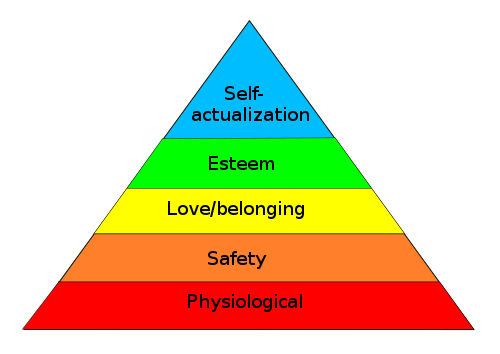
One look at Maslow's Hierarchy of Needs will show you that we've done a great job (on the whole) of getting those basic needs met. As I said before, we're wealthier and healthier than we've ever been in human history.
Here's another great example from Chip Conley, which condenses the pyramid into three layers (particularly the "employee" pyramid, which he's condensed to "money", "recognition", and "meaning").
Maslow's theory is that we work our way up the pyramid, once we've assured ourselves that our more basic needs are met. Once we've handled the basics like, food, shelter, clothing, saftey, and a paycheck, we can concern ourselves with "higher" issues like love, a sense of belonging, or recognition. Ultimately, once those things are handled, we can search for "self-actualization" or the meaning of life, if you will.
Here's the problem in a nutshell. We've been pushed up the pyramid, whether we like it or not. Computers have "connected" us, and made things incredibly easy, yet so many of us weren't ready for the shift.
Now, building a career can happen remotely. For my last job, I applied, interviewed, and was hired digitally. I worked from my Michigan home, and the company was thousands of miles away on the west coast. All my contact and interaction was digital: email, skype, webcam. No handshakes, no eye contact, just pixels.
Love and belonging (at least on some level) are just a facebook post away. When I'm feeling blue, I can post a simple "Hugs please" on Facebook, and my friends come out of the woodwork to encourage me. I never got that kind of instant gratification & encouragement before the Internet! So work, networking, and even relationships have gotten more efficient, thanks to technology.
We've got all this time on our hands, and yet we're stuck.
We're stuck because, now that the basics and middle-ground issues are being "handled," we have to look to ourselves and find meaning - something that takes time and can't be short-cut.
"Why am I here? What makes me valuable if a computer can do my old job in half the time? What real value do I bring to the world?"
We didn't have time to deal with these questions before. We had work to do, dammit, and that had to come first, so we could eat - so we could SURVIVE! But now, with all this time on our hands, we're having to face these questions - and some of us have a boatload of anxiety, depression, fear, or ambivalence toward it.
To make matters worse, we've been taught that thinking of ourselves is selfish and inconsiderate, and we are, therefore "BAD" for behaving that way.
No wonder our culture sometimes feels like it's on a downward spiral.
The truth is, you've been doing it since you were born. You "took" your first breath, and it's been downhill ever since. In reality, you can't NOT put yourself first. It's just that our culture has made it out to be some sort of a crime because there are those among us who would take it to the far extreme. Putting yourself ahead of everyone else - at all costs - is a kind of selfishness that often comes from a place of fear.
Self-care is not selfish - including in your work. (tweet this)
More and more employees are jumping ship to work for themselves. I'm meeting more entrepreneurs who left corporate America after only a few years of being disillusioned about their prospects with their employers. I'm also meeting entrepreneurs that are carving out a name for themselves by defining success on their own terms. They're creating businesses and offers that take into account how they like to work, who they like to work with, and what they want their life to be like so that they can experience success now - not in 35 years. They see that there's no pot at the end of the rainbow, that "someday" doesn't come with a big red ribbon, and they're deciding what they really want and going for it now.
To "older folks" entrenched in the ancient ways of the Industrial Age, it feels a bit like treason. It's definitely shaking up their snowglobes - the idea that they can give themselves permission to walk away from something they don't love and do something that brings them joy - and get paid to do it -still strikes fear into many of my older family members. They grew up in Depression-era America, where you got one job and stuck with it until you were old enough to retire, take the watch and the pension, and then go have a REAL life - if you lived that long. I know many employees of the assembly line factories who literally gave their lives to their work, dropping dead within a few days of retirement.
I've said before that now is the best time for you to create a business (and a life) that works for you. Of course, that means getting clear on who you really are and what's really important to you. It means doing the work at the top of the pyramid, and finding the meaning that matters...
... to YOU.
For some folks, this might seem foreign, or scary, but there are countless people in the world doing it. In fact, I'm launching a new series next year that spotlights these folks (more on that in a later post). They are becoming the norm. Gone are the days of three television networks and multi-national conglomerates that corner the market. Now is the time of what I call the "experience economy" - and creating a life for yourself that matters. It's reaching smaller, tighter markets and making a big impact. It's happening now.
On Monday, I'll be leading a free teleclass called "Success Your Way: How to have a profitable, sustainable business that works for you in 2015... and beyond." If you're at all interested in riding this wave of business with meaning, I invite you to join me. You'll learn more about this crazy "pyramid scheme" called business, as well as how to figure out which stage of growth your business is in and how to shape it to this new experience economy... which might sound more technical than it really is.
In short, we'll talk about how YOU can create a business that works for you, based on how you define success. And if you're not sure how to define success, we'll talk about that, too.
How are you dealing with the way technology has pushed you up the pyramid? What has been a blessing (or a curse) for you because of it? Share your comments below.