Every day, we're tasked with thousands of decisions.
How many? Well, Cornell University researchers said we make about 226 decisions just on FOOD in an average day.
The total number for adults is somewhere in the range of 35,000 decisions a day. Many of them are impulsive, and logic-driven (pro/con, etc.), but that's STILL a lot of remotely conscious decision making each and every day of your adult life.
Kids only make about 3000 decisions a day. Ahhh, those were simpler times, right?
Here's a decision making tool that I've used for myself and my clients for years now - one that gets immediate results and gives you clarity when you've probably been feeling stuck on something for a while, maybe even overwhelmed at the prospect of having to choose from several equally appealing (or unappealing, as the case may be) options.

This is just one of the tools you'll be working with in Your Breakout Year - my summer workshop for creative entrepreneurs. This program is designed to help you map out AND implement a clear path to a six-figure annual revenue stream.
THAT piece is the idea/concept/decision that holds the most energy for you, so that's where you need to act first (yes, even if you don't WANT to, which is another thing altogether).
The brain is a funny thing. When we take something out of one modality into another, our brain gets to work on the problem in a different way. By changing the way you assess the situation (from emotional or logical to visual), your brain has a new way of looking at the problem. The old block (which is probably a conflict between emotional and logical) is interrupted and you're able to make a decision so that you can move forward.
Often times, it doesn't matter what you decide, only that you finally make a decision so that you can get momentum again. So even if you "randomly" select a paper ball, you've made a decision and can move forward.
If you're a tactile processor, you might ACTUALLY write each option on a piece of paper and throw them on the floor. But then you've got a lot of cleaning up to do, which is totally NOT my jam. 🙂
Like I said, the messy room technique is is a powerful tool that's quick and easy to use to get clarity now, and get moving again.
Whether you're starting from scratch, been hobbling along at this for a while, or you're ready to expand and add a new revenue stream to your creative business, Your Breakout Year is the exact process I've used with clients - for over a decade now - to help them get clear on what really matters and build out a business model that gets them there faster, with less hustle, and more ease.
Courses and classes alone don't get the job done. You'll just end up with a lot of information and zero implementation. This is an implementation-heavy program because I believe that if you do the work, you'll get results. So doing the work is baked into the program. No "learn now, implement later" in Your Breakout Year. Implement as you learn, decide what works and what doesn't, cut the fluff, and see real financial results in your business.
There are still a few spots left for early bird pricing, and a 4 installment payment option to make it budget friendly.
If you're ready to find your right audience and make good money doing what you love without selling your soul, join me for Your Breakout Year.
No sooner had I finished my lunch when the phone rang. It was my oldest.
"Hey, are you okay?"
"Not really, Mom. Aunt Dian died."
Less than an hour later, I was on the road to Michigan. 9 hours later, I'm crashing at my ex-husband's house for the night. That meant I wasn't able to have any studio recording time this week to film new episodes of Creative Freedom for you.
And that turned out to be an important business lesson I didn't want you to miss.
People are born. People die. Stuff happens in "the in between years." You leave a thumbprint on the lives of many people in those years.
As a creative entrepreneur, our work is often an extension of who we are. It's not like you can put it on the shelf at 5pm and call it a day. It follows you everywhere, like a toddler who just wants more Mommy time. It wakes you from sleep. It keeps you up at night.
So it can be hard to really step back and NOT work on your business in some form or another.
In theory, I suppose you could say that we never REALLY step away, since inspiration is everywhere. But taking an intentional break is important to restore your spirit. ESPECIALLY if someone close to you has died.
This week's Special Edition episode is me, after a good bout of ugly crying, explaining why I'm taking a short hiatus.
Taking a hiatus is a great way to get a fresh perspective. I was already planning changes and updates to the Incubator, A-Club, and my coaching program, but hadn't had the bandwidth to really consider how I wanted to handle it. This time away frees up my brain to work on all the "back burner" stuff that's been marinating. And the best part is that my brain handles that without my intervention. I can be focused on my family, my own self-care, and just being present to the grief and mourning that I need to process.
Even when you're not grieving, a hiatus can be helpful to clear your head and give you a fresh perspective on your life. Unlike a day off, a vacation or a retreat, this is an intentional abstention from work-related activities for an extended period of time - usually longer than 2 weeks. Television shows have an "off season" when they are on hiatus. It gives the writers a chance to prepare new content and the actors a chance to get away and focus on other projects. That's what this is, only much shorter.
You won't see me on social media much. There won't be any new blog posts, and the newsletter probably won't go out - any training you've signed u for will still go out as scheduled, and you can still take the free quiz and get your results right away. And I'm still here, I'm just taking a big step back for a couple of weeks while my heart heals.
But I'll be back, so if you've got a question you'd like to see me answer, contact me and let's add it to the list. In the meantime, hug your loved ones. In the end, they're everything.
One of the scariest topics for most of my clients - the one that brings with it the most baggage and emotional upheaval - is pricing. Right now, about half of my Incubator clients are stalled out on the decision to raise their prices. As early-stage entrepreneurs, there's a struggle between wanting to earn more and not being convinced that they can/"should" raise rates, for fear that they can't get enough clients to pay them the higher rates when they've been struggling at a much lower rate for a while. What they don't realize is that those lower prices are appealing to the wrong kind of audience, and until they can clear their head trash, they'll stay stuck at the lower pricing.
Although I've used the phrase before, I don't believe you can really charge what you're worth. First of all, you're a priceless masterpiece. No one can define your worth. They can, however, decide how much their willing to pay for your Great Work. You can influence that decision, but ultimately, it rests with the buyer. So it's less about charging what you're worth and more about telling a compelling story so that potential buyers are willing to pay your asking price. As Tara Gentile says "Pricing tells a story". So what story does your pricing tell?
More often than not, pricing brings out a lot of hypocritical behavior. This week's episode explains how your inner hypocrite could be running your business into the ground.
Have you had moments in your business where you said one thing was important, but your actions revealed some other motivation? Have you experienced this "out of integrity" moment with other business owners? How did you handle it? Share your thoughts in the comments and be part of our Rising Tide.
Need support for your creative business? I have two openings in the Creative Freedom Incubator. Applications are accepted on a first-come, first served basis. If you're not ready for that level of hands-on help, join the growing community of supportive creatives in A-Club. We're here to help you grow.
I think it was my grandmother who first told me that you never get a second chance to make a first impression. I was going to her church for Easter Sunday, and, of course, I had to look my best. I was representing my family, I was showing up for God, and (probably most important to Grandma) her reputation was at stake.
It only made sense to put my best foot forward. I had to be well dressed, well groomed, AND well behaved. No pressure.
Then, maybe a year or two later, I heard it again, in a shampoo commercial.
So it's no wonder that those words strike fear into the hearts of many creative entrepreneurs when they attempt to bring their Great Work into the world (especially for the first time). One wrong move, one slip, and it's all down the tubes. Everything's over. Cash it in. We're done. Between that sentiment and the old saw about opportunity only knocking once, it feels like the stakes are incredibly high.
But are they really?
Do you really only get "one shot, one opportunity to seize everything you ever wanted, in one moment"?
Well, yes and no. Mostly no. Sir Richard Branson says that "opportunities are like buses; there's always another one coming." But there are things you can do to prepare yourself for the moments when opportunity comes a knock-knock-knockin' on your door. This week's episode explains.
Here's the "quick and dirty" summary from this week's episode:
Mike Michalowicz, a friend and author of the book Surge, explains that surfers can't ride every wave. They have to be able to get in front of it and be ready to stand up and ride. If the wave is too far away (or even too close up), they can't get in a good position to get up and ride. And if they chase every wave, they'd spend all day paddling and never get the chance to hang ten.
Waves are plentiful, so it's less about hitting every wave (or even finding the perfect wave), and more about being selective in the opportunities you take so that you can spend less time paddling and more time riding. Will you wipe out sometimes? Sure. But that's part of what keeps everyone from surfing: you have to be willing to wipe out a few times in order to catch the big wave.
What do you need to say "no" to, so that you can say "yes" to what really matters? Share your thoughts and ideas in the comments and be part of our Rising Tide.
If you need support, encouragement, and help bringing your vision to the world and preparing for your next opportunity, Accountability Club is now open for enrollment. Only a few seats remain, and I'd love to see you inside this community of doers. Our next training call is Feb 25!
Some dreams take a lifetime to come true... especially if you do it all by yourself.
Jim Bishop's dream started when he was 15. For some inexplicable reaason, he found himself drawn to the mountains just above his home in Pueblo, Colorado. One day he found himself staring at a for sale sign on a plot about 2 acres in size.
He had to have it.
He scrimped and saved all summer doing odd jobs and working in his father's ornamental iron shop. He was too young to buy the property himself, so he asked his parents to take his money and buy the land. He spent many summers with his dad on that property. As an adult, he eventually decided to build a stone cottage, using the resources all around him. He cut and milled his own lumber, placed and cemented stones from the property, and as he continued to build, people started asking if he was building a castle.
That gave him the idea to actually build a castle.
No architect's plans... just a vision for one room that grew into two, then more. Then a second level... and turrets... and spires. What started as a stone cottage in his 20's has turned into this glorious castle, which has taken his entire lifetime to build.
What this video fails to tell you is that the ONE man who built this castle, did so by hand over the course of decades. Some people offered to help, but like so many well-meaning people, the help never materialized.
#frustrating
Undaunted, Jim kept plugging away as he was able - on his own - one stone at a time. Jim has touched each stone an average of 6 times as he sized, placed and cemented them during construction. You wouldn't know looking at it that Jim is afraid of heights, would you? The fact that he placed each stone one at a time meant a gradual ascension, which gave him time to get used to the height as he built each layer of stone upon stone.
All these years later, and through the generous donations of recycled and reclaimed materials, there's now a bevy of castle features - including a ballroom, a portcullis and bridge at the entrance, and an ornamental dragon Jim fashioned out of recycled stainless steel and a canister from a hot air balloon.
Bishop Castle is open to the public year round, free of charge (Jim and his wife still live there).
Don't let anyone tell you that you can't build your dreams. You can do it. Even if you have to do it all by yourself, one stone at a time. It may take longer, but if Jim Bishop's work is any indication, you might surprise yourself at just how high you can go - and it will be all the more fantastic when it's complete.
Oh, and yes, the dragon breathes fire, too.
Hello dear one!
I have never been a big comic book fan. When I was a kid, I wanted to read "real" books. "serious" books. So comics were not part of the equation. Plus, I have an addictive personality, so that would be one more thing on which to spend money I didn't have.
So this whole resurgence of comic book films has been fun for me - to explore the heroic stories of these legendary heroes (many of which I wasn't remotely familiar with before the films). I'm one of those people comic book purists probably hate: I didn't read the books before I watched the movies.
Oh well.
Before this resurgence, the closest I could identify to a superhero was Wonder Woman - you know, the Lynda Carter version (again, never read the books, y'all!). She was something for my pre-teen, 80's self to look up to. But as an adult, I felt more drawn to action heroes like MacGyver, Jason Bourne, and the like.
Then came Captain America.
I admit, if it hadn't starred Chris Evans, I probably wouldn't have thought twice, but he seems like one of those really nice guys in Hollywood, so I went to check it out.
It just gave me another reason to love Evans. It also gave me a new hero.
One that reminded me of you.
In the movie, Steve starts out as this gangly little weakling of a kid (oh, and did I mention, he's an artist, too?). Through the miracle of "modern" science, he becomes Captain America.
But the core of Steve - that which made Captain America - was there from the beginning.
I was working on Pinterest lately, crafting a branding board for a client project, and came across a pin of this painting:

Here's little Steve, with all his heart, hustle, and commitment to the cause - regardless of his size or stature. He knows the person he's capable of becoming, even if the rest of the world doesn't see it yet.
Then, there's Captain America. He TOWERS over little Steve, yet, he's the same guy. The same heart. The same hustle. The same commitment to his cause, his beliefs, and what really matters in his world.
They are the same, even if the world doesn't always see it that way.
But that is how I see you.
I see you when you show up in your "small" self, just wanting to bust out. Ready to jump on your metaphorical "grenade" to save the lives of the people that matter most to you. I see you striving to be as big and strong as you know how to be. I see your "Captain America-ness" trying to burst out of you.
I see your potential - in all the various ways it can manifest: strong leader, successful business owner, deeply spiritual human, loving spouse and parent. I see your struggle for balance, your desire to win - but win something with meaning. To have a meaningful life, a beautiful living doing what you love in ways that inspire the world.
THAT is how I see you.
You don't need some crazy serum concocted by a mad scientist to get to where you want to be. That's just the window dressing that makes it easier for the world to appreciate who you already are. Steve was Captain America all along. The world just didn't know it yet.
I've seen it. I see it every day. I've lived it. I've had to look my own potential in the eye every day. Sometimes I see Steve. Other days, I'm clearly my own Captain America.
But it's all there, all the time. I know it, because I've lived it.
And I see it so clearly in you.
Thank you for letting me glimpse your awesomeness. Thank you for letting me shine a light so that the world can see your Captain. You have SO much to offer the world - even if the world doesn't get it yet.
I do. And I'm grateful to be part of your journey of awesomeness.
Love always,
-Me
In my house, there's a never-ending battle that's almost as epic as the fight for the remote control.
The thermostat.
My husband likes it hot. He closes the vent in our room and bundles under at least two blankets even during Summer!
My son likes it cold. If it's warmer than 65, he'll turn the thermostat down to 50 because he thinks that'll make it colder faster.
Me? I like it in "the dead zone" - a comfortable 70-72 degrees. Not too hot, not too cold.
Needless to say, we've had a few arguments about this. In fact, hubby and I are finally switching sides of the bed this week because he's been sleeping closer to the vent (which is why he keeps closing it).
But...even more datstardly than our family fight for the house thermostat is the epic battle that's been going on between my ears for years with my metaphorical "success thermostat".
You may have heard it called an upper limit problem - that's a term Gay Hendricks used in his book "The Big Leap." Like a thermostat, our brains have a "success set-point" that keeps us comfortable. When we get too far below that set-point, we get uncomfortable, and start working to turn up the heat on our success. But I had a cap on what I believed I deserved. My "success ceiling" was a set-point that actually kept me earning poverty-level wages. No joke!
It was as if every time my money situation started improving, or things started going very well for me, invariably something would happen and things would start to fall apart. My success set-point kept trying to cool things off just as I was heating up!
In her book "Overcoming Underearning" Barbara Stanny says that "money is a metaphor" and that "under-earning is a symptom" - specifically a symptom of a lack of self-worth or self-love. It manifests differently for each person, but ultimately, it centers on a success ceiling/upper limit problem around what you think you deserve.
This week's episode of Creative Freedom revels how to know if you're a chronic under-earner, how I discovered my under-earning success ceiling, and how I've worked to eliminate my upper limit problem in my own life. Oh, and you'll hear bits of my U2/Journey mashup from the 300 songs project.
One look at the Symptoms of Underearning from Underearners Anonymous and you'll have a better idea of whether or not your current financial state is because of a conscious choice to live on less, a short-term slump, or a chronic condition that's due to something deeper.
1. See the truth and OWN it. Just like a real thermostat setting, we have to make adjustments if we want to see things change. For most of us, we can't just "flip a switch" and solve the problem. Further, the "temperature" of our situation will most likely change gradually. You can't go from 32 degrees to 70 degrees in a matter of seconds - it takes time to turn up the heat! Decide on your new direction. What's going to change for you? Then commit to it, and be willing to make small (even microscopic) changes as you move toward your new set-point. The smaller the better actually. It might feel more tedious and time consuming, but micro-commitments are more likely to stick and lead to lasting change because they don't activate the fear centers in your brain. It's the fear center that triggers the thermostat to go back to what's "comfortable" - clearly a relative term when it comes to success.
2. Be wary of people who aren't used to your new settings. They will be uncomfortable (so will you). I have a colleague that says "new level, new devil". Remember what I've taught you before - you train people how to treat you based on what you've come to accept from tehm and what they've come to expect from you. Changing your success thermostat means you're changing the expectations. Some people won't like that - get used to it. It happens. The key is to recognize when people are trying to change your settings and stay the course even if things start to get a little (okay, a LOT) uncomfortable.
3. Believe you are worth it and stay vigilant! This is where all the micro commitments make a difference. Trying to re-program your brain to overcome years of unconscious programming ain't easy. When you've believed for decades that you're not capable of achieving a certain level of success, your brain may have difficulty accepting new ideas that seem to fly in the face of that old understanding. You need to keep looking for evidence for the file clerk in your head that says you are capable. Celebrate your wins even if they seem "small" or "insignificant" - the file clerk doesn't judge.
Eventually, the new set-point will feel comfortable. It takes time and patience, but it's totally doable.
Under-earning is one of the most prevalent problems of the creative community. From working for "exposure" to donating our time and offerings to way too many worthy causes, creative entrepreneurs need to reclaim their money making power! If you've overcome an upper-limit problem, we'd love to hear about it! Share your stories in the comments and be part of the Rising Tide community!
She was sprawled out on the sidewalk, screaming bloody murder. The bike - a garage sale special (meaning there was no padding on the all-metal seat) - was still somehow attached to her.
She and I lived close to each other, and were about the same age, but I had no real interest in bikes when I was six. I wanted her to play dolls with me, but no. She was a tomboy through and through. And she really wanted to learn how to ride a bike.
Her parents bought her this scrap metal bike with what little money they had, took it home, cleaned it up with a bit of red spray paint, and after letting it dry, gave it to her.
She wasted no time. She hopped on (no training wheels), and took off down the neighborhood. I lived at the end of the street, so most of the kids used our house as the turnaround. I waited for her there.
She was no stranger to bikes. Most of the neighborhood kids had them and let her ride when parents weren't looking. Some with training wheels, some without. When this little girl climbed on her very own bike, she was a natural.
Until...
Still straddling the metal heap of a bicycle, but flat on her back, the girl was screaming bloody murder. Apparently, she hit a sidewalk bump where the concrete was broken up and the metal seat jammed her... in the... well, you know.
She lost control, the bike fell over, and she was sort of tangled up in it.
So much screaming. So much crying. I kept looking for blood, but didn't see any. Maybe she broke her leg or something. I thought for sure her folks were going to end up taking her to the hospital. Even her brother - who normally ignored his baby sister - set out to figure out if she was okay... or at least get the kid to stop crying and screaming.
Once they calmed her down, they realized that beyond the need for a padded seat, the only thing that was really bruised was her pride. So her father, in all his infinite wisdom, encouraged her to "stop crying like a baby and get back on the damn bike."
The little girl obediently climbed back on - after setting the bike back up and giving it a firm kick to show it who was boss. This time, instead of riding up and down the street, she practiced in my gravel driveway. She practiced turning, braking, and navigating the bike on "a bumpy road" as she called it. She even managed to teach herself to ride "standing up" so that the seat didn't get the best of her again.
She fell a few more times (gravel wipeouts - OUCH!), but under the watchful eye of her parents, she managed to get back up without shedding a single tear.
By dinnertime, she was racing one of the neighbor kids, giggling and playing as if she was a cycling pro.
Eat your heart out, Lance Armstrong!
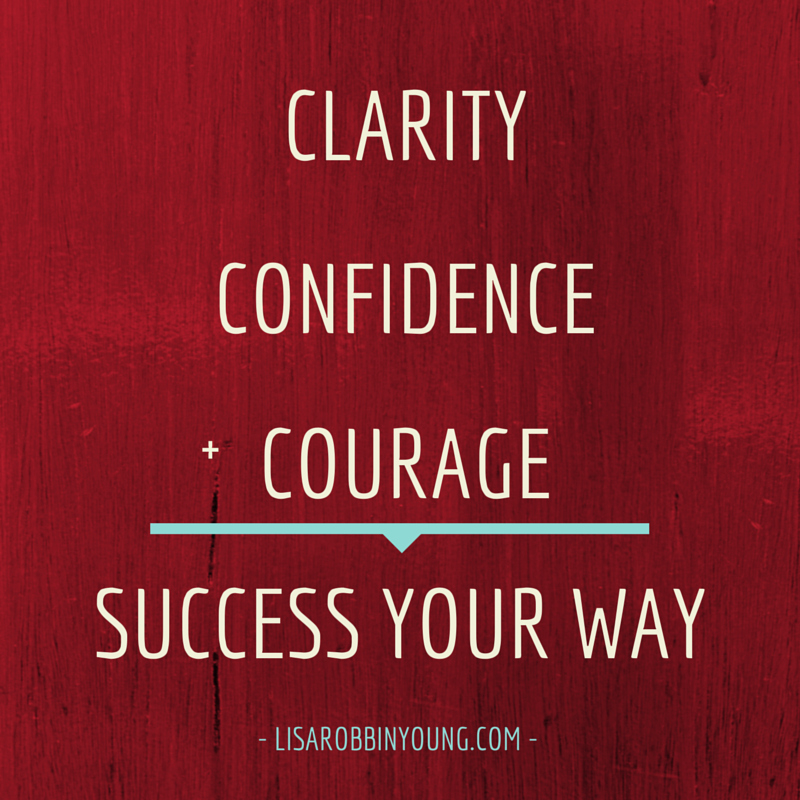
A colleague of mine once shared a similar equation with me. She was using it to talk about the power of irresistible presence, and how, when these three elements are combined, you are more able to show up in a magnetic and authentic way.
The more I looked at her equation, the more truth I saw.
Success in anything can ONLY come when we have these three elements in proper measure. Without all three, you'll fall short in some way. Don't believe me? Let's look and see:
One of the most important things I've ever done for myself was develop The PEACE System. It helps me have crystal clarity on my priorities for any given day. Coupled with my Dreamblazing program, I've created my perfect solution to knowing exactly what matters most in any given moment. I have total CLARITY on what to do, and why.
After she fell, that little girl had clarity that her bike had a few issues, and that she needed more practice riding with it before she took it out onto the broken sidewalks of our ghetto neighborhood.
But clarity alone only helps you see the bicycle. It doesn't give you insight into how to actually ride it. Clarity says "I need to learn how to ride the bike." Confidence says "This is how one rides a bike."
Big difference.
You know what that means right? No? Here's the Urban Dictionary definition. CONFIDENCE comes from this space of knowing. When you've got clarity, you can make some decisions about what to do, and what not to do. You can even help other people make decisions based on what you know. As a coach, I am lucky enough to work with clients that need to make changes in their lives and business, but if all I did was spout off my knowledge, or tell them what to do, I'd be nothing more than a "sexual intellectual" that no one wants to work with. What's more, if I left my clients in that space, they'd never make any forward progress.
Confidence is the by-product of practice. Practice can only happen in a safe space. Like learning to ride a bike, there's always a fear of falling down, but training wheels and a steady hand on the back of the seat can make all the difference between riding down the street and never getting on the bike in the first place.
Confidence is built when the action you take is positively reinforced. When that little girl got back up on the bike, her parents stood by (safe space) and encouraged her progress. When her progress was reinforced, it gave her the confidence to know that she could ride this bike.
That little girl knew she could ride a bike - she'd done it before. She just needed to figure out how to handle the particular quirks of this bike. She quickly realized the seat would be an issue, so she needed to learn how to ride standing up. That would pretty much solve her "cushion" problem.
But knowing is only half the battle (GI Joe!)... or in this case a third of the battle. Because all the clarity & confidence in the world won't help you if you don't have the courage to do something with what you know.
For most people, if you've got courage, you've got confidence. COURAGE is the active piece to the "knowing" of Confidence. But sadly, people act with "courageous stupidity" all the time. You hear stories about someone accidentally setting their house on fire because they tried to kill a spider with a torch. Crazed drivers struck by road rage who speed up as someone tries to pass them - only to find out that person was a cop.
We all have something we're fighting for, something we believe in, something that in our bones we know to be true (that we'll defend to the bitter end). But without clarity (of what an appropriate response would be, for example), our courageous acts come off just plain arrogant or stupid.
This little girl could have thrown the bike to the ground in disgust and refused to ride it. After all, she "knew" she could ride a bike, and this one wasn't behaving properly. But because she also had clarity that this was the only bike her parents could afford, if she really wanted her very own bike to ride, she'd have to act differently.
Clarity says "I need to learn how to ride the bike." Confidence says "This is how one rides a bike." Courage says "This is me, riding this damn bike."
I'm leading a free workshop on Saturday March 14, 2015 to help you have more clarity, confidence, and courage in your life and business. If you're ready to learn how to create your own safe space to develop confidence and courage in your life and work, I hope you'll join me for this special, one-time-0nly workshop. You can learn more and register here. I'll also be sharing more about my Creative Freedom Apprenticeship and telling you how you could earn a scholarship to attend at no cost to you.
As I hear clients, colleagues, and friends sharing their goals for 2015, there's a chorus being repeated over and over:
"This year is the year I FINALLY break __ figures!"
 I've heard it so many times that it makes me dizzy and sad to think about the number of folks who continue to miss the mark on this particular goal each year. When I ask why they haven't hit their goal yet, I hear lots of "reasons" - but ultimately, those reasons all mask the truth of why they really haven't hit their big income goal - whatever it is.
First a warning: "Big income goal" is relative. Like dream shame, the fact that you have a goal means it's big. For you, it might be 10 figures, or 6, or 5, or being able to finally quit the day job. The number doesn't matter. The principles are the same regardless of the number of zeroes at the end of the figure.
Why is it that most entrepreneurs that dream of making "mucho dinero" don't hit their big income goal? Here are a few reasons I've encountered (both on my own journey, as well as with my clients): (more…)
I'm not one for social commentary or deep philosophical discussions, so consider this the "light version" of any meaningful conversation about the nexus of technology and society. This isn't a commentary about technology, though. It's more about what's unwittingly happened to people as we've become more "connected" to the world.
The Industrial Age gave us cookie-cutter, assembly line techniques for being efficient and crafting a uniformly effective offering.
That's awesome in a survival-based world, where cranking out quality stuff in quantity is important.
But that's not the world we live in anymore. On the whole, we are wealthier and healthier than we've ever been as human beings. Yes. there are exceptions to the rule, but most of those folks aren't reading this anyway, so it doesn't apply to them.
This applies to you. You, the person that's been cramming yourself into the same cookie-cutter mold for decades (or railing against it), because that's all there was.
I've been pretty lucky to "grow up" in the digital age. I'm technically not a Millenial, but I'm on the cusp. I built one of the first e-commerce websites back when animated gifts were all the rage (the first time), and video wasn't even a glimmer in the Internet's eye.
In that time, there've been lots of "game changers" - which is almost silly to say. The advent of the Internet is like watching an infant grow into a toddler and then a teen - everything is new, thus everything is a "game changer". But the one commonality I've witnessed over the last 20 years is the growing ease with which people can access, use, and contribute to this technology - and how this new-found ease impacts their work.
10 years ago, the idea of watching your favorite TV show or a feature-length film on your stylish CaseFace phone was insane. Now, mobile and "third screen" viewing has eclipsed television, and will likely continue to do for the foreseeable future. The ability to take your media with you has relegated newsprint to the birdcage, and magazines I loved reading as a kid have gotten thinner and more ad-laden.
Less content, more commercials. A sure-fire end to most anything.
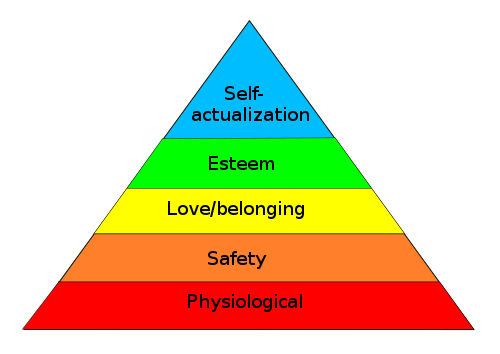
One look at Maslow's Hierarchy of Needs will show you that we've done a great job (on the whole) of getting those basic needs met. As I said before, we're wealthier and healthier than we've ever been in human history.
Here's another great example from Chip Conley, which condenses the pyramid into three layers (particularly the "employee" pyramid, which he's condensed to "money", "recognition", and "meaning").
Maslow's theory is that we work our way up the pyramid, once we've assured ourselves that our more basic needs are met. Once we've handled the basics like, food, shelter, clothing, saftey, and a paycheck, we can concern ourselves with "higher" issues like love, a sense of belonging, or recognition. Ultimately, once those things are handled, we can search for "self-actualization" or the meaning of life, if you will.
Here's the problem in a nutshell. We've been pushed up the pyramid, whether we like it or not. Computers have "connected" us, and made things incredibly easy, yet so many of us weren't ready for the shift.
Now, building a career can happen remotely. For my last job, I applied, interviewed, and was hired digitally. I worked from my Michigan home, and the company was thousands of miles away on the west coast. All my contact and interaction was digital: email, skype, webcam. No handshakes, no eye contact, just pixels.
Love and belonging (at least on some level) are just a facebook post away. When I'm feeling blue, I can post a simple "Hugs please" on Facebook, and my friends come out of the woodwork to encourage me. I never got that kind of instant gratification & encouragement before the Internet! So work, networking, and even relationships have gotten more efficient, thanks to technology.
We've got all this time on our hands, and yet we're stuck.
We're stuck because, now that the basics and middle-ground issues are being "handled," we have to look to ourselves and find meaning - something that takes time and can't be short-cut.
"Why am I here? What makes me valuable if a computer can do my old job in half the time? What real value do I bring to the world?"
We didn't have time to deal with these questions before. We had work to do, dammit, and that had to come first, so we could eat - so we could SURVIVE! But now, with all this time on our hands, we're having to face these questions - and some of us have a boatload of anxiety, depression, fear, or ambivalence toward it.
To make matters worse, we've been taught that thinking of ourselves is selfish and inconsiderate, and we are, therefore "BAD" for behaving that way.
No wonder our culture sometimes feels like it's on a downward spiral.
The truth is, you've been doing it since you were born. You "took" your first breath, and it's been downhill ever since. In reality, you can't NOT put yourself first. It's just that our culture has made it out to be some sort of a crime because there are those among us who would take it to the far extreme. Putting yourself ahead of everyone else - at all costs - is a kind of selfishness that often comes from a place of fear.
Self-care is not selfish - including in your work. (tweet this)
More and more employees are jumping ship to work for themselves. I'm meeting more entrepreneurs who left corporate America after only a few years of being disillusioned about their prospects with their employers. I'm also meeting entrepreneurs that are carving out a name for themselves by defining success on their own terms. They're creating businesses and offers that take into account how they like to work, who they like to work with, and what they want their life to be like so that they can experience success now - not in 35 years. They see that there's no pot at the end of the rainbow, that "someday" doesn't come with a big red ribbon, and they're deciding what they really want and going for it now.
To "older folks" entrenched in the ancient ways of the Industrial Age, it feels a bit like treason. It's definitely shaking up their snowglobes - the idea that they can give themselves permission to walk away from something they don't love and do something that brings them joy - and get paid to do it -still strikes fear into many of my older family members. They grew up in Depression-era America, where you got one job and stuck with it until you were old enough to retire, take the watch and the pension, and then go have a REAL life - if you lived that long. I know many employees of the assembly line factories who literally gave their lives to their work, dropping dead within a few days of retirement.
I've said before that now is the best time for you to create a business (and a life) that works for you. Of course, that means getting clear on who you really are and what's really important to you. It means doing the work at the top of the pyramid, and finding the meaning that matters...
... to YOU.
For some folks, this might seem foreign, or scary, but there are countless people in the world doing it. In fact, I'm launching a new series next year that spotlights these folks (more on that in a later post). They are becoming the norm. Gone are the days of three television networks and multi-national conglomerates that corner the market. Now is the time of what I call the "experience economy" - and creating a life for yourself that matters. It's reaching smaller, tighter markets and making a big impact. It's happening now.
On Monday, I'll be leading a free teleclass called "Success Your Way: How to have a profitable, sustainable business that works for you in 2015... and beyond." If you're at all interested in riding this wave of business with meaning, I invite you to join me. You'll learn more about this crazy "pyramid scheme" called business, as well as how to figure out which stage of growth your business is in and how to shape it to this new experience economy... which might sound more technical than it really is.
In short, we'll talk about how YOU can create a business that works for you, based on how you define success. And if you're not sure how to define success, we'll talk about that, too.
How are you dealing with the way technology has pushed you up the pyramid? What has been a blessing (or a curse) for you because of it? Share your comments below.
Ever have one of those moments where you think you know how something is going to go, and then it turns out completely differently, but it still works to your favor?
That was my experience last week when I asked my facebook connections to vote on a video topic for a contest I'm entering. I asked them to choose between these two topics:
Hands down, the winner was #1 - in all but one group where the vote was evenly split. For whatever reason, people I know can really relate to the struggle of showing up fully as themselves - a malady I can SO relate with.
But here's the thing... both topics are really about the same thing.
It almost sounds like a dangerous idea, right? I mean, there are "blueprints" and "formulas" galore in the world. There are gurus, guides, and coaches who want nothing more than to sell you their 'proven system' to help you be "successful" in some area or another of your life or work.
Heck, I'm a mentor myself. I have systems and tools that I use and offer to others, so it stands to reason I could lump myself in that category, too, right?
I wouldn't blame you if you did.
The thing that I hope sets me apart is that I detest the one-size-fits-all approach that so many leaders laud. A lot of people tread that path, and in my experience that's where the mediocre are. Back in my direct sales days, there was a "technique" that was touted as a sure-fire way to get business: pass out your business card to everyone with a pulse. Does it work? Sure. Eventually. But it's painful, awkward, and gives you a bad reputation.
Cookie cutter "blueprints" have their place. Like making cookies, or building houses. You want to know, before you invest your resources, a reasonable idea of what the end result will be. But you can take one blueprint and build two "identical" houses and they won't even be close to the same. Why? Location, interior decoration, and other considerations that have nothing to do with the blueprint itself. Likewise, three people can take the exact same cookie recipe and have three dramatically different results. Why? Again, lots of considerations that have nothing to do with the recipe itself.
The difference in the house and the cookies lays squarely with the owner. Who's the one doing the building, the decorating, the baking? That's what's really going to dictate how things shake out. That's something most coaches and gurus don't take into account in their blueprints.
Frameworks are helpful, but you can't expect to duplicate someone else's success because you are not that person! Believe me. I've invested my share of cash into training, blueprints, and frameworks. Any time they're a step-by-step "here's what I did to be successful" approach, it falls flat. Because I'm not them! I've been coaching and training for almost 10 years, and while there are some common themes, every client is different. There are no two people, no two businesses that are exactly alike. Even in direct sales, where every consultant is selling the exact same product from the exact same catalog, the results are markedly different because of WHO is doing the selling and HOW they are doing it.
A blueprint or a framework can show you how, but it may not work for who you are. It's the underlying principles, the concepts, and the WHY this worked that matters. Once you know WHY something works, you can figure out HOW to apply it to your situation in a way that works for WHO you are.
It was my very first tagline and it's still true. You are the most important piece of the puzzle in growing a profitable, sustainable business. Without you, it's just another product, another service, another offering. You are what makes it special. But if you're spending all your time, money, and energy trying to fit yourself into the mold of someone else, you're missing out on your biggest opportunity for success.
Showing up as yourself more completely means being willing to own your shadow and your light. None of us - not even the well-paid gurus and muckety mucks of the world are perfect. No matter how much spit and polish they put on. We all have bad days, make poor choices, and then have to live with the consequences. Being willing to admit your imperfections takes courage, and a little vulnerability, it's true. What I've learned, though, is that when I am willing to show up as myself - warts, sparkles and all - it gives the people around me permission to show up as themselves, too. It's an upward spiral that perpetuates itself.
When I finish speaking in front of an audience, I usually hear two comments. The first is usually about my energy and enthusiasm. The second is about how refreshing it is to see me be so "real" on the stage. They appreciate that I speak without talking down, insulting their intelligence, or making them feel inferior. They appreciate that I'm not afraid to tell the messy stories of my life. It gives them confidence to share their stories - sometimes just with me, but often with a larger audience they've been nervous to talk to.
From my perspective, life is messy. We all know that, yet so many people try to pretend otherwise. Embrace your mess, maybe even love it a little, since that's where the juicy stories come from. That's what makes you relatable.
Don't be afraid to be yourself. It's a job no one else is equipped to do. (click to tweet)
That doesn't mean you have to air all your dirty laundry. I do my best to share my stories in ways that are helpful to others. I'm one of those people who believes that if you can learn from my mistakes, then you won't have to repeat them. I also believe that every choice I've made (for better or worse) has led me to this moment. That if there's something from my journey that can help you on yours, then I want to he able to share it.
We've all put on the brave face, the happy face, the facade that says everything's okay when it's not. But I'm talking about something deeper. You've heard me talk about "The Pretender" and "The Coward" before. One mask protects you from the world, the other protects the world from you. Yet, neither serves your highest good. You have to take off your masks to risk being truly seen.
When you know who you are, you aren’t afraid to admit who you are not. I'm not a scientist. That's my husband. When the kids come home with math homework, I quickly remind them I was a music major in college, so I can count to 12 and divide by 7, but that's about it. I know my limitations there. But it's easy for me to forget those limitations when I slip on the mask of what a good mom is "supposed" to be. I'm pretending. It's frustrating. And it's just digging my hole deeper.
Once you start wearing a mask, it becomes risky to remove it. Showing up as yourself means letting people see what you don't know, what you can't do, what you aren't capable of in this moment. That's scary stuff.
But it also means showing people what you do know, what you can do, and what you are truly capable of in this moment. That is sometimes even more scary.
I grew up in a "gifted" program full of smarty pants kids. We were all too smart for our own good and socially awkward. Most of us had one or two things that we really knew - we were smarter than even the smart kids! But if we dared to show our intelligence in that area, we were quickly brought down a peg by someone who was smart in another area - just to show us that we didn't know everything.
Sadly, that attitude doesn't leave us when we're adults. So being seen as smarter, faster, or better than someone else can become an equally heavy burden and scary proposal.
Masks, to me, are like McDonald's. Once you've seen it, you know what to expect. When you walk into a McDonald's you pretty much know what's on the menu, where the bathroom is, and how competent the counter help will be. On those rare occasions when they're offering a special menu item (remember McDonald's pizza?) it throws you off. Now you're not sure what to expect. That could be good or bad, but either way, you're thrown for a loop for a minute while you get your bearings.
Masks become a cultural shorthand. The problem is that humans grow and change, and masks don't fit forever. Try taking a picture of yourself when you were a child and wearing it around during the day. Unless it's Halloween, people are going to be thrown off. Why is this grown-ass person wearing the face of a small child? What are they hiding? Why are they hiding?
Peeling off the masks is a must-do. How can we fall in love with you if we can't see who you are? If you're wearing a mask, we're not falling in love with you, we're falling in love with the mask, and that creates all kinds of internal backlash and self-loathing. It's a vicious downward spiral that keeps us trying on different masks, hoping that one will eventually fit.
It takes guts, and tremendous amounts of courage to be true to what really matters to you. Lady Gaga takes a risk every time she steps out in public in one of her crazy ensembles. Yet, it's far less of a risk than playing small and not owning her outlandishness. If you fell in love with "small-playing" Lady Gaga, you just might have a heart attack watching her tramp around in some of her crazier get-ups. Her outspoken, outlandish appearance is part and parcel to who she really is.
To deny any part of you is to deny all of you.
You can't say "that's not my hand" when it's clearly connected to your body. If you deny the hand, you deny the body. Likewise to deny what's important to you (family, faith, travel, relationships, etc.), is to deny YOU. You can't deny a part of you. You're denying your whole self, because that "part" is woven into the very tapestry of your existence. It's a meaningful thread of who you are... whether it's a piece from your past, your present, or your future, it's every bit as important as every other part of you.
In the next few days, I'll be sharing a special gift with my subscribers to help remind them to remove their masks and show up more consistently as themselves. If you'd like to get it, be sure you're subscribed above. In the comments below, I'd love to hear your stories. When did you recognize you were wearing a mask? Did you choose to take it off? Why? What happened as a result? It's in sharing your stories that we lift each other up.
I've been wanting to write a post for a very long time about a concept I dubbed "the two I's". Inasmuch as we have two eyes through which we see the world, there are two "I's" through which we see the world: our divine self and our human self.
You can try to dodge them, but no matter how hard you try, you will experience the agony and ecstasy of both "selves" in your lifetime. I've talked about our Shadow self before. How the Coward and the Pretender protect ourselves from the world, and the world from us. How they are all part and parcel to our being. But I thought an incredibly personal example from my own upbringing might drive the point a little deeper.
It's probably a good thing my family doesn't read my writing much. Especially this week. I've written about my Dad before, but I don't usually talk about my Mom. That's because ours wasn't the greatest of relationships. While my Dad and I weren't exactly buddies, he wasn't around much as a kid, so he and I didn't develop the strong animosities that Mom and I did.

Dad was a Vet from WWII. He fought in the Asia Pacific Campaign on the island of Hawaii. I never knew much about what he did or who he was, since that was 30+ years before I was even born.
This past week, his replacement Army medals arrived. He earned a bronze star for his campaign medal, and I'm still not entirely sure what that means. In addition to the victory medal, also earned a Good Conduct Medal and a marksman badge for rifle (which explains the gun he kept in the closet when I was growing up). He also earned an honorable service pin. To look at all that regalia, you'd think Dad was some kind of war hero deserving of a halo and a front row seat in Heaven.
Perhaps.
This was the same man who, in his 60's no less, took my mom to abandoned houses to pull out and strip the copper wiring to sell at the junkyard for cash. Granted, that cash was used to feed his family and keep a roof over our heads, but breaking the law is breaking the law, no matter what the intention.
Lest you think Mom was some kind of victim in all this, she is the prostitute in the subheading above. Did you ever wonder what happens to prostitutes after they clean up their act and get off the street? I did, until I learned about Mom's "torrid past".

Back in the early 1970's, Dad was a cab driver. He was in his early 50's, married to a drug addict with two kids - one whom he'd sired and she another she brought to the marriage. To hear Dad tell it, he loved her, but she couldn't kick her habit, so he was looking for another "option". That's when he met my mom. She was this 20-something vixen - one of the few white chicks that hung out at an all-black bar in town where he liked to go between calls.
I never knew mom or dad to be much in the way of drinkers, so that story took me by surprise.
He knew she was earning money the "old fashioned" way, and decided he wanted to get her off the streets and clean her up. So he moved her into his house - with his wife and kids - under the guise of being a live-in nanny and part-time cabbie.
My mom, the undercover live-in lover of my dad, a married man with kids. The wife was too high to care, I presume. Then one day Dad was in the kitchen making wifey a sandwich. She OD'd right in front of the kids and died.
There was nothing to stop them from getting married, so they did. Mom & Dad eventually adopted both boys and went on to have both me and my sister - all before the end of Gerald Ford's presidency.
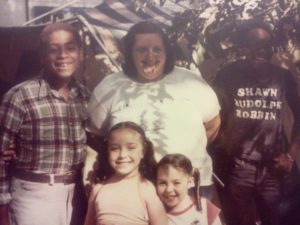
By the 1980's we were one big family - the kind that put the "fun" in dysfunctional (this picture is from one of the few family camping trips we all took together). My oldest brother (on the right) started stealing from the family. My heroic war vet dad would bind his hands and hang him from the wrists in the garage and whip him with a belt to get him to 'fess up. That put fear into the rest of us to not steal.
My other brother (on the left) decided that it was okay to force himself upon his much younger sister (me) instead. I didn't understand then why my Mother defended him. For years it was easy for me to see the darkness of Mom and the light in my Dad. Dad, the Angel, had left my mom because, well, she was the Devil. Nothing was ever good enough for her demanding ways. It was stressful, painful, and downright horrible.
After Dad and mom split up the first time, Mom took to the belt like a natural. It was an abusive, yet loving home - something you'd only expect to hear from a child of an abusive home. I'm pretty sure my extended family was somewhat aware, but nothing was ever done to my knowledge; no visits from child protective services as far as I know.
Then, in an effort to "make it work for the kids' sake" they got back together. That didn't last long. It was a painful mess of a relationship that colored so much of what my view on men, marriage, and family became for many many years.
It wasn't until I was an adult, with a child of my own, that I could really own that they were both a tangled web of shadows and light - like we all are.
As I approach my fortieth birthday, I look back and do my best to temper both the light and dark in my family. Fitting, since I'm biracial, right?
Amid all that darkness, I remember how my Dad would sit with me every week when my oldest son was still a toddler, and instruct and encourage me to be a better parent. How Mom attended and supported my sister's softball team in high school. The vacations and road trips we took to various parts of Michigan and the Eastern U.S. How they were both compassionate grandparents for as long as they were alive.
Those were good, glorious times: when Mom and Dad were letting their Divine selves shine through.
No one is perfect, in the zone, or "on" all the time. We see it played out when celebrities get caught doing something stupid, or a politician admits to some "corrupt" act. When I yell at my kids, swear at the driver that cut me off, or give credence to the "not enough" voices in my head.
On the other hand, our Divine nature calls us to live beyond our humanity. Wallowing in the "bad" things we do and resigning ourselves to our imperfection is a cop out. Saying "I told you I was trouble. You know that I'm no good." - with apologies to Amy Winehouse - is a cop out. We owe it to ourselves - to our highest good and to the people who need us to share our divine gifts - to keep showing up, warts and all.
When I meet someone for the first time that's previously watched my videos or read my blog, invariably, they say something about how inspiring I am because I have the courage to just show up as I am. That me "being vulnerable" is some kind of salve for them that gives them hope and courage to show up for themselves, too.
I used to think it was a back-handed way of saying "you could at least put on some makeup in those videos!" See how I couldn't even receive the compliment that was being handed to me? I was stealing from myself and robbing them of the gift of true gratitude.
Recently, though, I've noticed more and more people saying the same thing - as if my vulnerability is a gift I get to shine into the world for those who need it.
I'll be the first person to tell you I'm not perfect (my kids would probably be the second). It's part of why I don't show up with flashy videos and perfectly coiffed hair. My dishes are regularly undone, my house it quite often in disarray, and don't even think about looking at my desk right now - I'm not sure you could find it.
I've lied. I cheated. I've been "the other woman" - on more than one occasion. I've been mean, cruel, and just a downright "bad" person. And, as my favorite poet likes to remind us, still I rise.
Why?
Because my Divinity refuses to let my Humanity own me. Each day is another chance to stand up to the shadows of all my yesterdays, shine a light and say "screw you yesterday, I'm going to show up and keep trying to do better."
Not "do perfect." Do better.
My Humanity also refuses to let my Divinity own me. Because each day is another day for me to experience joy, emotion, respect, fear, lightness, darkness, faith, courage, happiness, anger, rage, and all the other emotions that are part of the human experience.
It's difficult to see the world through one eye. You're constantly craning your neck to see what you're missing. If you have two eyes, it seems senseless to cover one of them and pretend it doesn't exist. Why not put it to good use and see the rest of the world around you?
Why indeed. It's much harder to live life pretending you're perfect (or evil). You're constantly shift around to keep people from seeing the side you wish to ignore. If you have two sides, it seems senseless to cover one of them up and pretend it doesn't exist. Why not put it to good use and let us (and yourself) experience you showing up fully in the world around you?
About a year ago, my husband and I bought a Porsche. We call it "The Time Machine" because it's really a blast from the past.
When we bought it, we got the expected commentary from friends and family:
"A Porsche? Really? How can you afford that?"
"What are you going to do with a Porsche? It's way too small for your family."
"Mom, can I have it when I graduate from high school?"
... and on and on.
When they found out it was a Porsche 924 - a classic from 1977 - and we only paid about $1500 for it, the comments took a different turn:
"What are you going to do with an old beat up car?"
"Forget it! I don't want my friends seeing me in an OLD car!"
"That's $1500 more than I would have paid."
"Does it have seatbelts?"
"Regular or unleaded gas?"
... and my favorite: "Can you even fit in that thing?"
One guy I used to know - who owns a limited edition Porsche Panamera (valued around $75k) - liked to poke fun and ask me when we were going to get a real Porsche. He'd say to me "Don't you want to see yourself someday in a new Porsche?"
I wonder if he'd say that to his wife - who is about 20 years his junior. 🙂
Last summer was a rough one for us. After two years of trying to keep a failing business venture afloat, and some personal financial issues around the health of our kids, we made a tough decision (more…)
"I am enjoying showing up as myself more completely."
That was the nugget of gold I rendered from my weekend intensive with my coach this past weekend. Once a quarter I sojourn in Minnesota for a few days to do deeper work to heal my "stuff" and open up blocks around my mindset. Because I'm a coach myself, I know the value of having a different perspective to help me open my eyes to my own hangups about success and how my life "should" be at this point in time.
This revelation came as a surprise as much as it came as a soothing realization. There's ease in showing up as myself - without worry or self-censorship. Granted, there are times when a little tact is recommended, but to just be myself fully - warts, sparkles, and all - is a gift I'm learning to give myself (and the world) more regularly.
Comparisonitis is a dreadful condition. It's a horrible inflammation of the ego, causing immense discomfort about who you are, and overall dissatisfaction with anything you've accomplished. When you suffer from Comparisonitis, everyone else is always farther along, doing better, making more money, living the life you believe "should" be yours. There's no sense of satisfaction, and often you feel guilt - like there's something wrong with you, or you need to be doing more.
Comparisonitis is fear in disuise. Instead of doing what we can where we're at, we're constantly comparing ourselves to every Tom, Dick, and Jane out there that appears to be in a better position than us.
One of my first (and admittedly worst) cases of Comparisonitis was with a contemporary colleague of mine. It was around 2008, and another coach was having what appeared to be way more success and making way more money than me. We both launched our businesses about the same time, and I was frustrated at how much exposure she was getting, how many "big name" people were talking her up, and how she looked like she was on the fast track to success.
What I didn't know was that all that surface shine came at a great cost to her personal life. She had taken out a second mortgage on her home so she could invest in all the programs that those "big names" were offering, which came with a promise of promoting her stuff to their audience. Ultimately, she ended up divorcing her husband and starting over on a much smaller scale. She tried to leapfrog and wasn't ready for the hard landing that comes from such a high jump.
You don't know what's going on in someone else's world. Stop comparing your success to theirs. (click to tweet)
There's a difference between Comparisonitis and benchmarking - which I'll get to in a minute - but for now, realize that your first step in moving beyond Comparisonitis is to stop "shoulding" on yourself.
I forget where I first heard the phrase, but if you've worked with me for any length of time, you've heard me use it. We get so caught up in the "shoulds" - instead of accepting (and maybe even embracing) where we are now. I think Mark Silver over at Heart of Business said it to me best:
"As long as you are in comparison, you are rejecting what is true [for yourself], and you are not able to be present to what is... People make up stories to protect themselves from having to surrender to what is currently true for them."
- Mark Silver"
When we're not focused on what is, we're focused on what we think should be happening, what we should be doing, what we should be experiencing. All that does is create more anxiety, more guilt, and more frustration about where we are not, instead of appreciating where we are.
Yet, if we stop comparing ourselves to anyone (except our past selves), we can see how far we've come in our lifetime, despite the obstacles, trials, fear, worry, doubt, and pressure to be something other than who and what we are.
When I look back on my life (instead of comparing that life to someone else), I'm really proud of what I've accomplished, who I've become, and what's on the radar for my future. I get a chance to appreciate my own awesomeness (without arrogance), instead of poo-pooing and downplaying my life because it's not "enough" compared to someone else.
My coach has helped me practice what she calls "AWOJAWA" - awareness without judgement, awareness with acceptance. We often think that pain, discomfort and other feelings of that ilk are "bad" and to be avoided. While it's true that I wouldn't want to live there all the time, sometimes pain can be a powerful tool for recognizing a need to change. Fear can be a powerful motivator to get stuff done. It's not good or bad, it just is.
Likewise, we think that happiness, pride, peace, joy and other feelings of that ilk are "good" and to be sought after. Yet, how much happiness is there in chasing joy? How healthy is it to be peacefully blissed out and completely unaware of the 8 year old setting fire to your kitchen?
It's not good or bad, it just is. We are the ones putting all the judgment labels on our emotions.
Comparisonitis still flares up in me from time to time, and I do my best to use a healthier way to track my growth and progress. Benchmarking is an idea that's used a lot in corporate worlds, and one that I think we can use beneficially in other ways. The idea is to look to a standard and measure our results compared to that standard.
But here's the kicker - you can't measure to some external standard. Take for example, my weight loss journey. If I constantly compared myself to every other woman that was more than 100 pounds overweight, observed the charts and "standards" that governing health agencies said were ideal, I'd be miserable.
My standard, instead, is consistency. What can I do consistently? I can run - if I'm pushed - but I can't sustain that. I hate running (for now anyway). What can I do - and do it consistently? I can get off my butt and dance around my house for 10 minutes a day. Will that cause me to lose 100 pounds overnight? Nope. But once I'm consistent at 10 minutes, I can increase it to 15, and so on.
So I benchmark my progress against my own reasonable standard. Will I get there as fast as I want to - as fast as I think I should?
Um nope. But I'll be making healthier choices more consistently... which eventually leads to the result I want.
Did you hear that? I'll let you take a minute for that to sink in. You are already a success. How's THAT grab ya?
In benchmarking, I'm allowed to see myself as already successful. Because I'm comparing myself now to what I've already done, and what's doable for me going forward. I can celebrate my wins NOW instead of waiting for "someday" in the great beyond.
Tomorrow never comes, yo. And yesterday is always gone. Insert cheesy cliches about embracing this moment here.
So in showing up fully as myself - as often as I can - I get to experience the grace and beauty of my own success. I get to draw closer to the Divine ideal of my life - whatever that is. I'm still figuring it out.
Here's another tidbit I gleaned from Mark - if we look at "excellence" (or "success" in this case) as a way to Master our world, we miss out on the other, more glorious result - we draw closer to the Divine.
So becoming myself more fully means I'm becoming excellent at being myself - instead of becoming something else that moves me farther and farther away from Divine Alignment.
Showing up as myself more completely means I own who I am, and I speak from my true voice - my truth - warts, sparkles, and all. Which, I think, is part of why I'm here on the planet in the first place. God doesn't make extra parts and pieces. We all have a gift and the only way we can share it is if we share it from our true self. I think Judy Garland said something about being a first rate version of yourself instead of a second rate version of someone else. Why would you want to be a second rate version of anything?
It's so important that we understand how important we are - how important YOU are in this world. What do you see as your gifts? And what are you doing to share them with the world - fully as yourself?
(Author's note: this post originally appeared in 2011 on one of my old blogs. I've freshened it up a bit for you today.)
One of the things that really annoys me are those folks that say they want change, but don't take action when answers are provided.
It dawned on me why they don't budge.
Picture a huge file room in your brain. There's a file clerk in there, taking in "evidence" for the various files in the "cabinets."
The file clerk never takes a break. He's contstantly filing away bits of information in the various files.
Let's say, in one cabinet, you have two files, one marked "I can't sing", the other marked "I'm a good singer."
Then let's say you're invited to sing in a local Karaoke contest.
Quickly, you run to the file clerk and say "pull out the files to help me decide what to do!"
The file clerk, never missing a beat, pulls out two files. One is significantly larger than the other. The one that says "I can't sing" weighs 100 pounds, while the other has only a few slips of paper inside.
(more…)He was laying in that hospital bed for several days. Stubborn, cantankerous.
He'd had difficulty breathing when they admitted him, but this eighty year-old man was a fighter, and while he hadn't been eating well for the past few weeks, his strength was contagious. His children, gathered in the room, listened to him tell off the nurses, the doctors, and just about everyone that entered the room.
He talked about how he wasn't done living yet. He just bought a new house. He just celebrated his 80th birthday. He had a grandson he wanted to watch grow up. He was a vigorous "old dude" that didn't give up easily.
His vitals looked good, and no one knew what was causing the trouble. All signs pointed to stress, maybe from making that move, or not getting enough rest.
After a couple of days in the hospital, test results came back.
"You've got a tumor the size of a baseball on your lung. It's causing pressure on your stomach when you eat too much, which, is presumably why you're not eating." the doctor said.
"Cancer?" said the old man. "Well, I guess that's it."
 (more…)
[Note: I originally wrote this post a few years ago, for my Business Action Hero website. I've refreshed it here because it's still relevant - maybe now more than ever.]
"If you are deliberately trying to create a future that feels safe, you will willfully ignore the future that is likely.”
- Seth Godin

It hit me between the eyes. This painful, jarring sensation at far too early on a Sunday morning - on a holiday weekend no less. This strange need for safety that we all seem to crave - even go out of our way to re-inforce.
Even if the result is less comfortable than pursuing change.
We don't want to rock the boat and get people mad at us. So we stay in the comfort zone. Maybe we push a little here and there, but we're not really making true progress on our own path.
It's here where we have to choose:
Because safety is the ultimate risk. Hoping and praying that nothing will change. Images of ostriches with their heads in the sand come to mind. They can't see that tornado bearing down on them, but golly, they sure feel safe!
[tweet "When it comes to owning your dreams, safety is the ultimate risk."]
Back in 2010, I had the honor of interviewing best-selling author Jonathan Fields about the upside of being an entrepreneur. During that interview, he said something that has stayed with me:
"There is no sideways in life. It's an illusion. There's only up and down. Usually this is the most horrifying scenario of all."
- Jonathan Fields
At first, I didn't want to believe it, but my own experience has validated that there's no standing still. You're either moving forward (as you define it) or you're getting left behind. When I interviewed him again for his second book, "Uncertainty", he offered up this gem:
"If you want to do great things in the world, you have to go to a place where you don't know how it's going to end."
- Jonathan Fields
(You can listen to that interview here.)
Since then, he's launched the Good Life Project and Revolution U, all the while, going where he'd never gone before. It's been fascinating and fun to watch. Clearly, this is a guy that continues to choose "adventure" over "safety".
Safety is your nemesis.
I don't mean you should recklessly throw caution to the wind. We need to be smart about the risks we're taking. Safety and security is one thing most of us crave - it's the foundation of Maslow's Hierarchy of Needs. Without it, we don't feel like we can move forward.
But once we "have" it, we're less likely to move forward because of it. Safety means we don't have to push, strive, or work as hard because, well, we're safe, and nothing's going to happen to us in our safe space, right?
That's a wicked catch-22.
Safety works hard to keep you stuck - just as hard as you work to plow forward in your adventure.
"What if they don't like it?"
"What if they think I'm crazy?"
"What if it flops?"
"What will _____ say?"
"That's too hard/easy/fast/slow/tedious/tiresome/boring/good for me."
"I'd love to but I don't have enough ______ (or I am not ____ enough)."
We judge ourselves so harshly that we don't give ourselves a fighting chance. Let's change that!
Remember: perfection is an illusion. You're already as perfect as you're gonna get. You're human. To expect perfection 100% of the time will only cause more judgement (pain, resentment, frustration). Stuff happens that we call "failure". Big deal. Take a moment to celebrate the wins, stop staring at the door that closed, and look for your next steps.
The nature of a nemesis is that it has an equivalent level of power and sway. Think of The Joker and Batman, Prof. Moriarty and Sherlock Holmes. A nemesis is not easily defeated, but can be thwarted and often contained. It is when you underestimate your nemesis that it takes a foothold, and often wins a battle or two.
Simple, but not easy.
[Note: This isn't a topic I get to blog about much, because, well, my skin color is usually irrelevant to the work I'm doing in the world (funny how that works, huh?). I've been very fortunate that the bulk of the racist remarks I've dealt with in my life stemmed from ignorant classmates during my school days. There was that one dumb co-worker, but I'll just chalk that up to his old age and inability to grasp multi-ethnicity. Fortunately, he's part of a dying breed, and a relic of a by-gone era, that hopefully never returns.]
Growing up as a multi-racial kid in a blended family wasn't easy.
I was called all kinds of names every day on the school bus. My favorite?
Zebra. The black kids thought I was "too white to be black" and the white kids thought "I was too black to be white". It was the one term they could all agree on.
As a "Zebra" I was delightfully different (okay, it wasn't so delightful then, but I digress). Able to embrace both my white-ness and my black-ness - regardless of how derogatory the term was meant to be. It was certainly better than "honkey" or that "n" word that still floats around in certain circles.
So imagine my delight (and my surprise) when I found this (more…)
Last year, I was introduced to a concept that I've continued to grapple with from time to time. The picture below is taken from page 61 of Dr. Maria Nemeth's book "The Energy of Money". It's an illustration that one of her teachers once shared with her:
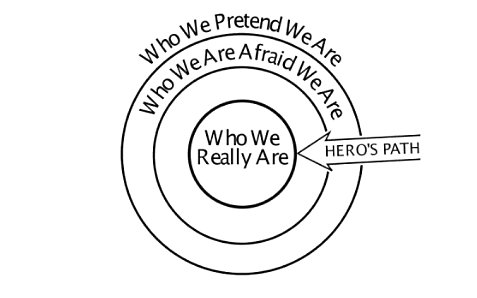 When my coach first introduced it to me, it made perfect sense. I spent little time trying to understand it, and a TON of time trying to figure out where I was on that path.
I recognized I spent a lot of time pretending, a little time being afraid, and almost NO time embracing who I really am.
Sadly, my own experience as a coach tells me I'm not the only person living this way.
These three identities: The Pretender, The Coward, and True Self show up at various moments (more…)
[Editor's note: This is Day 22 of the Be Your Own Guru series, and we're continuing the them of "how-to's" this week. I met Winnie in an online class, and we teamed up to practice elevator pitches. Then we started talking about fear, love and God. Yep. Deep stuff. Winnie's got a great take on fear and how to get past it today.]
That famous social commentator, Anonymous, is quoted as saying “Owning a business is the best self- development program around.”
How right she is.
Whether you’re an accidental entrepreneur, fulfilling a lifelong dream of being on your own, or you’ve got talents and a passion you’re driven to share with the world, at some point as you build the business you come face-to-face with emotional baggage you either didn’t know you had or were sure you had unpacked when you were 18 and still knew everything.
Starting a business isn’t hard. Any child can tell you how to start a lemonade stand: Figure out what you’re selling, come up with a price, put up a sign, and collect the money.