When something isn’t working, most people feel the urge to do something.
Launch a new initiative.
Cut expenses (and/or headcount).
Change the offer or the audience.
Call the donors.
Change the leadership structure.
You get the idea. "Do something... ANYTHING!"
Throw some spaghetti at the wall and let's see what sticks.
That impulse is what I call the Expansion Reflex.
It’s the energy that often shows up when an organization is under pressure and the old model is no longer producing the results it used to produce.
It's one of The Four Horsemen of Organizational Collapse, along with Outsourced Certainty, Command Leadership, and Quiet Compliance.
Each one can be dangerous when it’s used reactively or out of alignment with the organization’s values and Conditions for Success.
But each one can also be useful.
Used poorly, the Expansion Reflex can scatter an organization away from its core.
LEGO is a familiar example. In the early 2000s, Lego was near bankruptcy after expanding into multiple innovation efforts that pulled attention away from its core business. At one point they were losing a million dollars a day!
That is the dark side of the Expansion Reflex.
When things are not working, an organization starts adding more (and more) in an attempt to solve the problem. But the expansion isn't aligned to the core of the business. It doesn't reduce risk or create resilience. Instead that expansion creates more complexity inside an already strained system.
But other times “do something!” is not panic.
Sometimes it is the first honest recognition that one support has been carrying too much weight for too long.
Take the Oregon Shakespeare Festival (OSF) for example.
The Expansion Reflex is not automatically bad.
It becomes dangerous when it pulls an organization away from its core.
It becomes useful when it builds more support around the core.
OSF’s story shows how expansion can become a stabilizing force when it's used to create aligned resilience instead of scattered activity.
The Oregon Shakespeare Festival is one of the Pacific Northwest’s most significant cultural institutions.
Based in Ashland, Oregon, this theater company is a key part of the identity and economic life of Southern Oregon.
For years, OSF’s model depended heavily on ticket sales. Oregon Public Broadcasting (OPB) reported that OSF had historically received 70% to 80% of its operating revenue from ticket sales, while Portland Center Stage’s managing director said theater companies usually earn closer to 50% to 60% of revenue from ticket sales.
Now, I'm all for a theater that can be profitable and not rely solely on grants and donors to stay afloat!
In fact, a theater company with strong ticket sales has something many arts organizations would love to have: a direct, meaningful relationship with the people who come to see the work.
Ticket revenue can be a sign of relevance and reflect audience trust. It means the work is compelling (and popular) enough that people are willing to make the trek to see the shows time and again.
So the lesson here is not that funding your theater with ticket sales is bad. That's actually a GREAT thing!
AND...
Two things can be true at the same time.
A success factor can become a risk factor when too much of the model depends on it and the organization does not have a contingency for what happens when that condition changes.
Or as my mom used to say "don't put all your eggs in one basket."
For OSF, ticket sales were the visible result of several Conditions for Success working together:
When those conditions were available, the model worked.
When they became unstable, gaps in the model were exposed.
This is why I talk about Conditions for Success.
Most leaders use goals to think about what they want. That's important, but it's only part of the story.
Conditions for Success help you see what has to be in place in order for the goal, strategy, or model to work.
They also help you see where the risk lives.
When I work with clients, we look at their Conditions for Success through seven Domains of Influence (DOI):
The domains matter because not every condition is equally controllable.
Some conditions sit close to the organization’s center. Leaders can shape them directly.
Others sit farther out. Leaders may be able to influence them, but have little to no control over them. And some conditions cannot be fully predicted at all. They can only be met with adaptability, reserves, trust, and contingency.
In the Core Domain, OSF had to reckon with identity and purpose. What was the organization trying to preserve? The old operating model? The mission? The cultural role it played in the community? The answer matters because not every version of preservation leads to the same decision.
In the Personal Domain, the human layer came under strain. Leadership capacity, staff morale, artistic energy, decision fatigue, and the emotional load of uncertainty all matter when an organization is trying to survive prolonged pressure. And that doesn't even take into account the personal health and well-being of everyone during COVID restrictions!
In the Operational Domain, OSF needed enough staffing, production infrastructure, rehearsal time, venues, seasonal planning, and logistical capacity to mount a repertory season. COVID and the wildfires did a number on that!
In the Relational/Social Domain, the organization depended on relationships with audiences, artists, staff, board members, donors, the Ashland community, and the broader theater world. As much as people loved the theater, COVID and wildfires meant they simply couldn't attend, and therefore, didn't buy tickets. When ticket sales plummeted, there weren't enough available funds to cover the gap.
In the Capital Domain, OSF needed usable money. Not theoretical money. Not assets on paper. Usable money: ticket revenue, donor gifts, grants, cash flow, unrestricted reserves, and enough financial flexibility to cover operations. Their endowment fund was made up primarily of restricted funds that could only be used for specific purposes, not for the general operations of the company.
In the Systemic/Macro Domain, OSF was exposed to forces no single organization could control: COVID, wildfire smoke, tourism shifts, audience behavior, inflation, philanthropic patterns, and the broader instability facing live performing arts. There was no contingency in place to cover those possibilities.
And then there was DKDK: the unknown-unknown layer. Some disruptions could be anticipated in general, like wildfire smoke becoming a recurring risk in Oregon. You may not know WHEN they'll happen, but if you set up a theater in the wilderness, there's a non-zero chance that you'll be impacted by wildfires at some point.
But the timing, scale, and compounding effects of pandemic shutdowns, audience hesitation, leadership turnover, and post-COVID recovery patterns could not be fully known in advance.
When ticket sales collapsed, it revealed pressure across the whole system.
OSF was hit by multiple disruptions: Wildfire smoke affected outdoor performances. COVID disrupted live performance, travel, and audience behavior. OPB reported that OSF laid off about 80% of its workforce in March 2020, and that ticket revenue during peak COVID years dropped by almost 98%.
When a core success condition fails, the organization does not simply have a marketing problem or a sales problem. It has a model problem.
If your model depends heavily on people buying tickets and attending live performances, and people cannot or will not attend live performances at the same level, then the entire support structure gets tested.
They force the harder question: What does our success depend on?
And then: What happens if one of those conditions becomes unavailable?
For OSF, the answer became painfully clear. The model depended heavily on ticket sales, and ticket sales depended on conditions the organization could influence but not fully control.
The risk was concentrated and no contingency was available.
To be clear: this was an issue felt across a number of industries during the COVID lockdowns, it's not an isolated case.
There was another important issue: OSF had assets, but not all assets are equally useful in a crisis.
OPB reported that OSF’s total assets were nearly $96 million according to its 2021 financial audit, but much of that was tied up in land, buildings, and other forms that were not easily usable. OPB also reported that almost all of OSF’s approximately $39 million endowment was restricted by donors for specific purposes, with only about 15% unrestricted.
Having assets is not the same as having liquidity.
An endowment fund is not always flexible operating money.
Money designated for specific purposes means you can't use it to cover payroll, bridge a cash gap, or keep productions running... unless that's what it was designated for!
So OSF needed more flexible support because their operating model relied heavily on a success factor that had become unstable.
This is where Conditions for Success becomes a risk map.
If a key success factor carries too much of the model, leaders need to ask:
What happens if this condition weakens?
What kind of contingency do we need?
Where do we need more flexibility?
What would give us more time to respond?
What other supports need to exist before the primary support fails?
Those are stewardship questions that give your organization a better shot at longevity.
By 2023, OSF was in a public financial crisis.
In April of that year, the organization launched The Show Must Go On: Save Our Season, Save OSF, an emergency fundraising campaign with a goal of raising $2.5 million to help complete the 2023 season. OSF said the funding gap sat between May and July, and that the campaign was intended to prevent season closure and layoffs.
It also launched a transformational gift campaign aimed at larger gifts, announced major commitments from the Hitz Foundation and Mellon Foundation, cited individual pledges toward stabilization, noted endowment funds released in December, and identified board pledges. OSF also canceled that year’s production of It’s Christmas, Carol! so staff could focus on the 2023 repertory season, paused planning for the 2024 season (pending fundraising results), and temporarily adjusted executive responsibilities.
While it looked like they were making cuts, they were actually making moves that just happened to be cuts.
That is Expansion Reflex. Not one move. Many moves.
A grassroots campaign. A major-gift campaign. Foundation support. Individual and board pledges.
They even got approval to pull some money out of the endowment fund.
From the outside, that was a flurry of activity.
But flurry and failure are not the same thing.
The Expansion Reflex becomes dangerous (one of the Four Horsemen) when the organization expands activity without expanding clarity. It becomes usefl (a White Knight) when the organization expands its options in service of the mission.
In OSF’s case, the expansion was aimed at a specific problem: create enough stability for the institution to survive while the model underneath it is rebuilt.
That is different from “try everything and hope something works.”
OSF was trying to solve a Conditions for Success problem.
Ticket revenue had been carrying too much weight, so the organization needed more supports...
Emergency fundraising.
Major gifts.
Endowment fund flexibility.
Season adjustments.
...and so on.
That is the White Knight version of Expansion Reflex.
Not expansion away from the mission, but expansion focused on the core mission of the organization.
The 4 Horsemen of the Collapse version of Expansion Reflex pulls the organization away from its core - like what happened with Lego. It adds more, but not necessarily in ways that strengthen the thing the organization exists to do.
The White Knight version expands the supports around the core of the business.
For OSF, the core was not just “sell more tickets.”
The core was live theater, artistic work, cultural contribution, community identity, and the continuation of an institution that mattered to artists, audiences, and the region.
Ticket sales had been one major way that core was supported.
But when ticket sales became unstable, the organization had to expand the support structure.
The Expansion Reflex worked because the old model needed more than one way to stay alive!
By the 2025 season, OPB reported that OSF saw a 42% increase in ticket sales from 2024, that almost half of theatergoers were new, and that many shows exceeded revenue goals. OPB also reported that ticket sales represented only about a third of company revenue, down from as much as 80% in past years, while donations made up about half of the year’s revenue.
That doesn't mean everything is solved.
In fact, the same OPB report noted that OSF was still relying on large seven-figure gifts and that the organization had less than half the number of members it had in 2019.
This is, as of this writing, an incomplete comeback tale, but it's still a good one!
It is a story about an organization creating more options for itself after discovering that one option had been carrying too much weight.
That is what strategic resilience looks like in real life.
Not a magic bullet, but a broader support structure to make things more stable and sustainable.
Every organization relies on something. Where are you relying too heavily on one or two things?
Solo and micro-preneurs often find themselves as the bottleneck in the business, but even there you can plan contingencies. In larger organizations, it may look like overdependence on one revenue stream or one major donor. Or a platform (social media, anyone?) or audience segment.
Or, in the case of OSF, an assumption about what people will keep doing.
Any of those can be a legitimate strength, until it becomes the thing that makes the organization unstable.
A useful Expansion Reflex asks not just what to do quickly, but also where you need supports first.
A destructive Expansion Reflex asks what you can do quickly without regard to how it impacts the core of the enterprise.
One creates resilience; the other creates unnecessary complexity.
The Expansion Reflex becomes a White Knight when leaders use it to build aligned optionality.
That means the organization expands in ways that match its values, protect its mission, and strengthen (or are contingengies for) the Conditions for Success required to keep going.
For a nonprofit, that might mean diversifying funding without becoming donor-captured.
For a business, it might mean opening a new revenue stream without abandoning the core customer.
For a school, it might mean changing program structure without betraying the educational mission.
For a community institution, it might mean expanding support while preserving the trust that made the institution matter in the first place.
Expansion is easy. Aligned expansion is harder.
And in a crisis, aligned expansion may be the difference between recovery and collapse.
The Expansion Reflex did not help OSF because “doing more” is always the answer.
It helped because the organization needed more than one way to stay alive.
When the old model was too dependent on ticket revenue, the organization had to create new supports around the mission.
That is the White Knight version of Expansion Reflex.
The Oregon Shakespeare Festival story is not a neat little case study about a theater that had a hard season and bounced back.
It's a story about what happens when a long-successful model becomes vulnerable because one of its most important Conditions for Success can no longer be taken for granted.
It is also a story about how a Horseman can be a White Knight.
The Expansion Reflex can contribute to collapse when it shows up as frantic overactivity, misaligned initiatives, or leadership panic dressed up as momentum.
But when it's used consciously, it can help an organization create the options it should have had before the crisis arrived.
Know what your success depends on. Know which of those conditions are fragile. And when one support carries too much weight, build other supports before the whole structure starts to wobble.
That is the real work of high-stakes decision-making.
Not just deciding what to do when the crisis arrives.
Deciding what must be true so the organization has enough options left when it does.
Is your organization circling a decision or facing a high-stakes situation where an outside perspective can help? Let's talk.
Transformation doesn’t typically fail because people hate change.
That’s the lazy answer.
It sounds tidy. It gives leaders and business owners somewhere easy to point.
“They’re resistant.”
“They don’t like change.”
“They just need to get on board.”
If you're a founder-owner or solopreneur, you might be saying things like:
“I guess I need to be more disciplined.”
“I guess I need to communicate better.”
“I guess I need another system.”
Maybe.
But often, that’s not the problem.
A lot of the time, the real problem is that you skipped the decision layer.
You made a plan. You announced the direction.
You wrote the strategy doc, mapped the launch, hired the contractor, booked the retreat, bought the software, decided to “focus on visibility,” or told the team this quarter was about growth.
And then everyone, including you, had to figure out what that actually meant.
That’s where the trouble starts.
Because when the real decision hasn’t been made, people don’t have clarity.
They become interpreters instead.
And interpretation is where momentum leaks.
The decision layer is the set of choices underneath the strategy.
It’s not the polished plan. It’s not the inspiring, sexy vision. It’s not the theme for the quarter.
It’s the harder, more specific set of decisions that make the plan executable:
That last one is huge.
Because when everything stays on the table, nothing is really decided.
You just end up carrying a heavier, messier version of the same business.
More ideas. More pressure. More open loops. More “I should really get back to that” energy.
And then you wonder why the plan that looked so reasonable on paper feels impossible to execute in real life.

In a bigger organization, the decision gap shows up as the "meeting" after the meeting.
You know the one...
The official meeting ends. Everyone nods in quiet compliance. The direction seems clear enough.
Then come the side conversations:
The same issue shows up again two weeks later with a slightly different name.
That’s usually not a communication problem. It’s a decision problem.
The leaders skipped the decision layer. And that’s the most important part of your job!
A strategy that needs secondary translation was not fully decided in the first place.
Let me say it again for the people in the back:
A strategy that needs secondary translation was not fully decided in the first place.
If you run a solo or micro business, this can be harder to spot because there may not be a conference room, a leadership team, or a Slack channel full of confused employees.
Instead, your meeting after the meeting sounds like this:
So you voice-memo your biz bestie, or open another Google Doc. You add one more task to the already-overstuffed list. You look for another template, another framework, and borrow another person’s certainty.
Maybe it's an avoidance behavior or executive dysfunction (hello ADHD and/or perimenopause brain!), but it may also mean the real decision was never fully made.
Eisenhower was in to something when he said "Plans are worthless; planning is everything."
The plan itself is only the start. I've been hosting my annual planning retreat for almost a decade. I see plans get made ALL the time that never get fully implemented. Heck, I even blogged about the time I made a plan to take my business to $5 Million and then tossed it in a box for 5 years. That post was almost 10 years ago now and I never did follow through on that plan.
This is where a lot of smart people get tangled up. A plan can look impressive and still be full of undecided decisions.
That’s why the issue keeps coming back... because the actual decision underneath it is still unresolved.
Circling is expensive.
It costs time, obviously. But it also costs attention, trust, energy, morale, confidence, and creative bandwidth.
For a solo business owner, circling might look like weeks of mental churn over a decision that could have been named in one focused conversation.
For a small team, it might look like everyone doing their best, but pulling in slightly different directions.
For a larger organization, it might look like a transformation initiative that sounds good in the announcement but gets quietly diluted in execution because nobody knows what actually changed.
The cost of delay is not always dramatic at first.
Sometimes it looks like a little more friction.
A little more hesitation or second-guessing.
A few more meetings and “quick questions” to clarify something.
A few more "open tabs" in your brain.
Over time, those unresolved decisions compound.
The work gets heavier, the strategy gets blurrier, and your capacity gets eaten by the very plan that was supposed to create momentum.
This is why I keep coming back to order of operations.
Not because sequencing is sexy.
It isn’t. I hate filing. I hate organizing much of anything until I absolutely haftagotta.
But knowing the order of operations is often the difference between momentum and mayhem. And that's something I'm HELLA GOOD AT.
Do this first.
Stop carrying that.
Protect this.
Decide who owns the next move, then build from there.
That’s not glamorous, but it works.
Because most people don’t need fifty more moves, they need the one move that makes the next part clear. They need to know what matters now, what can wait, and what is no longer on the table.
That’s true whether you’re a solo business owner trying to stabilize revenue, a founder trying to focus a team, or an organization navigating AI, growth, restructuring, or culture change. The decision principle is the same, regardless.
Here’s the truth everyone wishes weren't true:
A decision that cannot be carried by your actual capacity is not a strategy.
Nope. If that old plan of mine is any indication, that's a wish with a deadline that you'll blow through for the next ten years (and counting!)
The plan looked good. The idea had merit. The intention was sincere. But the order was wrong.
I've done this more than I care to count. The timing was wrong. I was trying to keep too many things alive at once, or I didn't make the hard decision about what needed to stop so the next move could actually work.
That’s a strategy-capacity mismatch.
And if you don’t name it, you’ll keep trying to solve it with more effort or more "discipline".
More content.
More software, tools, or templates.
More meetings.
More “getting organized.”
But the real work may be simpler and harder:
Make the decision underneath the plan.
When you’re stuck, don’t start by asking, “What else should I do?”
Start with one of these questions:
These questions won’t always give you an instant answer, but they will often point you toward the real decision. And once you name the real decision, the next move gets a LOT clearer.
Transformation doesn’t become real in the slide deck or the company announcement.
It doesn’t become real in the emotional high that follows the offsite, the mastermind, the retreat, or the strategy session.
Transformation becomes real in the order of operations.
What changes first?
What stops?
What gets protected?
Who owns the next move?
What tradeoff are we making?
What are we no longer pretending we can carry?
That’s the decision layer.
And if your business, team, or organization keeps circling the same issue, the visible problem... the one you think you're trying to solve... may not be the real one.
You may not need another content plan or productivity hack.
You may not need to blow everything up and start over.
Instead, you may need to figure out what decision is actually asking to be made.
That’s where I can help.
If you’re circling something and you’re not even sure what needs to be figured out yet, a Next Steps Session is built for that.
We’ll look at what’s on the table, name the real decision underneath the noise, and identify the next right move. Not fifty moves...the one that makes the next part clear.
In "The Great Inbetween" that I find myself in right now, I'm having a LOT of conversations with all kinds of business owners. Big business, municipalities, non-profits, coaches, and more. Each of these convos is shaping my thoughts around what's next for me and for business life after Creative Freedom. I've been invited to co-host a podcast, among other things, and it's a time filled with uncertainty and promise for the future.
While I won't go into any details about MY future direction here (my brand strategist would strangle me!), I AM sharing one of those conversations with you today.
I met Becky Mollencamp YEARS ago, when I spoke inside her online community. Since that time, she's gone through a journey of unpacking some of the old ways she learned of doing business. That journey led her to write her book, Liberate Your Business: A radical guide for entrepreneurs who want to build without harm. It's available now at all the usual places, but I'm linking directly to Becky's own website for reasons you'll come to understand by the end of this interview. Here's how Becky describes the book:
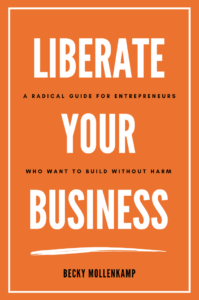
Liberate Your Business is a practical, no-bullshit guide for progressive entrepreneurs who want to build people-first businesses without burnout, manipulation, or extraction.
It's part reality check and part roadmap. You'll name the invisible rules you've been trained to follow, then replace them with practices that support sustainable growth, ethical marketing, and leadership that feels like you.
In our interview, we talk about many of the concepts in the book, along with some of my favorite quotes from it. Plus we wrestle with the importance of giving credit where credit is due (particularly to underrepresented or marginalized voices), when you should call out a problematic business owner, and when you should probably "close your mouth and stay in your lane".
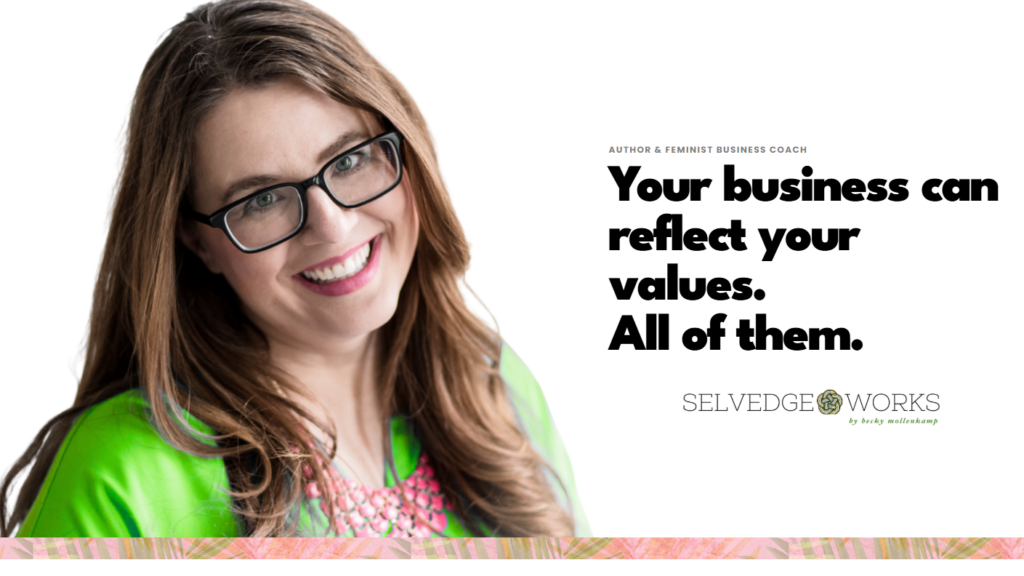
Becky Mollencamp is a feminist business coach for service-based entrepreneurs who want to build human-first businesses that honor collective flourishing over "profit at all costs" growth.
I was crawling across the floor... or should I say I was trying to crawl across the floor.
Everything hurt. Every muscle twitch was excruciating.
Tears fell like hot lava from my face - and somehow, even THAT hurt. At best I was whimpering, at worst, outright wailing, as I made my way from the floor in the family room to the bathroom.
And then I had to try and stand up.
I was seriously entertaining the idea of just laying there - creating a pool of my own filth - just so I didn't need to move another millimeter.
But I kept going. I still don't know how I managed to "hold it" until I got to the toilet.
When my husband got home from work, we beelined to the ER. A few tests later confirmed that the sciatica that had disappeared months ago had come back with a vengeance. A pinched nerve that required neurosurgery to solve the problem.
Swell.
They sent me home with pain meds and told me to come back. The soonest they could get me in was 11 days away.
I'm sorry, what?!?!
Did you not hear the howling? Did you not see my wrenched up face and contorted body? I literally rode in the back seat of the car because I couldn't sit up straight, I was in so much pain.

I ended up having to reschedule my Creative Freedom Retreat because there was no way I could stand for more than a few moments at a time, never mind trying to lead a planning workshop.
At least with some pain meds, I could still get some work done. Right?
Wrong.
The meds took the edge off, but the pain was constant. I gave up trying to dress myself and ate as little as possible to minimize trips to the restroom... because said trips always required help. I practically had to be carried, it was that bad.
"Work" consisted of a handful of virtual appointments where I was strategically "propped and covered" so as not to reveal too much of myself on video. The less I moved, the less it hurt, so anything I could do without a camera on, I would attempt.
I had 4 semi-productive sessions before I finally gave up on the idea of doing anything that involved other people. The remainder of my "waiting" time, I was alone with my thoughts, wondering what would be left of my business when I was finally able to return to work.
Hustle taught me how to push — how to make things happen through grit, willpower, and sheer stamina. It trained me to override my body’s signals, distrust my intuition, and measure my worth by how much I could produce before collapsing at the end of the night.
Hustle applauds the late nights and the full calendars. It rewards the moments you say “yes” when your whole being is whispering “not now.” It’s a survival strategy dressed up as ambition.
When my kids were young, I wore busy like a badge of honor. So much so, that my kids thought I was always working and my youngest started to think his babysitter was his mom.
While I let a lot of that thinking go over the years, I was still the bottleneck in my business. I could outwork almost anyone, and I often did - until I couldn't anymore.
I told myself it was passion. Dedication. Proof that I was serious about success. And maybe that's a little bit true.... maybe.
What it really was, though, was fear.
Fear that if I slowed down, everything I’d built would crumble. Fear that if I stopped producing, people would stop paying attention... or caring about me at all.
I knew how to reach for the next milestone, but I didn’t know how to rest in what I’d already achieved. Every goal met, every box checked, every objective achieved only opened the door to the next one (and the next one, and the next).
Satisfaction never lasted long. It's a chronic condition for Fusion creatives - wind your key, put your head down, and go.
Ask for help? Naw. It's faster to just do it myself.
Celebrate? Maybe. Will there be cake?
Even with all the growth work I've done, I still didn’t realize how I’d internalized the notion that success is earned through exhaustion. That the more I sacrificed, the more I proved I was worthy of having it.
Well, crap.
It took being laid up in bed for 11 days to see how hustle had conditioned me to mistake constant output for consistent progress. To believe that if I wasn’t moving, I was somehow failing.
Double crap.
Hustle won't teach you how to hold success—how to sustain it without sacrificing yourself in the process. Because it’s one thing to climb the mountain; it’s another to live at the summit without losing your footing.
Real, sustainable success doesn’t demand more from you; it asks for something different: discernment, pacing, and the courage to stop performing your worth. It’s the quiet, grounded kind of success that expands your capacity instead of depleting it.
I knew how to climb the mountain of success. I'd been climbing my whole life. But I didn’t know how to live at the top without losing myself.
Hustle glorified the sprint and ignored the recovery.
Sustainable success is not about doing more; it’s about doing what matters with integrity and enough space to breathe. It asks you to trade urgency for rhythm, exhaustion for discernment, and constant striving for steady alignment.
It calls for pacing, not pushing. For courage—not the kind that conquers, but the kind that trusts.
The world doesn’t need your burnout. It needs your brilliance: steady, embodied, and alive.
Hustle culture disguises depletion as achievement. We’ve been conditioned to believe that busyness equals importance — but as leadership coach Ray Williams notes, being “addicted to busyness” actually diminishes well-being and real productivity.
The culture of hustle convinces us that constant output, all-in commitment and “always on” momentum are the marks of real achievement. Actually, though, research shows this mindset often leads to the opposite: exhaustion, declining performance and diminished creativity. Over-working (i.e., more than ~50 hours/week) actually reduces productivity, impairs cognitive function and stifles innovation rather than increasing it.
This is how depletion gets dressed up as achievement: you check off the hours, you hit the metrics, you keep moving — but the foundational capacities for leadership (clarity, presence, deep thinking) erode. The badge of “busy” becomes a mask for being drained.
When our identity is tightly bound to what we produce, our self-worth hinges on the next "result" - another client session, another set of deliverables.
Not that I speak from experience or anything. It took a LOOONG-ASS TIME for me to figure that out... and more time to do the work of unravelling it. And yeah, it still pings me from time to time... especially when my results aren't what I expect them to be.
The first six months of our move to the Pacific Northwest have felt like I was doing everything I could to just tread water. It would have been easy to slip into old patterns of feeling crappy about how little "progress" I felt like I was making.
Two things are at play here. First, I had to acknowledge that my capacity constraints had shifted in ways I was not planning on. I knew I was leaving my gig at the radio station, packing or selling everything we owned and finding a new place out west. But I didn't plan on Jim having 4 heart procedures, a cancer diagnosis, and surgery for said diagnosis during that same time frame!
So, um, yeah... a LOT was going on and my "results" were focused in the personal part of my life, not the work part!
Second, I had to acknowledge that I was doing something - just not what I had originally planned! My container was full - with different, and equally important things!
To begin separating identity from output, you might start by asking: “Who am I when I’m not hustling? What parts of me are independent of my last result?” Then create structural practices (e.g., a weekly non-work reflection, a non-output-related role) that remind you your value isn’t tied to what you ship. This shift frees you to lead from your whole self rather than your last achievement.
When I gave myself credit for taking care of a move, my partner, our home, and that my container was full in other, equally important ways, I could let go of the notion that I had to hustle. As I tell my clients, resting is doing something! And even if I wasn't actively doing anything, I am still priceless to the people who love me most.
Having a foundation you can depend on (rest, rhythms, boundaries, mission) while continuing to evolve, expand, and learn (without spinning or burning out) creates a kind of stability that allows you to keep growing in meaningful, effective ways.
Here's what your "magic paintbrush" image might look like:
Rather than growth that feels like sprint after sprint, you’re building a resilient ecosystem — the soil is strong, the roots are deep, the trunk is steady.
Growth happens up and out, not just forward at any cost.
You wake up feeling grounded and energized instead of on the brink of burnout.
You have a business that expands - without losing your weekends, your focus, or your sense of peace.
You feel like your effort actually sticks... compounding instead of constantly resetting.
Output is transient, but belonging and worth are enduring.
Belonging to yourself, and what really matters (alignment, integrity, impact, connection) instead of the misleading signals of “more" is what I mean here. Enoughness... in life and work.
Hustle promises short-term wins, usually at a long-term cost. It teaches you to sprint every race like it’s the last one—to chase visibility, validation, and velocity over intentionality.
You can’t build longevity on adrenaline alone.
The harder you push, the less space you have to integrate what you’ve built. Eventually, your growth outpaces your grounding—and the Noble Empire you worked so hard to build starts to feel like quicksand.
“If you just work harder / longer / push through, you’ll win and you’ll be safe.”
Whatever safe means.
I've said it to myself. My own clients have said it, too. I had to invite one client recently to consider that maybe, just maybe, their brain was lying to them.
Sometimes, it's true. When you're reaching the finish line, that little extra push can be exactly what you need to get over the hump and get it done. I call that "compassionate hustle".
I'm not anti-hustle. I'm anti-hustle culture.
Hustle culture sells the notion that exhaustion is a sign of commitment, that sacrifice equals reward. You're always "on" you can never rest, never quit, never replenish.
But the evidence says this isn’t reliable. It's not sustainable. Extended working hours correlate with worse health outcomes and reduced productivity — the premise of “more hours = more success” is flawed.
Because effort looks like virtue, it’s socially rewarded. It perpetuates the “ideal leader” myth of being tireless.
Also we lack good signals: when you’re busy and “on,” you might still hit goals, so the erosion is gradual — creativity diminishes, relationships strain, presence fades — but you still check the boxes that make it look like you're successful... while you don't feel successful at all. Meanwhile, culture normalizes overworking. One rocket-launching billionaire once tweeted that "nobody ever changed the world on 40 hours a week."
I call bullshit.
Working within your capacity means you’re not doing more — you’re becoming more effective, generative and whole. You're making space for what really matters so that you can grow with more ease - if you even want to grow in the first place!
Building from capacity (what I call your Conditions For Success) unlocks greater creativity and innovation. When you stop frantically "producing for the algo" and allow space (for reflection, rest, and integration) your mind generates richer ideas, your leadership voice deepens, your presence becomes magnetic rather than frantic. One report says that constant “output” pressure stifles the very creativity that innovation demands.
It’s built inside seven domains:
When these conditions work together in your favor, growth stops feeling like a tug-of-war—and starts feeling like a rising tide. Just knowing that they exist can make a big difference in how you choose to show up and what you choose to take on in your life and work.
Imagine building your business from stability instead of strain. Growing with rhythm, not reactivity.
You don’t have to chase balance because your systems and energy naturally support it. Opportunities flow because you’re operating in resonance—not resistance.
To slow down enough to hold what you’ve built.
To lead with clarity instead of compulsion.
To measure your worth by your alignment, not your exhaustion.
Become a member of my Rising Tide community (it's free, yo!) and you'll get access to my upcoming Conditions for Success workshop. Together we'll walk through the seven domains of sustainable growth, so you can build momentum that lasts, without losing yourself in the process, and create growth that doesn’t drain you.
Early morning. You roll out of bed, feeling heavier than you did when you went to sleep. You got your 8 hours, but your brain is already racing through the daily to-do's before your feet even hit the floor.
“Let me check my email,” you mutter under your breath. But the thought of doing even that feels exhausting.
On your phone (because you're so "efficient"), you open your calendar and see all the tasks you planned yesterday—and start putting things off. Not because you don’t care, but because your mental energy is already taxed. That important client follow-up gets pushed to “later,” and you justify it:
“I’ll do it after I finish this big project.”
So, you skip breakfast and jump into that project, but your excitement is gone. Questions that used to energize you now feel irritating, and you find yourself thinking, “Why am I even doing this?” Small frustrations feel magnified, and the enthusiasm that once fueled your vision feels muted.
You grab food and eat lunch at your desk to squeeze in another task. Coffee replaces nourishment. A walk or a moment to breathe feels impossible. Energy dips, muscles ache, and your patience thins—yet you keep pushing.

By early afternoon, even simple decisions feel heavy. Should you reply to that email now or wait? Should you tackle marketing or bookkeeping first? Your mind cycles endlessly, and your usual creative solutions feel out of reach.
Headaches creep in, shoulders tighten, and stomach discomfort reminds you that stress is taking its toll. You notice the small signs, but there’s no time to pause. You push through anyway, hoping it will pass.
"There's too much to do. I'll sleep when I'm dead," you joke.
But that joke's not funny anymore, and you're starting to think you're calling something into existence.
If this feels eerily familiar, you're not alone. What looks like just another day "on your hustle and grind" could also be the red flags of something else that's going to keep you stuck at a plateau indefinitely.
You’re working harder, thinking you’re “doing what it takes,” but results stall—or worse, regress.
More effort doesn't always leads to more success.
Leaders often focus on enhancing their competencies—skills and knowledge—believing learning more or doing more will solve the problem. Fusion Creatives are known to be "credential collectors". And my neurospicy and multipassionate folks may also find it challenging to accept that knowing more isn't insurance against burnout. In my experience, it can sometimes even hasten the onset!
I kind of blame Einstein for this. He's the one who said we can't solve our problems with the same level of thinking that created them. This leads a lot of people to think that more thinking is the solution.
That only works if you've got the capacity to execute on that new way of thinking!
Capacity development involves building the internal resources to handle complexity and change. Without developing the capacity to manage increased demands, even the most competent leaders can struggle to maintain performance (source).
When your effort outpaces your capacity, you create drag. Systems strain, decision quality drops, and your creativity - the very thing that built your success - gets buried under exhaustion.
Before you know it, effort is outpacing capacity, and your business suffers. Recognizing this early can allow you to course-correct before burnout hits.
It starts small... procrastination or task avoidance (source)—but then it compounds. Decision fatigue. Emotional friction, self-neglect, and physical fatigue slowly creep in.
Here's another scenario:
A colleague invites you to a connect. You decline. A friend texts to check in. You don’t respond. Engaging socially feels like extra work. Your world narrows to your tasks, leaving less energy for connection.
You feel like you’ve run a marathon in slow motion. Your mind is foggy, and your body aches. Sleep might come tonight, but even rest won’t fully restore you—because the cycle has been building for weeks.
Maybe months.
Mistakes you normally wouldn’t make have slipped through the cracks. Deadlines are missed or postponed. You know you’re capable of more, but your current capacity isn’t enough to support the level of effort you’re putting in. Anxiety creeps in as you think about tomorrow—and the day after.
This is the pattern your business can fall into when effort outpaces capacity. It starts small—a skipped break, a postponed task—but compounds into a full-blown misalignment between energy, attention, and output.
The good news? You don’t have to reach this point.
Many leaders equate increased effort with greater impact, assuming that doing more (working harder or longer) will yield better results. However, this overlooks the importance of aligning effort with capacity.
Without sufficient capacity (resources like time, energy, and money, among others), additional effort can lead to burnout, not to mention losing your effectiveness (source). Success, then is not just a function of effort. It's also a function of the capacity to execute effectively.
Or said differently, your strategy has to match your capacity.
"Success ...is not just a function of effort. It's also a function of the capacity to execute effectively."
- Lisa Robbin Young
Look, I get it. When things get stressful, we often look to what we can do to fix things. Because not doing something feels wrong. We've heard "somebody do something" in so many crisis scenarios - in life and on TV - that it has become sort of a cultural default setting.
According to an article in the Harvard Business review, busyness has become some sort of status symbol. The article mentions research report that shows how, in various parts of the world, "people consider those who exert high effort to be 'morally admirable,' regardless of their output." So, this isn't just a U.S. phenomenon.
The past 6 months have been an emotional and physical roller coaster for me. Moving from Bloomington, Indiana to the Pacific Northwest was just the tip of the iceberg. The stress of caregiving for my partner after 4 heart procedures and surgery for cancer was a lot. Oh, and I am filming for a reality show while also trying to find a new editor for said show, because my editor went back to school to pursue an IT degree when federal funding for public media was cut.
Clients don't stop needing support just because things in my life go off the rails. There are still sessions, deliverables, and meetings that have to happen. And they do. And I still have to take care of myself.
Which... to be honest... wasn't happening. I was waking up with a sense of dread - not because I didn't love my work, but because it all felt like too much for one person to carry. I stopped saying yes to social invitations. Me. An extrovert who mostly LOVES being where people are.
That's when I remembered to review my Conditions for Success.
I'd fooled around with this concept in workshops in the past, in a somewhat generic way. There's a sheet in my annual planner where you record the things that help set you up for success. That helps you be intentional about creating an Environment of Empowerment that gives you as many advantages as possible.
Maybe that means starting the morning with coffee in your favorite mug. Or maybe that means getting the right amount of sleep in a bed that's actually comfortable. Whatever those things are for you, document them and start arranging your life to include them.
But this time, instead of just making a quick list, I went deeper. Because I'd seen where this surface-level ideation wasn't always helping my clients. Sure, a good cup of coffee can start you off right, but those effects wear off. What about things that would have more of a lingering effect?
Yes, your environment, but what else?
Turns out, your Conditions for Success aren’t just about energy, tools, or mindset—they include the world you choose to live and work in. Sometimes, the smartest move isn’t more effort, it’s moving toward contexts that naturally amplify your zone of genius or your ability to find success for yourself or your work.
In my exploration and research, I've identified 7 domains that range from the highly personal (that we can control) to the more global (where we have minimal individual influence).
In all, there are about 25 different things inside these 7 domains to consider in your Conditions for Success. Even though you can't control or directly influence all of them, awareness that they even exist gives you the ability to better design your Conditions for Success.
By assessing your 7 Domains, you can identify where effort is exceeding capacity and course-correct before burnout, inefficiency, or frustration take hold.
When you operate in full alignment - meaning your values, goals, energy, resources, and client work are all moving in sync - a number of shifts happen. These changes are often subtle at first but become deeply impactful over time, both internally (how you feel, how the team functions) and externally (client results, reputation, growth).
When your values and purpose are aligned, leaders report much greater clarity. Decisions become easier because they have a filter: does this align with what I care about? What I stand for?(source) You waste less time on deliberation - playing “should I or shouldn't I?” - because you have internal criteria for what fits.
Doing work that aligns with your values ignites intrinsic motivation — doing things because they matter, not just for money or recognition (though, that's great, too!). That gives you the ability to stick with things when it gets hard.
When your work, your client relationships, and your schedule all align with your values and capacity, you reduce internal friction. You tend to take more sustainable care of yourself: rest, breaks, saying “no” more often (because misalignment often forces those to fall by the wayside). Full alignment supports self-care, which helps you replenish your capacity (source).
Being aligned means you're more likely to show up as your true self. That builds credibility. Teams, clients, collaborators sense authenticity, and trust increases. when you are clear about your values, your way of working, and your goals, you attract clients who match (source). That means fewer misalignments over deliverables or expectations. Relationships become more collaborative and less draining.
That’s exactly what the Conditions for Success workshop will help you do: spot the gaps, understand the root causes, and create a plan to work smarter, not harder.
Give yourself the gift of commitment to YOU. Set aside a minimum of 15 minutes in your weekly calendar. Treat this pause like a meeting with your most important client - you (or your business). Honor this commitment as best as you can.
Review your tasks and calendar commitments for the urgent and the important. What tasks are sucking up energy without delivering proportional value (busy work, low-leverage admin, etc.)? Be ruthless. Especially if you've got extra capacity constraints, it's important to focus your resources on the items you know are the most impactful and require the fewest resources. I call this HI-MR-C. You can see it in action in my One Move That Matters for Greater Visibility workbook. While that version is for your visibility efforts, the concept applies to any situation where you need to invest limited resources and need a positive return on that investment. So, really, anywhere. Focus, as much as you are able, on things that are high impact that also require the fewest resources.
Will other things slip onto your radar? Probably.
Sometimes you'll need all your spoons for something unexpected. That doesn't mean throw out your regular plan, it just means pause it, for now. Set a boundary to protect your capacity as you are able. And give yourself recovery time - even something small like a 5-minute reflection, stretching, or journaling.
Humans are not machines. We are not always predictable nor are we always built to be efficient. We are complex organisms, functioning inside a complex ecosystem. Hijinks will ensue.
-Lisa Robbin Young
Notice, I keep saying "as you are able" - because our capacity to "do" varies from day to day. Society wants us to believe something very different than that.
Why?
It's called the Capitalist "machine" for a reason. Machines are often predictable and built to be efficient, so creating metrics around "machine-like precision" are very attractive. But they also set up the very unrealistic expectations that underpin many of the problems with Capitalism.
Humans are not machines. We are not always predictable nor are we always built to be efficient. We are complex organisms, functioning inside a complex ecosystem. Hijinks will ensue.
The goal then, isn't to eliminate the complexity so much as to work with it. To have a strategy that matches the flexing capacity of our very human nature.
Make the commitment to take time for yourself... even small "stolen" moments make a difference and help build momentum. Over time, as your alignment improves, you'll find yourself "finding" more time and adjusting your capacity. Maybe even growing it.
But for now, awareness is a good place to start.
My latest workshop, Conditions For Success: The 7 Domains That Shape Sustainable Growth is happening Friday, November 7 at 11am Pacific US Time (2pm Eastern). It's free to all members of the Rising Tide community. Not a member? That's also free (for now)! Get signed up and save your spot!
Conditions For Success is a topic I've touched on in planning workshops over the years. It was inspired by a quote attributed to the Irish poet of the Victorian age, Oscar Wilde:
"Success is a science; if you have the conditions, you get the result."
When I saw it, I felt this desire to prove or disprove the notion.
I mean, really? Can it be THAT easy?
In nature, we can see that some seeds bloom and grow while others - from the same plant - won't. We easily say "well, the conditions weren't right for the seed to grow."
Can this also apply to humans?
Apparently, yes... with an asterisk.
For years, I've led planning workshops and retreats where I've asked clients to consider their conditions for success in a generic way. Maybe they do their best work when they've had a cup of coffee first thing in the morning, or if they get to bed by 9pm and get eight hours of sleep. The focus was on things that were obvious and apparent - things they could control.
The logic being that when you know the conditions that set you up for success, it gives you more power to create or establish those conditions for yourself in an intentional way.
Some clients were able to take this rather generic assessment and run with it, while others still met challenges that made it difficult, if not impossible for them to create conditions that allowed them to thrive.
That's when I started thinking there might be something deeper at play. In our imperfect world, there are downright hostile conditions that make it impossible for almost anyone to thrive. And yet, there are a handful of people who can manage even despite those conditions.
There's a lot of "Darwinian, survival-of-the-fittest-type stuff" that's been baked into our world. Our culture, our communities. It's why we see the deep need for accessibility legislation and other resources to help people that are NOT optimized to function under those conditions to at least get by (or subsist, as is the case in many places where unaffordable housing is the rule, not the exception).
As I became more aware of these systemic issues, I recognized that there are some conditions we can control or influence, and others that we can't - at least, not at the individual level.
Turns out, your Conditions for Success aren’t just about energy, tools, or mindset—they include the world you choose to live and work in. Sometimes, the smartest move isn’t more effort, it’s moving toward contexts that naturally amplify your zone of genius or your ability to find success for yourself or your work.
In my exploration and research, I've identified 7 domains of influence that range from the highly personal (that we can control) to the more global (where we have minimal individual influence).
This helped me see where things were falling short with my clients' Conditions for Success. When you're in a Macro domain where the deck's stacked against you, it's a much harder slog. You can do everything "right" in your Core and Personal Domains, and still struggle more than someone who is operating in a Macro Domain that offers them more favorable conditions.
That's not to say that those personal things don't matter in those cases. In fact, they are even more important! While I'll stop short of saying you can create your own parallel society, I will say that the more aligned you can be with your personal Conditions For Success, the less friction there is for you to deal with. If you don't have to fight your Core or Personal Domains, that's less friction in your day-to-day. If there's less friction, that energy's freed up so that you can use your spoons to deal with the bigger, systemic conditions that are out of alignment.
Will it solve every problem? No. But the goal is minimal friction, not a problem-free existence. I'm not sure anyone can promise that!
Consider where you might be out of alignment. What's one small step you can take this week, today, right now even, to improve your Conditions for Success?
Reinvention isn’t just inevitable—it’s essential. If you’re a creative entrepreneur, you know the drill: what once felt like a perfect fit can suddenly feel like “itchy pants.” (Been there, done that, got the rash.)
In the final episode of Creative Freedom Season 8, I’m sharing 9 clear signs you’ve outgrown your brand—and how to embrace the next phase of your journey, even if it feels scary as hell.
If any of the topics hit home, you’re not alone. I’m right there with you—navigating my own messy, magical reinvention. You’ll hear more about that, too!
Download Season 8 Episode 10 | iTunes | Spotify
In this episode, we are talking about:
Rising Tide community members can login and access your free downloads here.
Not a member yet? It's free! When you register for the Rising Tide, you also get email updates, the FREE learning library, and access to episode transcripts, worksheets, and more!
Special thanks to our Patrons for your continued support.
Theme music: “Big Time” by Ikoliks, licensed from Artlist.io
In a world full of noise, your story is what sets you apart. As a solopreneur, you don’t need a massive marketing budget—you need a brand story that’s real, relatable, and rooted in your unique journey.
In this episode of Creative Freedom, we’ll explore why stories are the heartbeat of your brand, how your personal journey forms the foundation, and why shared values create deeper connections with your audience.
We also include a guide of 16 different stories you can start telling today to build that all-powerful “Know, Like and Trust factor” with your audience.
Your brand story is actually MULTIPLE stories. When you weave them together, you create a narrative that captivates, connects, and inspires action.
Ready to make your mark? Tune in to Season 8, Episode 9 of the Creative Freedom Show and discover how to craft a brand story that’s as unforgettable as you are.
Download Season 8 Episode 9 | iTunes | Spotify
In this episode, we are talking about:
Rising Tide community members can login and access your free downloads here.
Not a member yet? It's free! When you register for the Rising Tide, you also get email updates, the FREE learning library, and access to episode transcripts, worksheets, and more!
Special thanks to our Patrons for your continued support.
Theme music: “Big Time” by Ikoliks, Artlist.io
Ever roll your eyes at the phrase “personal branding”?
You’re not alone. For multi-passionate creatives like us, it can feel like trying to fit a rainbow into a single crayon box. But here’s the thing: your unique blend of passions is exactly what sets you apart.
Here’s the thing: your personal brand isn’t about creating a flawless facade. It’s about embracing who you are—warts, sparkles, and all—and sharing that with the world in a way that resonates with your Raving Fans.
Brands that last aren’t the slickest or the loudest—they’re the ones that keep showing up, being recognizably themselves. That’s how you build trust, loyalty, and a community of Raving Fans.
Check out the full episode and grab your free branding guide in our Rising Tide community.
You know you want to!
Download Season 8 Episode 8 | iTunes | Spotify
In this episode, we are talking about:
Rising Tide community members can login and access your free downloads here.
Not a member yet? It's free! When you register for the Rising Tide, you also get email updates, the FREE learning library, and access to episode transcripts, worksheets, and more!
Special thanks to our Patrons for your continued support.
Theme music: “Big Time” by Ikoliks, Artlist.io
In a world that often demands we “pick one thing,” multi-passionate entrepreneurs and Fusion creatives can feel out of place. But what if your diverse interests are your greatest asset?
In this episode, I’m sharing how to embrace your multi-passionate nature and turn your many talents into a thriving business - plus, the inspiring story of someone who built her empire by refusing to be put in a box.
Together, we’ll explore practical strategies for integrating your passions, balancing priorities, and weaving your unique story into your brand. If you’ve ever felt “too much” for the business world, this episode is your permission slip to shine.
Download Season 8 Episode 7 | iTunes | Spotify
In this episode, we are talking about:
Rising Tide community members can login and access your free downloads here.
Not a member yet? It's free! When you register for the Rising Tide, you also get email updates, the FREE learning library, and access to episode transcripts, worksheets, and more!
Special thanks to our Patrons for your continued support.
Theme music: “Big Time” by Ikoliks, Artlist.io
The music business has changed a lot in the last few years. Music technology has opened up so many opportunities for independent artists, introducing a whole new breed of overnight success stories who've had a video go viral... and then suddenly, they're the next big thing.
But for every one of these "overnight" sensations, there are hundreds of thousands of musicians trying to build a following online (or offline) - to become a professional musician that makes a steady living from performing this music that they love.
There's a lot of competition out there because the technology has lowered the barriers to entry, opened up the playing field, and just about anybody with an internet connection and a halfway decent audio recorder can get seen and heard, which is both bad and good.
Bree Noble, the founder of the Female Entrepreneur Musician Podcast and Profitable Musician, talks about her entire career - from the early stages of being in corporate to moving into becoming a musician full time… and the “profit path” that she developed to help you do the same.
Download Season 8 Episode 6 | iTunes | Spotify
In this episode, we are talking about:
Rising Tide community members can login and access your free downloads here.
Not a member yet? It's free! When you register for the Rising Tide, you also get email updates, the FREE learning library, and access to episode transcripts, worksheets, and more!
Special thanks to our Patrons for your continued support.
Theme music: “Big Time” by Ikoliks, Artlist.io
In this noisy and competitive business world, it's easy to get caught up in comparing ourselves to others and trying to fit into the mold of what others think we should be - or even what WE think we “should” be. But that's a recipe for frustration and mediocrity. (Cue the sad trombone)
Instead, we want to use our quirks - our STRENGTHS - to our advantage. They are really your secret weapon or your special sauce in both life and work! So today, we’re going to unpack exactly HOW to put them to work for you. How can you better leverage your strengths to grow your business? That’s what we’re here to discover.
Download Season 8 Episode 5 | iTunes | Spotify
In this episode, we are talking about:
Rising Tide community members can login and access your free downloads here.
Not a member yet? It's free! When you register for the Rising Tide, you also get email updates, the FREE learning library, and access to episode transcripts, worksheets, and more!
Special thanks to our Patrons for your continued support.
Theme music: “Big Time” by Ikoliks, Artlist.io
In a world filled with noise and competition, standing out can be a challenge, and it’s particularly daunting if you’re a multi-passionate entrepreneur or Fusion creative. You’re so good at so many things that defining a clear niche or brand identity can be hard.
But what may look like a challenge is exactly what you need in order to captivate the attention of your Raving Fans. In this episode, I'm sharing three secrets that you can start implementing TODAY to break out of the sea of sameness, along with the story of someone who defied expectations, became a force for good in the world, and is a celebrity in their niche.
Together, we’ll discover the keys to standing out in a noisy market and unlocking more freedom and ease in your business.
Download Season 8 Episode 4 | iTunes | Spotify
In this episode, we are talking about:
Rising Tide community members can login and access your free downloads here.
Not a member yet? It's free! When you register for the Rising Tide, you also get email updates, the FREE learning library, and access to episode transcripts, worksheets, and more!
Special thanks to our Patrons for your continued support.
Theme music: “Big Time” by Ikoliks, Artlist.io
There. I said it.
I'm not the only one who's said this over the decades, but it seriously bears repeating.
I've been talking a bit in my recent emails about the power of a strong brand.
Strong brands have the power to influence, excite, disrupt, and move the masses.
Millions of people can be swayed by the power of a strong brand.
But a logo, in and of itself, is not a brand. It's a visual element of a much bigger story.
My own designer, Tracy, wrote a great post years back about why so many logo designs are a waste of time and money - and what to do instead.
And to create a really great logo, you've got to do some deep thinking about your brand as a whole.
It's important work, and when you're elevating your brand in the eyes of your customer, you can't half-ass it. I'd even argue that you've reached a point where you can't DIY your brand anymore.
Instead of trying to create something that won't do what you want it to do anyway, focus on the decisions that go into making a strong brand.
That's the BEST ROI for a micro business owner because it's something that only you can do!
A logo is meant to encapsulate what a brand is about. So, what is YOUR brand all about? I asked you the other day to remember who you are. What you stand for, what really matters. There was a reason for that.
Because those are two important decisions that go into the creation of a strong brand.
Tracy and I have been noodling on a workshop at the end of the month to help you make those key decisions about your brand. I'll share more details soon!
I've been looking for reminders lately.
Things that remind me who I really am... who I really WANT to be in the world.
That happens sometimes when you start questioning everything. When everything starts to feel unsteady, uncertain, unsure.
Two things from my annual Creative Freedom retreat this year keep coming back to me.
The SWOT Analysis - where several folks listed the outcome of this year's election as a potential threat to their business - and the reminder I shared with everyone on repeat:
Remember who you are.
When the world is off-kilter, dangerous, and hard to take...
Remember who you are.
Stand moored. Resolute in what it is that you stand for, what you believe in, and what you're about in this world.
Remember who you are.
Don't let the "slings and arrows of outrageous fortune" take you out of the race.
Remember who you are.
Gird your loins, light your torch.
Remember who you are.
Mount your horse, draw your bow, raise your shield.
Remember who you are.
Sing your song. Create your art. Dance your dance. Speak your mind.
Remember who you are.
Protect your peace. Honor your boundaries. Rest. Then RISE.
Remember who you are.
Don't let the bastards get you down.
Remember who you are.
I wasn't trying to wax poetic when I started this. I was actually trying to get you to think more about who you are. What YOU stand for. What you WON'T stand for. Where do you draw those lines in the sand?
Believe it or not, those are important questions for your business, too. I'll share more tomorrow, but for now...
Remember who you are.
In Heart-Centered Business: Healing from toxic business culture so your small business can thrive, Sufi spiritual business teacher Mark Silver, M.Div. speaks to those who hate the toxic way business has developed, and want an approach to business that is as nourishing as it is powerful.
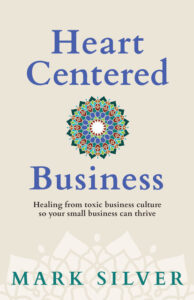
The effects of global business have brought devastation and injustice that no one wants. Instead, we yearn for beauty and real vibrancy in the world around us, and healthy heart-centered business must be part of the healing.
This book is a guide to doing business, your business, in a truly spirit-centered way. We need to, and can, realize the truth that, as Mark says, every act of business can be an act of love.
Rising Tide community members can login and access your free downloads here.
Not a member yet? It's free! When you register for the Rising Tide, you also get email updates, the FREE learning library, and access to episode transcripts, worksheets, and more!
Special thanks to our Patrons for your continued support.
Theme music: “Big Time” by Ikoliks, Artlist.io
Let's talk about something we all know deep down: there's no one-size-fits-all approach to success in business. It's all about finding YOUR way and embracing your unique creative spirit (within legal boundaries, of course!). But hey, let's be real; carving out your own path can be a bit challenging, especially if you're a Fusion creative like me. No matter where you fall on the creative spectrum, if you're feeling a little lost on your journey to success, I've got you covered!
In this episode, I'm sharing five exercises that will bring clarity to your life and business. Trust me; they're game-changers! Tune in now to discover your path to success and get ready to unleash your creative freedom!
In this episode, we are talking about:
Rising Tide community members can login and access your free downloads here.
Not a member yet? It's free! When you register for the Rising Tide, you also get email updates, the FREE learning library, and access to episode transcripts, worksheets, and more!
Special thanks to our Patrons for your continued support.
Theme music: “Big Time” by Ikoliks, Artlist.io
Woo to the hoo! Creative Freedom Season 8 launches next week!... and we are kicking things off with the most frustrating yet important topic I could ever share with you! You don't want to miss it, so stay tuned!
Special thanks to our Patrons for your continued support.
"About Damn Time" is a parody of "About Damn Time", originally recorded by Lizzo. Parody lyrics by Lisa Robbin Young.
At the end of March, I had the honor of speaking at the TEDxBloomington Salon and it was amazing.
Salons are generally smaller scale TED-style events that are locally curated, like any TEDx event. Unlike a larger, full-day event where the talks can range pretty widely, Salons are generally on a more focused topic. Our topic was (sustain)ABILITY.
The theme still lends itself to some pretty wide-ranging topics, including a sonnet on sustainability, the importance of preserving indigenous language for future generations (and the tech to make it accessible to everyone), how kindness and generosity can sustain us, the 3 steps to find healing in business, and more. I look forward to sharing the talks once they're all uploaded, but for now, I can share my talk on How the Marginalization Tax impacts finding Enoughness for micro businesses. You can also access the bonus resources for my TEDx talk here.
My life is a paradox. As a business coach and entrepreneur, I rely on Capitalism to keep food on the table. And I help my clients to do the same. But as a human being, I also rail against what it seems like Capitalism has become: a money-grubbing, soul-crushing free-for-all for the wealthy elite that would rather leave our big blue marble than invest in healing, protecting, and sustaining it.
About 40% of my clients are multiply marginalized, many with a chronic illness, disability, or other capacity-limiting constraints that have essentially forced them to leave traditional employment and go out on their own because it works for how they're built. Forced, because capitalism asks more of us than we can consistently give, and no one feels this quite as much as the marginalized people of the world.
Entrepreneurship then, becomes a way for them to "leverage" the capacity they DO have - but not everyone is equipped to meet the challenges of entrepreneurship.
The incessant invitation to grow for growth's sake is a siren's song that hypnotizes entrepreneurs into the trap of adding one more zero to our revenue… and then another… and then another. But that "MORE" doesn't include room for things like more rest, more play, more ease - unless you hustle your face off first. There's this persistent myth that if you just work hard enough long enough and do your best, you'll make it to that "some day" where you can retire in style.
But Capitalism asks for more than many of us can give. And it has a bad habit of moving the goal posts on us.

With so many companies shooting for the moon - both literally and figuratively, this incessant drive for "More" isn't a sustainable path. How do we find the sustainable path in business? We strive for Enoughness instead.
When we look to nature, a cactus can thrive on very little water and a lot of sun. That is Enoughness for the cactus. If you flood the desert, the cactus rots. If you take away the sun, the cactus starves.
So Enoughness looks different in different situations.
For the folks that I work with, Enoughness is a result of building a business that works for their unique situation.
They are not corporate behemoths. They are parents, artists, travelers, authors, healers, activists, and more. They want a living wage that allows them to retire a spouse or provide for their families, and be able to enjoy the fruits of their labors - even when Capitalism tries to ask more of them than they can give on their own.
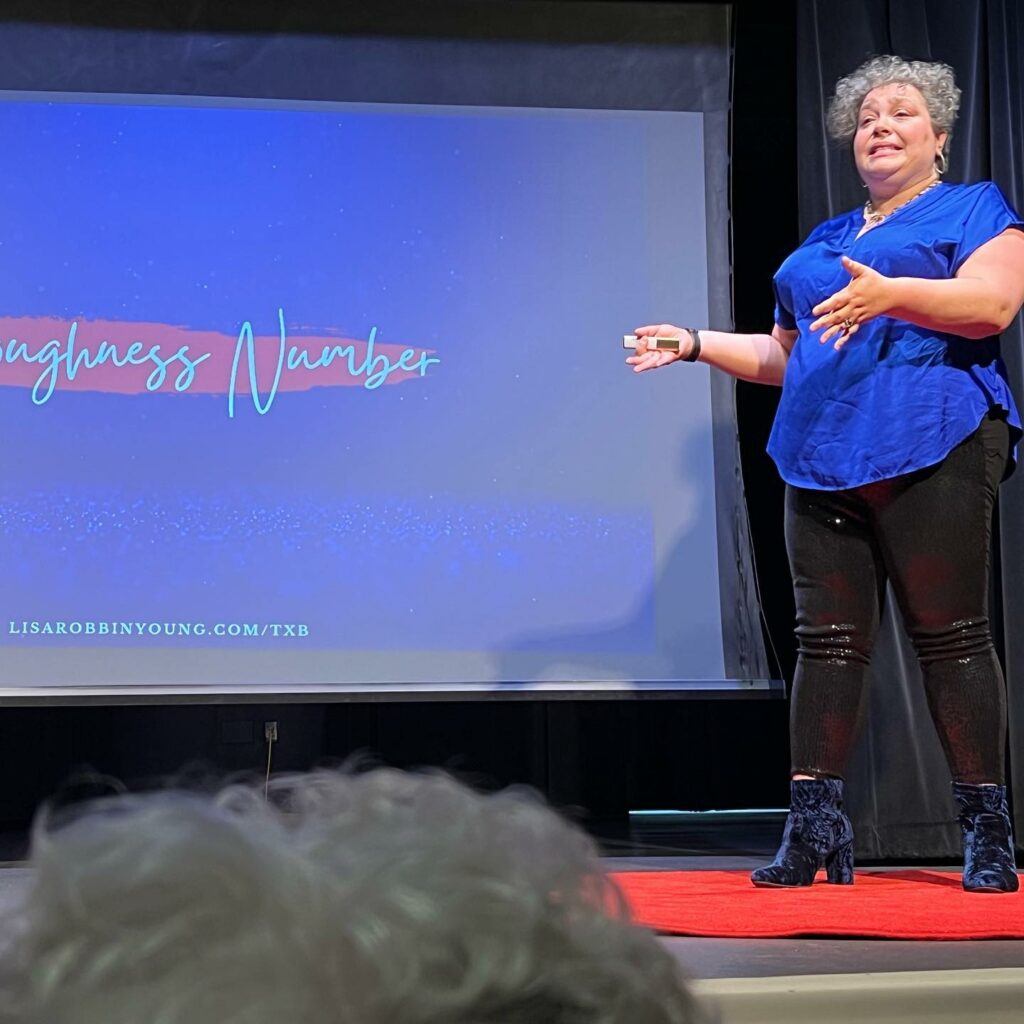
For years, I've taught what I call your Enoughness Number. It's essentially the revenue your business needs to bring in on an annual basis in order to have an experience of Enoughness. Not excessive, but appropriate. Not just subsisting, like so many marginalized folks do, but thriving.
But then one of my non-normative clients pointed out that I had not taken into account the additional resources required to navigate a world that asks more of you than you can give. We dubbed this added cost The Marginalization Tax.
At that time I was still under the spell of meritocracy. Just work harder. Keep working, and eventually you'll get there…. however long THAT is. I had always been able to keep working… until the day I needed back surgery. For eleven days I was unable to walk, stand, or otherwise move my body without substantial pain and significant help.
I was lucky I had help at home and owned my own business. If I'd been in a traditional job, I probably would have been fired or forced to use all my time off. And then where would I be for the rest of the year?
This tax is a spectrum of disadvantage based on a number of things like skin color, religion, gender expression, geography, age, body shape, economic status, social status, and basically any circumstance where there's a power imbalance that puts one group of people at an advantage to the detriment of others.
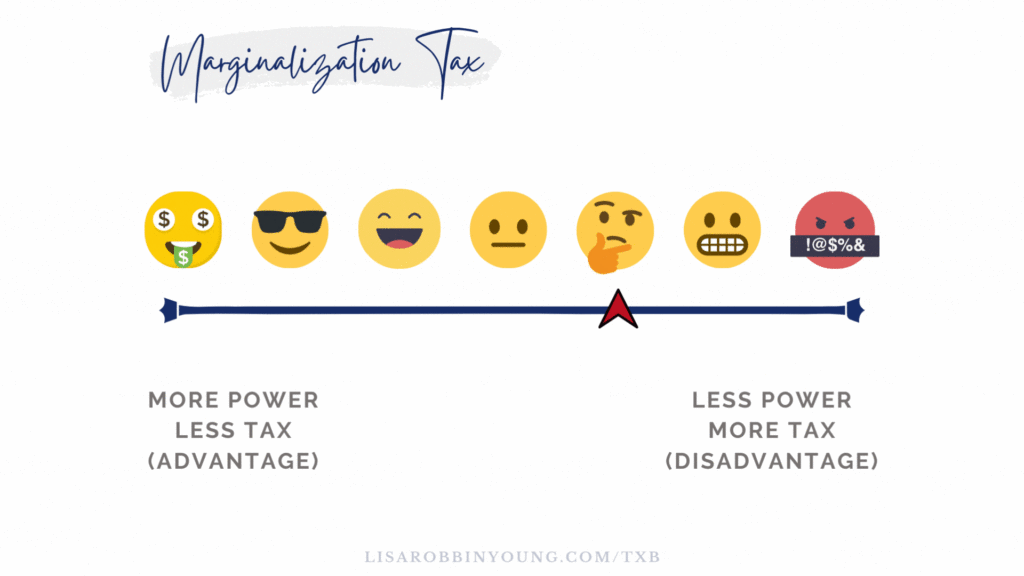
For example (and this isn't exhaustive, but you'll get the idea): I'm a cis, straight, neurodivergent, mixed-race, black woman that presents as white and able-bodied. I'm almost 50 and my body shape is not the socially accepted norm. I have a mix of privilege and disadvantage that impacts the resources I need. The more resources I need, the greater the marginalization tax I pay to participate in this world.
So let's look at what Enoughness looks like both with and without the Marginalization Tax applied so you can see how this works.
First, what are your total living expenses? Let's say $60k
Now add to that your growth. Maybe you've got a nice-to-have or a want that you'd like to see happen in the next year. That's your take-home pay requirement.
If you're a business owner, on top of your take home pay, what are the other "living expenses" of your business?
Then add your business growth to that. Maybe you want to launch a new offer and need to invest in infrastructure or support. Put it in your total.
Now add all that up and add a 10% cushion for unplanned surprises. They happen.
That's already a large number for a small business.
But, now we add the Marginalization Tax.
Based on where you fall on the spectrum, this could be anywhere from zero to as much as 50% of the total. Think that's steep? According to a 2021 report from the national women's law center, black women make a million dollars less over their career than white men. That's 37% less. That is the Marginalization Tax in action.
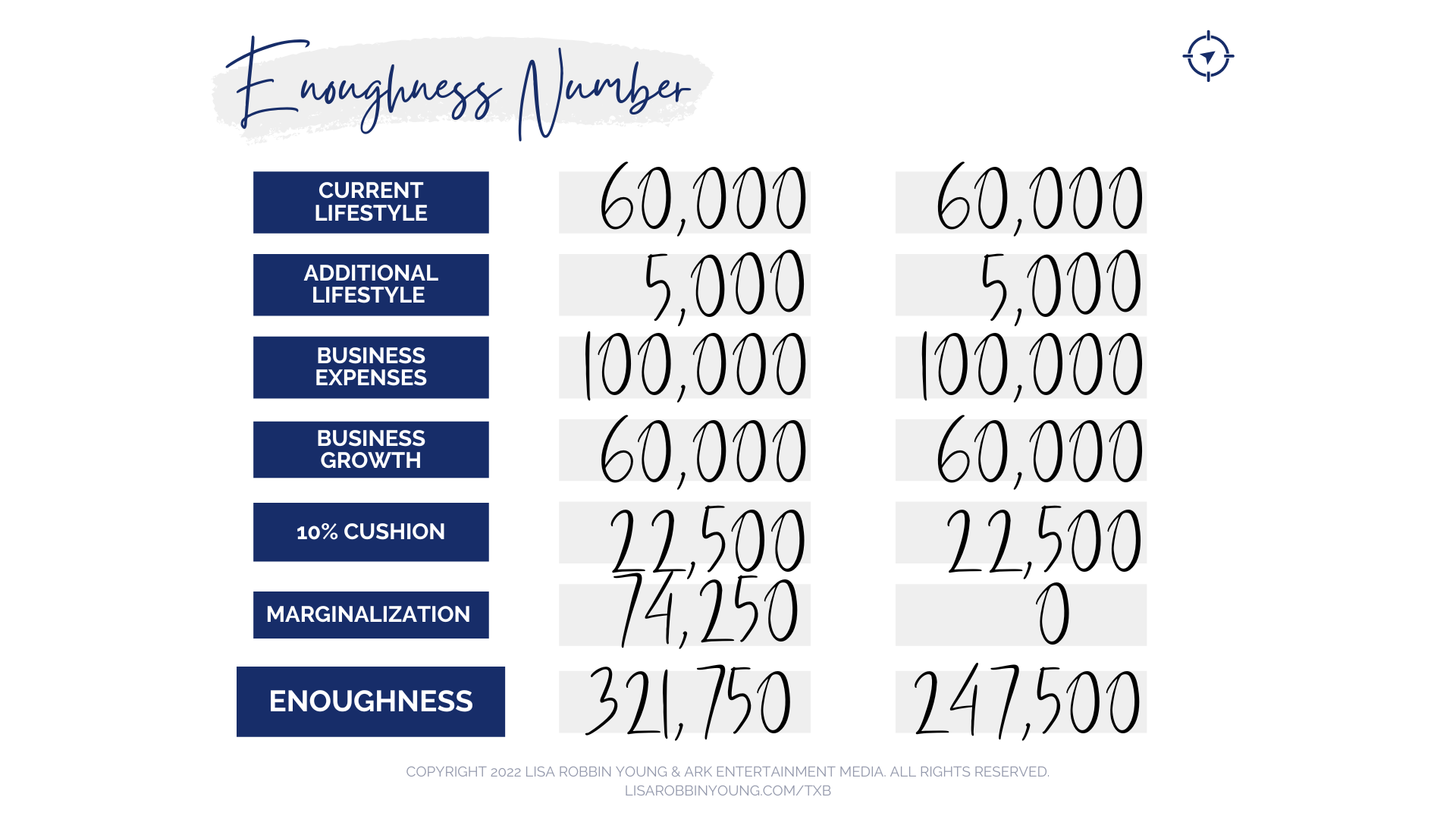
So we total this all up and there it is - one Enoughness Number that's drastically different than it would be if you didn't have to pay this tax.
Unlike the taxes you pay to your government each year, the bill for the Marginalization Tax comes due each day. This weekend my husband bought some cookies for $4. But I can't eat those cookies because some of the ingredients will hurt me. If I wanted to have a comparable amount of cookies that I can eat, I'd have to pay nearly 3 times as much - or I could spend just a few dollars more for all the ingredients and make them myself. Which would take an additional 45 minutes out of my day.
He can just open a package of cookies and go to town! The Marginalization Tax means I pay significantly more either in time or money - resources I may or may not have - just to enjoy a cookie.
Now you might say, "But Lisa, that's a cookie. A treat. You don't NEED a cookie. You can live without a cookie."
Yes, but why should I have to settle for less just because my body is built differently than yours?
But, let's say you're right and look at another case: One of my clients applied for medical disability long before we started working together. She had a profitable business that she'd built around her chronic illness which was so severe and variable that she never knew what her capacity to work would be like from one day to the next. Once she got approved for disability, she shut it all down. She said to me, "I can't jeopardize my disability payments. What if I go off disability and then my business has a down year? I'll have to re-apply and go through all of this all over again - and I might not survive!"
I don't blame her for wanting to protect herself and know that she can survive in a world that makes it hard for her to just exist. I blame the system where the deck is stacked against some of us and not others. That is the impact of the Marginalization Tax.
Everyone should be able to experience enoughness - a fully belly, a warm bed, and the safety of knowing they have what they need to thrive. There's certainly plenty on this planet to make it possible. But the playing field isn't level. What's worse, Capitalism keeps moving the goal posts.
But I believe that the best way to change a system is from the inside. That's why I'm a business owner. That's why I help other business owners - who aren't trying to hustle their face off to be a squijillionaire. They just want to find the balance that allows them to be paid well, within their capacity constraints, and have the time and energy to enjoy the fruits of their labors.
We don't need more rockets into space. We need more business owners striving for Enoughness for everyone.
When we have Enoughness it's… well, it's enough.
Like I said, it's a paradox.
For years, I've held connection calls where I hop on zoom for 20-30 minutes to get to know a new networking connection. Invariably, a business question pops up and most of the time I can spot a solution to their issue before the end of the call.
In many of these cases, I was able to help them see a way to open up a new income stream, refine a system or process, or just make their business easier in a matter of minutes. Not long ago, I was talking with a guy and by the end of the call we'd mapped out a new approach to one of his existing offers.
That new approach landed him a $15,000 deal later that same day.
I know that might sound a bit unbelievable, but I have receipts. This was both a blessing and a curse for me. A blessing, because I've been able to help hundreds of people over the years. A curse because, for years, I didn't really know how I was doing it.
So, I finally sat down and spent time examining how my brain works... the questions I was asking in order to get those kinds of results for total strangers.
That's how the Creative Freedom Business Model Equation was born! Once I had it worked out, I tested it with a few of my clients before rolling it out in last year's CashFlow Creator Workshop.
I'm excited to announce that we've re-opened the doors to this popular workshop and I'll be hosting it again this month!
The Cashflow Creator Workshop is designed for entrepreneurs and business owners who want to create a business that reflects their personality, voice, and style and connects with more of their ideal clients and customers with greater ease. More money, more time to enjoy it. A business that works for how you're wired to work.
Whether you're just starting out or looking to rebrand and redesign your business, this workshop will provide you with the guidance and support you need to succeed. By the end of the workshop series, you'll have a personalized roadmap for building or refining your business, based on your unique lifestyle and goals.
This 5-day workshop series, running from April 17-21, will provide you with the tools and guidance you need to design a business model that works for how you're wired to work. Each day, we'll focus on one part of the Creative Freedom Business Model Equation. By the end of the workshop, you'll have a comprehensive understanding of what is and isn't working in your business and how to fix it.
Day one of the workshop will focus on the first part of the Equation: You. We'll dive deep into what really matters for you, including your values, personal context, and the mission/vision for your business. We'll look at how those things play together and what your non-negotiables are to actually feel successful. At the end of the day, you'll be able to communicate clearly the strengths that you bring to the table through your company, and what's most important for you - both personally and professionally - so that you can have a business that supports you to have more of what you want and less of what you don't!
On Day 2, we'll dive deep into the "why" of your business. Not YOUR personal "why" - although that's important, too. Instead, we'll explore why you're in this line of work, what motivates and inspires you, and what makes you uniquely qualified to do what you do. We'll also examine the core purpose of your business, the change you want to see in the world, and the impact you want to have on your customers or clients. By the end of the day, you'll have a clear understanding of the driving force behind your business, which will help you create a brand message that resonates with your ideal audience and sets you apart from the competition.
On Day 3, we'll dive into the "who" of your business model equation. We'll take a deep dive into your ideal clients from a different angle - those who already resonate with your "you" and "why" elements. Instead of trying to conjure up some niche market out of thin air, we want to connect more deeply with people who already resonate with who you are and why you do what you do. We'll explore who your ideal customers are, where they hang out, what they want and need, and how your business can best serve them. By the end of the day, you'll have a clear picture of who your business is for, and how to speak directly to their needs and desires.
On day four, we'll dive into the "what" element of your business model. We'll explore the transformation your offer provides for your clients or customers and identify any gaps or areas for improvement in your current offers. This day is all about fine-tuning your offers so they are aligned with your unique value proposition and the needs of your ideal clients or customers.
Day five will be dedicated to the "how" of your business model. You can deliver the same "what" in different ways - different "how's". A book, a course, and a video, for example are different ways to delivery the same "what". We'll examine the delivery and pricing of your offers, as well as your marketing strategy. By the end of this day, you'll have a solid understanding of how to package and promote your offers in a way that resonates with your ideal clients or customers, and generates the cash flow you need to sustain and grow your business.
This is one of my favorite testimonials from our workshop last year:

"This workshop is POWERFUL! And Lisa Robbin Young is a MASTER at the concepts and practices she teaches - not to mention a great coach. I got a level of clarity of purpose and strategy for going forward that had been missing for me. And it's a strategy that EXCITES me and had me saying 'YES! That's ME! I can do that!' Thanks Lisa!"
Teresa Romain - Founder of Access Abundance
Other attendees said they also experienced:
So if you're serious about having a business that works for how you're wider to work, get your buns over to my info page and register for the CashFlow Creator Workshop series and take the first step towards a fulfilling and sustainable business.
I'm capping registration at 20 people. If financial accessibility is an issue for you, please reach out. Partial scholarships or grants may be available.