Over the past decade or so, the world has gone through a revolution in terms of internet marketing and social media. Nowadays, any business needs social media markets as a primary tenant of its overall marketing strategy. The fact is, social media gives businesses unprecedented access to customer data that was previously unheard of. It allows you to generate insights that can further boost your marketing strategy and develop a better understanding of your key customers. The fact is, by knowing your customer, you can connect with them and show how you add value to their lives. Let’s take a look at how social media can boost your business.

Humanizes your Brand
One of the great things about social media is that it is social. By having an account, customers can engage with you and have real conversations and debates, which gives you the chance to show your human side, build trust and loyalty. Before social media, contact with organizations was limited, but now that has completely changed. Anyone from anywhere can ask you a question or make comments, both good and bad. However, every comment, no matter what the content, is an opportunity for you to show your human side. The best course of action is to comment quickly and appropriately, try not to ignore a bad comment. Use this as an opportunity to showcase your humanity, boost your brand, and your caring side. If anything is particulate personal or related to an individual case, offer to continue the conversation in private.
Alignment with Core Values
Posting on special media goes you a chance to tell the world something about your brand personality and its core values. Your branding, in essence, can act as a foundation for all your marketing material, and there is no better place to show the world what our organization is about than by using social media. Posting gives you a chance to stay in contact with your audience and communicate regularly something of importance. Generally speaking, the best posts are ones that connect with your target audience in a specific way, be it emotive, thought-provoking, designed for engagement. As long as each post’s key message has a background within the core values of the brand itself, it will come across as authentic, and this again helps you build trust and loyalty.
Insights
Social media is a great way to garner insights into your customer and the success of any given post. The engagement you get is valuable as all this can add to your understanding of your key customer. You can create polls if you want to learn about attitudes to certain things too. Moreover, by developing KPIs (key performance indicators) and using technology such as ai corporate solutions, you can better understand the success of certain posts, which will help you create better and more targeting marketing material going forward. Before you post on social media, you can set the right KPIs to monitor its success and see if it achieved what you wanted it to.
Conclusion
Social media is becoming more essential for a business's overall marketing strategy. Without social media, a company will fall behind its competitors and will be unable to connect with its key customers in any meaningful way.
The goal of any business is to make money. The more money your company makes, the more opportunity you have for success in the future. Many people view this concept as a motivator to work hard to increase profits. However, they are often unclear what measures are necessary. This article will offer three practical ways to maximize your profit margins.

Before you can establish high-profit margins, you must take steps to maximize the amount of money you are capable of making. Many businesses mistake selling their goods or services at a low price to generate more profits. They lose money in the long run because their clients will always want their services or products at lower costs.
The solution focuses on the price you plan to charge before making your product or service. That way, you can create a budget that works well for you.
Another common mistake many businesses make is underestimating how much money they will need to run their operation. Many small companies make the mistake of starting their project with only a tiny amount of capital at their disposal.
The result of this practice is higher overhead costs than they had anticipated. They end up spending more money than they are earning, and as a result, their profit margins remain low. Some companies pay more than necessary because they do not know how much capital they need to get their business off the ground.
To avoid this issue, you need to create an accurate budget that accounts for all business expenses before you begin making sales. By doing so, you will produce a profit that exceeds your expectations.
Implementing new equipment and machinery can be essential to increasing the profit margin in your business. If you have been running a small business for some time, it might be time to upgrade your current equipment and get a raise in operational efficiency. There is no reason you cannot start selling more of your products than you are currently doing.
In addition, purchasing new tools is essential for many industries. For example, creating a building that requires shelving for inventory requires more than just making the structure itself. You will also need racks, wire cages, and other supplies that make the process more efficient.
On the other hand, buying new equipment can be a costly decision. Be sure to do as much research as possible to ensure you are getting good value for your money. Compare prices from different suppliers to find the best bargain. You can also search online for new suppliers of equipment. Once you have found a company that offers quality products at reasonable prices, purchase what you need and pay them when the invoice arrives. If you need professional advice, view this page of this site to access some of the best real estate agents.
These steps can help you establish high-profit margins in your business. Be sure to consider each of them before making a product or service for sale. Doing so can help you increase profits and grow your noble empire. The goal of any business is to make money. The more money your company makes, the more opportunity you have for success in the future.
However, you need to develop a solid plan and implement it as soon as possible. Take the time to consider these tried-and-true tips that will help your business grow faster and produce higher profits with less investment.
[10 years ago, I blogged regularly at businessactionhero.com. While I still own that domain, it's redirected here for years. That means many of the posts I had there haven't seen the light of day in a decade. I'm bringing back some of these posts with new thoughts since I'm 10 years older (and hopefully wiser) than I was back in the day.]
This post talks about the importance of being in integrity in your business - and how I had fallen OUT of it. I also mention a concept I learned from internet marketing "guru", Yanik Silver: providing 10-100x ROI for your clients.
In the 10 years since I shot this video, I've learned that 10-100x ROI is not always doable or sustainable, depending on your industry. I think there are times when it still is important and makes the difference, but I also now have the wisdom to recognize how foolish it is to expect that everything you offer is going to provide that kind of "EPIC VALUE". The three factors that drive pricing (market, price for the market, content for the market) are still relevant, but margins vary from market to market.
It's also subjective. I may think that it's delivering that kind of value, while you may not. What's the more important consideration? In the eyes of the buyer, it's what THEY believe that matters.
The original post intro and transcript of the video are below. Where are you rooting your tree?
So, I was reading Laurie Beth Jones’ book, “Jesus, Life Coach” yesterday. After our conversation this week about pricing, gurus and the “one step ahead” concept, I wanted to autopsy a major lesson in my own business this year regarding pricing.
Hey, it's Lisa Robbin Young here and I'm dressed like an Eskimo on winter holiday or summer holiday I guess. My son has been sniffling and sneezing for the last few days and I was walking him home from school yesterday and I got a little going on, so this is my healing ritual. Basically, I wrap myself up as warm as I possibly can stand…and then get just a little bit more warm. Down a lot of orange juice and hot tea and try and fight off – or no that's the wrong word, because we want to stay positive. It's my healing ritual to expel the thing that's trying to live inside me right now, so that my body can, in return, reject the virus…or whatever.
The reason I'm talking about healing rituals, and healing in general today, along with pricing is because yesterday I was reading Lori Beth Jones's book, "Jesus Life Coach", and in the section on productivity, she opens the chapter by talking about a passage from Ezekiel 4712. And she paints the picture through the scripture of this tree growing by the river, and it produces
fruit, and you know, it's the water from the river that comes from the sanctuary. And she makes the point that from a productivity standpoint the tree doesn't attempt to accomplish bearing fruit, it just does what its naturally inborn design is built for.
She's making the point that we need to stop fretting about accomplishing, and focus on what it is that we were designed to do. And just do that thing. But as I read it, I created a completely different image in my mind.
I think of the tree as your business, and your business bears fruit every month. And your business has products and services that nourish and heal. Okay those are the leaves in the fruit of the tree that nourish and heal, and the tree is routed by this river of healing water that flows from the sanctuary well. From a micro entrepreneur's perspective, the water, the healing water, is that which nourishes you, the business owner. And it comes from that sacred spiritual place inside you. Whether that's your core values, or your belief in God, or or whatever spiritual aligning construct works for you. And so as I read that I was like…that's what I want! That's what I've wanted all along! I want to build a business that nourishes and heals consistently.
And when we think about trees, you know the leaves drop, then you know it's cold, and then you know the leaves come back out, and then there's flowers, and then there's fruit and then the cycle starts again. Well, this passage says it's bearing fruit every month which means it's never dormant - it's constantly producing healing nourishing goodness for those who would, you know, pick fruit off the tree or use the leaves.
So when I thought about that and I looked at how my own business has been in the last year, I recognized that there were some things that I wasn't doing properly. So I'm going to autopsy it for you right here in this video and talk about shifting into a business more focused on healing, but also pricing my products, because one of the things that you're going to see over the next few months is a complete overhaul of the way I have priced just about everything on all of my websites.
And the reason for that stems from something that I read a couple of years ago. I think it was the way that Yannick Silver talks about the 10 to 100 x value proposition. The idea being when you create a product or service, when you put something out into the world, you want your people to feel like they are getting 10 to 100 times the value back to them for the investment that they're making in whatever it is that you're offering. And this year I did not do that.
You know, I could say it was because I listened to too many other voices, I could say it's because I got lured by the idea of higher paying clients, all of that would be true. But what it really comes down to is I uprooted my tree from the stream and moved down into the desert – or someplace else – the big city, you know, whatever. Someplace other than by the nurturing healing water that keeps me completely in alignment and in integrity with who I am. And what ended up happening was I was pricing products higher than that 100 x value. Sometimes it was closer to 10, sometimes it was closer to five, you know, I always strongly believe that I'm providing more value than I'm, you know, asking for in return. But there's a difference between two to three times the value of your investment and 10 to 100 times the value of your investment.
I think it, you know, it really speaks volumes when you can be the kind of entrepreneur who can stand proudly in their space. The entrepreneur who says “I am very confident that you are going to get 10 to 100 times the value out of this program as what you put into it”, and that's where I want to be. So that's what I'm doing.
There was a time in my business where I wouldn't have just done an across-the-board price change like this, like you're going to see over the next few months. I would have modified the program or taken some stuff out. I'm not a person who does sales because I believe that sales train your people to wait for a discount. I think that sales water down the value of the product that you're providing. I think maybe in the five years, six years that I've been online I have maybe done three sales, maybe, and generally it comes along with an “I'm going to give you this thing on sale but you won't get this thing that, you know, normally goes with it” kind of a thing. Because I didn't want to train people to expect that they were going to get, you know, this great bargain from me every other month or whatever because that's going to crimp cash flow.
Okay so there was a time when I wouldn't have just gone, you know, across the board “we're gonna change all over pricing” but what I'm doing I'm taking a lot of time over the next, you know, two months, the holidays and whatnot, to really sit with all of my products and services and if I don't believe that I can deliver ten to a hundred times the value of what they're asking to put in them, I'm taking them out.
I'm taking them off the shelves and they won't be available anymore. I believe there are three factors that drive pricing: 1. You have to have the right market; 2. You got to have the right price for that market and 3. You have to have content that that market wants.
If your product doesn't sell one of those three things, it has a problem and you gotta fix it. You have to find a new market, change a price, or change the content so that they see the value. We will launch Business Action Hero earlier this year and Phil is about 300-400 people. Most of those came from a teleclass that I did expressly on membership site programs, so I know these people wanted information about building their own membership sites. When we presented the product I had zero takers which is very uncommon for me when I'm clear on the market. I knew I had the right market because 400 people signed up for this program and I knew I had good content because the content mirrored what they were learning in the teleclass show.
That really meant that the only thing left was the price. I didn't have enough people in that audience that knew me, liked me, and trusted me enough and what I was providing that had a need for that information, to put down five hundred dollars to be in that program.
I don't really want to change the content of the course, so I'm gonna adjust the pricing and you're going to see that in a lot of my programs. In fact, I'm starting today with income acceleration strategies, and if you're on the newsletter list you saw that I've already repriced it. It's already on the website. You can already see what I've done there. It's me coming back in alignment and moving my tree back to the river so that I can continue to be nourished by what I know is right, instead of listening to the voices in the wilderness telling me, you know, throw yourself down from the mountaintop or whatever and and go chase after this bright shiny dream.
At the same time, I don't want anybody to think that this is my last-ditch, desperation attempt to get sales by slashing the prices on everything, because if I truly don't believe that I'm going to be able to bring ten to a hundred percent value on a program, it's gone.
I want to stand confidently in that space and know beyond a shadow of a doubt that if you put your nose to the grindstone and do what I'm asking you to do in my courses and in my programs, you're going to get the results that I expect you'll get at 10 to 100 times the value of what you're putting into the program.
I want to stand there and I want to be proud of that and I want to be confident of that, and it means that there are going to be times when I am going to have higher price programs because I know they're going to produce infinitely better results. I guess the thing that I want to come back to on this a certainty there are a lot of people out there that will talk about different ways to price your products, you know, one of the best I think is Mark Silver over at Heart of Business, who talks about resident pricing and how to find a price that resonates well for you and still provides value to your customers and, you know, brings that message home on both sides of the equation.
But there are people who will say, you know, whatever price you're getting now, you're paid what you're worth, and you know, you need to price it higher to command a higher paying audience. There are a lot of voices out in the wilderness, you want to find that price that resonates within you that's not self sabotaging, self-serving, you don't have to make minimum wage to serve and heal the world, okay? The tree won't survive if it's, you know, taking a sip every six months. It's got to be rooted in the healing water and you don't have to charge ten million dollars and have one client here to make good money. Balance your experience level with the pricing that you're setting. Can you confidently walk into a room and command five hundred dollars an hour if you've never done this thing before? I don't think so. I don't think that's in integrity with anybody. I think that's someone telling you you should charge five hundred dollars, so you walk in and do it and then you're feeling all of this anxiety about “oh my gosh I gotta deliver, oh my gosh, oh my gosh, oh my gosh”.
Well you know what? I had an amazing client who asked me to do something I had never done before and quote him a price on something I had never done before and I said to him, “look, I would really like this job, I would really like to do this with you, but I have no experience in this particular area and I am going to adjust my pricing for this project to reflect my lack of experience here and if that's not good enough for you, godspeed, go find somebody who's got what you need. But I'm willing to learn about this pocket over here that I have no experience on if you're willing to, you know, ride with me on this”. And he bought into it and he's like, “Great! Let's do it!”
I didn't blow in there going sure I know everything there is to know about this thing and it's going to cost you ten grand to work with me on this thing and then try and scramble behind the scenes to try and figure out this piece. That stuff comes out, people find out that you don't know what you're doing, one way or another they find out so why not be transparent and adjust your pricing to reflect what you don't know because you'll build more trust and over time those people will look at you and go “Wow she really didn't know anything about that when we first started but look at her now and if she can handle that was something she didn't know oh my gosh i am totally trusting her with the stuff that I do know that she knows let's do this thing”. And that's where I want to stand.
I think that that's where a lot of people want to stand is in that value space that says I know my stuff, I know I'm worth my stuff, and so I'm going to ask for this kind of investment. But my commitment to you is I'm going to deliver this kind of value.
Don't let the voices out in the wilderness call you away from the river. Stay rooted at that spot where you know you are completely in your value and you are completely doing the thing that you need to do to build a profitable life and business
[10 years ago, I blogged regularly at businessactionhero.com. While I still own that domain, it's redirected here for years. That means many of the posts I had there haven't seen the light of day in a decade. I'm bringing back some of these posts with new thoughts since I'm 10 years older (and hopefully wiser) than I was back in the day.]
This post talks about the problem with following leaders who are only one step ahead of you. It was a problem then and it's still a problem in the online world, only exacerbated by the fact that there are now many more so-called leaders in the online space.
Add to that the number of people that bang the drum "done is better than perfect!" and you have a recipe for the problems I see every day with folks applying to the Creative Freedom Incubator - they trusted some guru enough to follow them down a rabbit hole that turned out to be a waste of their resources (time, money, effort, attention, etc.).
Like my friend and former client Les McKeown points out in the original post, there's a time and a place for peer-led or one-step-ahead coaching, but it needs to be framed as such, and you need to be willing to accept the consequences. Most of the time, though, it's not, and you THINK you're getting years of leadership and experience, only to find out, they're barely any further along on the success path than you and really can't help you get the results you need. What did you get yourself into?!
An edited version of the original blog post is below. Vetting your leaders is both harder and easier now. Listen to people you trust. Don't rely on "success by association" to see you through. - Lisa
Imagine an incredible labyrinth, something along the lines of the hedge maze from Harry Potter and The Goblet of Fire.
You’ve started into this maze, and there are dozens, hundreds, perhaps thousands behind you. Following your lead.
You’re doing pretty well, until you get about half way into this thing… and you realize…
You feel like you’ve got to know the answer because people are counting on you. And then someone else in your cadre shouts from the middle of the pack…
“Hey! I think I see something to the left! Maybe we should go left?”
Your confidence is shaking. Your followers can sense it. Half of them decide to follow the left turn leader, while the rest remain loyal to you.
You decide to press on – and find yourself a little further along in the maze – and facing a dead end.
Now what? All those people that were following you have followed right behind you. You’re cornered.
If you’re lucky, those folks will be compassionate, forgiving, and let you pass, so that you can “lead” them again.
Some of them will grumble and complain, walking back past all those folks -that were 20 or 30 steps behind you – who are still so grateful to have a leader pointing the way, that they won’t realize you hit a dead end and are backtracking. Besides, new people are coming into the maze all the time that may never hear about your missteps, right?
This is a common mantra of today’s “gurus” – particularly those in the internet marketing world.
“I’ll show you how to make a six or seven figure business – you only need to be one step ahead of your target market.”
“You don’t need to know everything. You just need to be one or two steps ahead of your audience.”
“As long as you can stay a step ahead of your clients, they’ll continue to look to you for guidance.”
You’re leading these entrepreneurs down a dangerous path – encouraging them that they only need to be “one step ahead” of their clients. What happens when you find yourself at a dead end?
I confess that for years, I was a subscriber to this “one step ahead” notion. I looked to people a step or two ahead of me on the “success trail” and thought they must have their poop in a tighter group than I did. Then, I found myself “behind the veil” – working on projects for these folks, and seeing the reality of their businesses. I also interview a lot of people, and I’ve heard horror stories that would make your head spin. One industry leader told me that her guru friend complained to her that she was keeping the guru on their toes, forcing them to create better content for their top-tier coaching group.
Here’s the problem: At no point along the line did anyone in “the lineage” stop to ask a valuable and important question:
“Does this stuff really work?”
I fell victim to this myself, so I speak from experience. I got guidance from a leader and never questioned if it actually worked. It was one of the more expensive lessons of my career. I was also mortified to learn I was not the only person who was led down this dead end path. It was, in fact, the same advice my leader had gotten from their leader.
YEOUCH!
We trust our leaders to keep us on a profitable path, that their time-tested knowledge actually works. Why would they recommend that we do something that wouldn’t produce results?
Because some coaches and mentors regurgitate the same trickle-down pablum that their gurus have fed them, without questioning the results.
And then, just like the economic theory, something breaks down in the system. It stops working. And the “house of cards” starts to topple.
The intention behind being “one step ahead” is a good one – to encourage you to get moving, to stop waiting until everything is perfect before you get going.
But let’s be clear. One step ahead is a slippery slope to business failure.
What if you slip? What if you “lead” your people down a dead end road? You have no opportunity to recover safely, secure your footing, and keep moving forward.
Chances are good, you’ll lose their respect, their trust, and their business – probably forever.
What if one of your own is more ambitious, more clever, or just plain smarter than you? What if they have a faster pace than you?
Yes, it’s true you’ll probably lose them as a client, but as I’ve witnessed at least two times in each of the past 4 years, those people not only surpass you, they strip you of the very clients that were travelling with you (much like that voice from the middle of the maze pack).
I have a friend who likes to remind me that as I’m standing here, pointing ahead to where I want to be, there are people behind me, pointing to where I already am standing. On one hand, it makes for great potential to lead and make big bucks. It also comes with a responsibility: to think things through before you try to pass along your “once off success” as a roadmap to riches.
Think of it this way: would you rather follow someone inside the maze who’s only one or two steps ahead of you, or someone that’s already made it through the maze and knows the traps, corners, and has, essentially, debugged the system?
Yeah, me too.
When I launched Home Party Solution, it was only after months of trial and error in my own business. I was my own guinea pig. I developed a process that works, shared it with my own team first, shared it with friends, then launched the website and the book. The system had a lot of testing behind it before I ever charge people a dime for it. I even joined multiple companies to test my theories in other product lines. I don’t believe in being irresponsible with other people’s dreams.
Les McKeown launched (and helped launch) scores of businesses, and continued testing and tweaking his Predictable Success model before he unleashed it on the world.
And let’s not forget the countless hours Michael Jordan spent honing his craft to make the NBA – after he was cut from teams in his school days.
Yes, when you hit a dead end, you can regroup, you can stage a comeback, you can be bigger, and better than before. But if you’re taking people with you on that journey, you’ve got to be careful what you’re promising along the way.
People are counting on you to lead them. You must do so with care. You have earned their trust. Violating it is a one-way ticket to the end of the line.
Has this been your experience, too, or am I up in the night?
I posed this question on twitter and had some brilliant peers play along with some great thoughts:
“Working on a blog post about the problem with the ‘one step ahead’ concept so many gurus are touting today. What’s your take on it? I’m talking about the idea that all you need to do is ‘be one step ahead of your clients’ in order to help them.”
The first major takeaway was a concept brought up by my smarty pants friend, Ted. He mentioned that someone can still be headed down a dead end road if they’re 5 or 6 steps ahead of us.
While it gives them time to recover, what about us? Is there a way to get started on your journey to building a successful business if you’re not already an expert, or is that a myth?
It’s The Emperor’s New Business Model: say you’re a master because you’re a step or two ahead in the maze, and hope you can keep yourself a step or two ahead until you cash flow, or really master something.
But then Les McKeown offered up an idea equally as brilliant (did I expect any less?):
And it would seem there’s the rub. Even Les admitted that coaches today are up against a wall to earn income, which causes at least a small (if not egregious) amount of puffery. Pricing is also relative to the quality of your product, your comfort level and what the market is willing to pay.
How refreshing. To admit that you’re on a journey, just like they are. There’s nothing wrong with experimenting, learning (and earning) as you go – so long as we’re all being honest and not drinking our own Kool-aid.
To “label a program as such” means admitting you aren’t a guru, that you don’t know everything, and that you may not be able to promise success (and you should charge accordingly).
Another very solid solution offered: develop proficiency as a side gig, not your primary source of income, and as your skill set increases, then you can charge more.
Seems entirely logical to me.
What are your thoughts on this concept? Have you felt a bit singed by a “one-step guru” in your life? What were your lessons? How did you/they handle it? How do you think expertise should be evaluated/priced? I know this could open a huge can of worms, but I’d love to dig deeper into this discussion and not be the only voice in the wind!
While things are getting better, there are still some careers and industries that are dominated by men, and it can be hard to fit into these as a woman. Whether you’re starting your own business in an industry like construction, finance, or trucking, or working at a company with mostly men, it can be tough, and people aren’t always welcoming. In a lot of industries, there is still a strong bias towards men and the male way of doing things.

Developing a few traits and habits can be very helpful to make your way in the working world as a woman in a male-dominated industry.
Learn to be assertive at work. It can be hard to make yourself heard as a woman in a male-dominated industry, even when you own the business! To do it, you need to learn not to let other people speak over you or interrupt you. That doesn’t mean that you need to be rude or interrupt yourself, but it does sometimes mean insisting on having your say. It can help to build your own knowledge, so you have confidence in what you’re saying. This might mean taking a training course, spending time on the building site yourself to understand the different jobs, deciding to purchase International Truck service manuals to get familiar with the proper operation and maintenance for your logistics company vehicles, or finding a mentor in your industry.
Nothing can generate goodwill or build morale as successfully among employees as a positive attitude. Think about your past victories, not your defeats, and focus on the milestones that you are set to achieve in the future.
Keep on top of the news in your industry every day. Take advantage of things like relevant seminars and continuing education classes that you can. Stay on your toes and make sure you stay informed. Staying informed will make you more confident and make sure you are a valuable resource to your staff.
If you find yourself always saying sorry at work, try to get rid of it from your vocabulary. You don’t have to be a pleaser in your career. A lot of people find that always saying sorry, especially when you’re not actually at fault, can undermine your ability to communicate with others. Some people think it’s better not to say it at all. If you’re always trying to please others, you’re more likely to be walked over than appreciated. You want people to respect you. Being liked is just a bonus.
This can be a tough line to walk as a boss. Many entrepreneurs struggle to give responsibility to others and often worry more about whether the team they have built up for their business likes them than whether or not they’re a good leader. Try to remember that as a company owner, your job is not to be a friend to your employees. You’re in charge, and they need to trust and respect you. If they like you as well, great, but if they don’t, it’s doesn’t really matter.
This doesn’t mean you need to be combative or always looking to avoid conflict. When a conflict does arise, try to be positive and look forward. How can you move past the conflict? Never attack someone personally, and don’t allow anyone to attack you either. Stay focused on the issue at hand. Be careful not to talk to your staff or send emails when you’re angry, or read emotion or tone into emails where there isn’t any. Let go of any grudges you’ve been carrying around.
There are lots of fantastic opportunities out there to meet other women in your industry. Take advantage of these opportunities to build camaraderie, find mentors, and network with other women in your industry. You can go to more general events, or join specific associations for your industry, such as the Association For Women In Science. Look for these options and take advantage of them. It can be helpful to know people who understand your struggles, can provide advice, and be useful links for you as your business moves forward.
Be ethical. This one might sound obvious, as we’ve all been taught some variation of this rule as children, whether it’s by putting out good vibes into the world or generating good karma, but it’s not uncommon for this rule to be ignored or forgotten. It’s discouraging to learn that women often tend to be harder on other women leaders in their industry than they are on male leaders, perhaps due to a sense of competition. Many women say they prefer a male boss. Remember, it’s not weak to be kind or agreeable. Women who treat others fairly will be happier and more productive employees or leaders.
It takes a certain amount of confidence and communication to be able to speak to investors, shareholders, and other leaders in your industry. It might help your confidence to have relevant qualifications, but it is a great time to be a women entrepreneur. Top companies are still largely owned by men, but more and more women are becoming business owners. Remember why you decided to start a business in the first place, and remember that you already have the tools to succeed.
The last few generations have been able to bring more women into the workforce and into leadership roles across many industries. We’ve come a long way, but there is still a long way to go.
Working to bring other women into leadership positions in your business is an important way to make the changes that we need to open up opportunities for others. Its also true that most critical change starts with shaping ourselves, the area where we have the most control. Cultivating the characteristics in this article should help you.
Whatever kind of business you are running, one of the main things you are always going to need to know how to do is how to bring the customer back for more in the future. As long as you are doing this, it means that you can expect the business to grow and grow, as it will always be popular in some way or another. The truth is that it is not all that hard to achieve this, but you will often need to think of some creative ways to make it more likely.
In this post, that is exactly what we are going to take a look at. As long as you are happy to take on board some of the following ideas, you should find that your customers are more likely to return again and again, thus ensuring the steady and healthy growth of your company.
In a word, what you need to do whenever possible is to deliver more than the customer expected in the first place. One sneaky way that you can do that is by actually under-promising to begin with, so that whatever you do from there on is going to look amazing. This is a slightly cheeky approach, but it’s one that is going to really make a huge difference to how the customer feels about you and your business, so it’s worth focusing on as best as you can. When you over-deliver on a regular basis, that has a way of ensuring that customers are much more likely to return to you in the future.
The more options that you are providing throughout the whole service experience, the better. People like to feel as though they have a lot of freedom when they are using your services, no matter whether it is in person or online, or whatever else. As long as you are providing plenty of options for your customers you are going to find that they have this natural tendency to return again in the near future.

One example of where this matters in particular is with the payment process. You need to make sure that you are providing the full range of payment options for your customers. That includes many kinds of payment processing machines such as card readers and contactless machines, as well as ensuring that you take cash, because some people prefer to pay that way. The more options you are providing like this, the better.
In terms of your outreach and marketing, it’s important to make sure that you are doing all you can to stay in touch with people. The more actively you do this, the better, as it is going to ensure that they don’t have much of a chance to forget you. Of course, that is something that can be particularly hard to do right, but at least these days it is easier than ever to do, thanks to the internet. Just make sure that you are doing it in the right way and the right amount - not spamming them, and not leaving it so long that they forget about your company altogether.
The reputation that your business holds in the world is a really important factor in all this too. As long as you are keeping the reputation going strong, it means that people are much more likely to return. There is a kind of shame that can creep in for people if they find out they have been using a company that is not that popular, and you need to avoid this at all costs by ensuring that your reputation is as strong as possible at all times. That is a simple matter of improving your branding and marketing, but also making sure that you are doing right by people and the planet. That has never been more important than it is right now.

Finally, remember that people are almost always going to respond well to you offering return deals, so this is one way to make sure that you are getting them back as often as possible. Those deals can really be whatever you like, as long as you are doing all you can to make them as enticing as possible. You’ll be amazed at how much of a difference this can make, and how many people come back again and again for this very reason. Be sure there are always deals in place to bring people back.

Outsourcing has become an increasingly popular part of running a business. There’s a wealth of reasons for this, ranging from optimizing your company to reducing its overall costs. That’s only if you properly take advantage of it, however.
Part of this involves making sure that you choose the right freelancer or company to outsource to. Coupled with that is what areas you outsource. Some will be much more cost-effective than others.
That could make them much more attractive if you want to reduce your business’ costs. You’ll need to focus on a few in particular when you’re doing so.
Perhaps the most complicated aspect of running a company is taking care of the finances. Few people are as skilled as they’d want to be to oversee their business’s accounting. Thankfully, this has been perhaps the most popular area for companies to outsource for quite some time.
Countless firms across the country focus on this, with many specializing in working with small businesses. That’ll simplify the process much more than you’d think. While you’ll still have to put a certain amount of work in on your end, it’ll be much less than you otherwise would have.
When tax season comes around, you could appreciate this more than you’d think.
Information technology is practically a necessity in every company. That doesn’t mean that every business owner knows how to set up and maintain their infrastructure. Hiring a full-time professional to oversee this could cost much more than you’d want.
That’s where IT support services come into play. As you might expect, this will be much more affordable than you might think. That doesn’t mean that your tech support will suffer for it.
Despite being offsite, the majority of these companies are much more effective than you’d assume. With increasing innovations in technology, they’d rarely have to visit your premises to do their job. With that in mind, outsourcing your IT makes much more sense than having a full-time employee.
Marketing has been a popular area to outsource for quite some time. That’s primarily because there are quite a few subsections and areas involved in this. In many cases, you may have outsourced your website creation and similar areas already.
The main benefit of this is that you’ll get access to a full marketing team at a fraction of the cost. You’ll typically need professionals that specialize in different areas. These can range from search engine optimization and copywriting to social media and email marketing.
If you were to hire each of these experts, then the costs would add up significantly. With outsourcing, however, you’ll pay much less while seeing all of the same advantages. Your company may only run marketing campaigns once in a while.
Should that be the case, then having a full-time employee focusing on it could be a waste of money. Save it by outsourcing it whenever a new campaign is needed.
Human resources can often be one of the most complicated aspects of running a business. If you’re a solopreneur, then this could be somewhat overwhelming. The process of hiring and firing can be tricky enough. Add in health insurance, administration, and other benefits, and it can quickly become stressful.
You mightn’t have the money to hire an HR professional to oversee this, however. Thankfully, there are multiple firms that specialize in offering these services. Outsourcing your human resources can be much more beneficial than you’d think.
Some studies have shown that doing so can help your business grow much faster. The same research also suggests that companies with such a setup typically have much less employee turnover. It’s possible that going this route could result in a smaller chance of your company going out of business. Multiple other factors could affect this, however.
That should mean that you’ll have much fewer costs associated with hiring employees and maintaining your workforce.
Outsourcing can be one of the most effective ways to reduce your costs long-term. You’ll need to make sure that you properly take advantage of the practice, however. While it might seem simple, it can be much more complicated than you’d think.
One of the more notable aspects of this is making sure that you outsource the right areas. Once you’ve determined this, you shouldn’t have a problem coming up with a list of third parties that can meet your needs.
Armed with that, you wouldn’t have any issues capitalizing on the multiple benefits that outsourcing offers.
'I want my own business; I want some independence,' millions of individuals who have lost interest in their work shout.
While it's lovely that so many are attempting to forge their own path, many are missing out on the sheer delight and ease of joining something that is already established.
That is where franchises come into their own.

You get to run a well-established company with complete control over employees, branding, marketing, and more. Doesn't it seem like a lot to do with no experience?
If it weren't for the excellent assistance you would receive from your selected franchise - then sure.
Franchises that are done well are tremendously helpful, and they want you to succeed. As a result, they will assign personnel to assist you in managing your finances, writing fantastic regional marketing plans, and executing them effectively.
You, the corporation, as well as other franchise owners, have a strong working relationship. You gain access to the marketing geniuses who brought the company this far, as well as the benefits of a big group of businesses, all with the same purpose, and excellent branding.
It will require some investigation; you ought to be searching for a franchise that will fit the days you want to work as well as the lifestyle you want to achieve.
It's important to remember that some of the fastest-growing industries include senior care, child care, and fast food. But there are so many options that you can explore, check out Franchise Direct to see some possibilities.
A franchise gives you a far better chance of making your business successful since you are so well supported, and the entire franchise is rooting for you (so to speak).
While starting a business on your own is appealing, it comes with several drawbacks. Much research is required, from working on your branding to figuring out how to promote your service or product, and roughly 30% of firms fail in their first year.
But let us not forget why you're considering a significant job change in the first place.
Flexibility, wealth, and status are all important factors. Those three small phrases have a lot of meaning for both freelancers and business owners.
You have the freedom to choose your times, days, and places. Money, income, creating and controlling your money down to the cent - this is seldom the most crucial, but it's beautiful to know that everything you make is the result of your hard work, and you can see it all.
It is, however, impressive to be able to claim ownership of a big brand name and know that you are part of a more significant global (or local) business with a tried and tested business model.
If you are looking for your next challenge and want to see what is out there, then don’t discount the incredible amount of franchise options there are.
Not ready for a franchise just yet? Well, don’t worry, read more about how to get your personal branding on point: How to Manage Your Personal Brand.
Has your business fallen down a few notches on the ladder? Try not to worry too much as it happens to the best of us at times. It’s not the worst thing in the world as it can be fixed. It is going to take some times and dedication on your part, but it can be sorted so that you don’t need to panic. In this article, we’re going to be taking a look at some of the things that you can do in order to move your business back up the ladder without a massive amount of stress.

The first thing that you need to do is learn to delegate. You don’t have to take on everything on your own as it is okay to ask for help. This might actually be one of the biggest issues that you have right now. You employ people for a reason, so you need to be able to lean on them and stop trying to do it all on your own. It’s already difficult enough to try and manage the tasks that you are supposed to be doing, so if you’re trying to take on everyone else’s work too, you’re going to burn yourself out.
It’s also likely that the work won’t be to the same high standard that people are expecting from your business. Doing everything alone might sound appealing, but it’s the worst move for your business.
Another thing that we suggest that you think about is moving people around within the business. Reskilling might be the answer to your problems. Reskilling is the process of someone learning new skills to be able to complete a different job or function within the same company. You don’t lose a fantastic employee, but they learn and then move to another part of the business in order to enhance that.
Of course, the person that you are hoping to move is going to have to agree to this as they are the ones who have to learn an entirely new skillset. Just remind them that this looks fantastic when the apply for a new job, showing dedication to the business.
Finally, you need to focus on social media as this is where the majority of your customers are going to be. Focus on targeting them on there with engaging content, and make them interested in your business once again. Make sure that the content you are posting is relevant and allows people to engage with you properly.
We hope that you have found this article helpful, and now see some of the things that you can do in order to move your business back up the ladder without too much stress. We know that you likely have enough stress in your life right now, and it makes far more sense to try and regain your position without making it worse. We wish you the best of luck, and hope that these simple tips help you reach your goal.

When you run a small business, you often feel like you should be grateful for every client you can get. However, most of us have experienced at least one client who is difficult, to say the least! They may be providing your business with money, which is always welcome, but dealing with them can feel like your very own personal nightmare.
If this sounds all too familiar, here are a few things that may help you deal better with those difficult clients:
Document everything
When it comes to dealing with difficult clients, it is really important that you document everything you can. Every interaction with them should be fully recorded and stored by you so that whenever they have a complaint or try to argue the toss with you, you can produce the evidence you need to diffuse the situation. These days, you have software packages like this industry-leading hospital contract management software that will track what clients owe you, amongst other things, and easy access to email “paper” trails so this should not be as taxing as it might sound and it will help immensely!
Be careful what you say
Difficult clients need to be tip-toed around somewhat in terms of the language you use. All it takes is for you to use a word that they deem too harsh and they can quickly get annoyed, or for example, if you say you’ll deal with their problem in a second, and you don’t in fact start looking into it until 5 or 10 minutes later, they can use that against you so be sure to always pick your words very carefully when dealing with them.

Deal with them via email
Okay, so this may not always be possible, but if you can deal with your difficult business clients via email rather than over the phone or in person, you should absolutely aim to do that because things are far less likely to get heated that way. When you get an angry or unreasonable email from them, you can take your time to calm down and draft a rational, yet firm response - it’s not always so easy to do that when you have them right in front of you/on the line.
Acknowledge without agreeing
When a difficult client has issues with you, it’s important that you acknowledge what they are telling you and how they feel about it, but if you don’t think what they are saying is accurate, never agree! It can be tempting to just agree with them to get it over and done with, but then you will have to put the non-existent problem right at your own time and expense. By letting them know you hear them and coming up with a resolution you can both agree on instead of simply capitulating, you are less likely to get a complaint, less likely to have to do a song and dance to put things right, and more likely to leave the office happy at the end of the day.
Difficult clients will pop up from time to time. You can't always eliminate them, but you don't have to do looking for them either. These tips give you a bit of a business strategy for dealing with them when you're not ready to fire them
When I was in first grade, my teacher saw me browsing the titles in the 4th grader section of the library. She tried to guide me back to the beginning readers, but I was undeterred. I wanted to read Charlotte's Web.
Mrs. McKellar wasn't convinced, so she opened to a random page, pointed to a paragraph, and asked me to read it. I did, adding character voices as I read along.
She never stopped me from reading ever again.
So yeah, I'm a reader. I'm often a double fisted (or more) reader. I have books everywhere, much to my husband's dismay. I also get asked to read and review new books from time to time. So, it made sense to me to give you the opportunity to see what I'm reading, what I like (and don't) and why.
Thus, this new "book of the week" post comin' atcha!
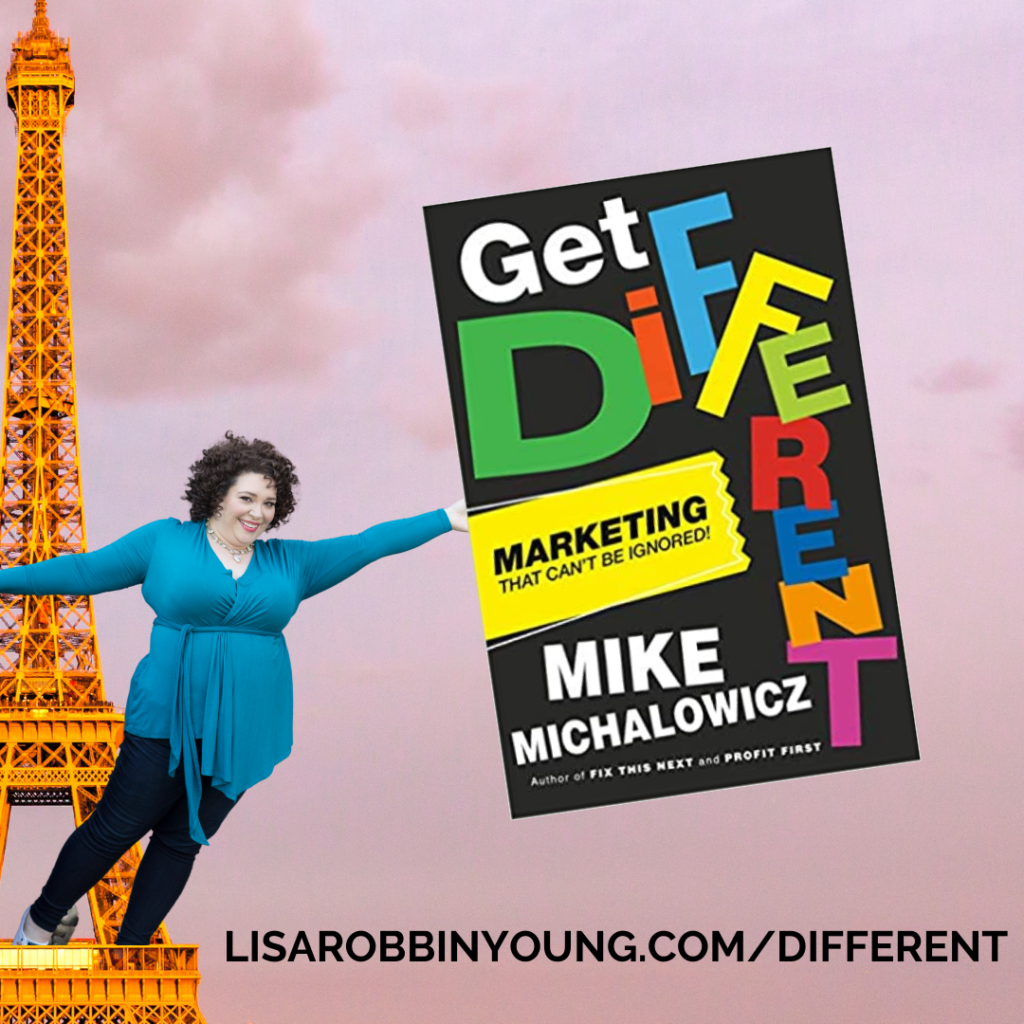
That's the premise behind Mike's book, Get Different. Mike Michalowicz has a brilliant, linear mind. He can distill anything into a useable framework or system - his past books (Fix This Next, Clockwork, Profit First), all illustrate this very well. But Mike's also good at making that framework understandable and USEABLE by just about everyone. So OF COURSE he developed a framework for marketing.
Justin Wise is the innovator of this system, and he and Mike bring it to life in this book. It's rich with case studies and examples - including from Mike's own business - to help you see how to implement and execute on the Different Is Better framework. The framework is simple - Differentiate - Attract - Direct (D.A.D) - but that doesn't make it easy.
I gave this book 4 stars because the opening chapter is SO bro-markety that it feels out of alignment with everything else Mike has ever written. It's definitely DIFFERENT, but I'm not a big fan of the guy he mentions, so the pot-smoking, pool playing, and name-dropping felt icky and not what I've come to expect from Mike's work. I'm no prude, mind you, it just felt out of integrity with the fun-loving, wise-cracking, caring approach Mike takes in his books.
But if you an get past that first chapter (and I did), you'll find a framework that's easy to understand and simple to use. Notice, I didn't say EASY to use. You'll have to test, tweak, and experiment to "find your different." But that's what marketing is all about anyway, so Mike just gives you permission to do more of it. The forms and instructions are very straightforward. It's easy to plug in your customer information and start testing/playing around with it. But you've gotta DO the work. You've gotta reach out to folks to confirm what sets you apart in the eyes of your best customers. You've got to iterate and evolve, too, because different today is samey-same tomorrow.
Overall, it's a solid read and, while I got an advanced (and autographed!) copy from Mike as part of his street team, I also bought several copies for my clients. It's a doable, understandable approach to marketing your business in a way that WORKS.
At some point, every entrepreneur will need to begin managing their personal brand. What is a personal brand? It's your reputation as an entrepreneur and leader in the community that surrounds you. When should you start to consider online reputation management services? Perhaps sooner than you think.

When entrepreneurs begin building their businesses, they primarily focus on product development and customer acquisition. This can be a winning strategy initially; however, as these fledgling companies grow more complex, there comes a time when founders must shift their attention from simply focusing upon their products and services to clients. In short, it's not enough for entrepreneurs to deliver great products anymore—they must provide outstanding service, which includes dealing with customers after the sale has been made. To do so effectively, entrepreneurs have to cultivate a strong personal brand—it makes them more visible within a specific industry—and a solid personal brand can be a business's most valuable asset.
In essence, your brand is your reputation as an entrepreneur and leader in the community that surrounds you. It consists of how other people perceive you because of your values and the behaviors associated with those values. In turn, this perception becomes part of their knowledge about you as a person. Therefore, it directly impacts how they think about you personally and professionally, which likely goes beyond just thinking about what type of services or products you offer through your company. As such, you need to carefully cultivate what others think about you if you want to drive up customer retention rates over time.
Once entrepreneurs discover developing a personal brand within their own company, it becomes a mission that they have to dedicate themselves to. While it's easy in the beginning to think of yourself as just one person within a bigger picture—the business you're building within a specific industry space—that couldn't be further from reality. Your success is entirely dependent upon how others perceive you and what they think about when they hear your name or see your face in public settings.
In short, every single move you make will either add value to your brand or detract from it. If others begin associating you with negativity in any way—through word-of-mouth marketing, social media posts that don't land well with prospective clients, etc.—you'll find it incredibly difficult to build a solid professional reputation.
Therefore, you must be very careful with portraying yourself as an entrepreneur and leader to the outside world. Credibility is built over time; it's not something that can happen overnight. Therefore, make sure your brand isn't ruining your ability to sell your value proposition to prospective clients whenever they think of you or associate you with a particular type of business model.
Entrepreneurs will quickly discover better customer retention rates over time by developing a solid personal brand within an industry setting. This is why it becomes critical for them to take their branding efforts seriously; without this foundation in place, they'll struggle to impress upon customers how much value they could bring into their lives through working together. As such, growing market share and revenue figures will become significantly more complex, and growth within their industry space will slow to a crawl.
Without a solid personal brand, it becomes nearly impossible for entrepreneurs to convince customers that they're capable of bringing value into their lives. Therefore, there's no chance for real growth; all momentum dies out quickly when your company doesn't have that type of brand equity in place.
It's not enough for entrepreneurs to develop great products anymore—they must also develop strong brands if they want to succeed in the long term.

No business owner likes to hear the word 'risk'. Whenever you hear it, you instantly shift a little in your seat and start to grumble. You've put your heart and soul into this business - along with a lot of money - so the last thing you want to do is take big risks.
By nature, a risk is something that might lead to negative consequences. As such, you try your best to avoid taking them. Most business owners will not take big risks with regards to things like a business or marketing strategy. In those cases, you're pretty calculated in your approach, ensuring you do things that are as low-risk as possible. Too many risks mean too many chances for things to go wrong, which usually results in your business either losing money or damaging its reputation.
Nevertheless, there are aspects of your business that present more risks than others, whether you like this or not. So, it's a smart idea to identify the biggest risks to try and come up with solutions that can help you mitigate them as best as you can. Here are what most business owners like Andy Defrancesco find the riskiest elements of their organization:
Yep, if you have employees, you have to understand that they present high levels of risk. How so? Well, it's largely because you have no real control over them and what they do. Yes, you are in charge of giving them orders and telling them what work to do. But, as free-thinking human beings, you can't account for their own errors.
For instance, let's say you operate a delivery business where you have numerous truck drivers delivering goods around the company. Talk to any truck accident attorney and they'll tell you that truck accidents are the most common on the roads, and this largely comes down to human error. All it takes is for one of your drivers to pull out blindly and cause an accident, with the negative consequences falling on your shoulders. Orders get unfulfilled, customers are unhappy, and you have the legal dealings of a truck accident case.
Even in an office setting, an employee can be a risk. Someone might be working on something, and they put the wrong data into a box, completely screwing up your analysis. In both of these completely different examples, you can counter the risk of employees by reducing human error. This might mean using automation in some cases, but a wiser idea is to conduct more thorough employee training. If you are confident your employees know what to do, the chances of things going wrong will decrease.
Again, it seems crazy, but technology is one of the riskiest things in your business. Mainly, you can't trust that it will always work for you. The internet is a fine example; how many times has your internet connection cut out? It might be for a few minutes, or it could be a few hours. Either way, you lose valuable time being unable to get online and do your business.
The same goes for applications; they can often freeze or stop working. It slows your productivity right down and means you might have to deal with unhappy clients and customers. To counteract the risks of technology, you need to have fail-safes in place. These are ideas and solutions that you call upon when technology fails you. For example, let's say you use the Microsoft Office Suite, but it bugs out and you can't save or do any work. Here, you should also have Google Docs to call upon and use until the Office suite works again. Simple stuff like this can save you when technology plays up.
If you use equipment in your business, it will always present a certain level of risk. This is purely because equipment can malfunction or break down at any given moment. Imagine you're in a manufacturing plant and one of your machines stops working. Or, on a more relatable and general level, your printer breaks in the office. Once again, your productivity ceases as you need to find a solution to get things up and running again.
Your best course of action is to maintain your equipment religiously. This means cleaning it all the time, getting it serviced as often as you can, and so on. Well-maintained equipment is less likely to break and present risks, keeping you safe.
Minimize the risks in your business if you want to maximize success. Calculated risks can be beneficial, but the things listed above tend to be risks that are somewhat out of your control and ever present across all industries. Find the solutions to counter these, lowering their risk level.
Maintaining good prices as a business is crucial to attract the most customers and maintain regular sales. Whether you are working on launching your next offer or trying to increase the sales of existing products, it is important to maintain fair yet competitive prices to attain regular customers. Here are some top tips for how to maintain good prices as a business and how lower prices can actually make you more money.

Think about your shipping
When a customer makes an online purchase, they will likely need to pay for shipping alongside the price of the product. Thus, you need to factor in the shipping cost to make sure that the overall price of customer purchase is fair and attractive.
When you are pricing your goods, you will want to think about how much shipping will cost. You will definitely need to consider that for international shipping, as extra fees may apply when the item arrives at the customer. Avoiding these extra fees, or letting your customer know about them when they are making the purchase, will ensure that they know how much the overall cost will be.
Finding out more about customs brokerage for international trade will unveil the complexities and ensure that you can mitigate the high fees and increase the safety of your goods before they meet the border to go to your customers.
Understand your competition
Most businesses have competition. Thus, you will want to offer fair and competitive prices so that you don’t lose out on customers. If you price your products too high, then you will likely look unattractive to customers, especially if they can find the same product elsewhere for less. Likewise, if you price your product too low, you could be taken advantage of and hinder your potential profits.
Understanding your competition comes from analysing your competitor’s prices and how often they offer free shipping, discounts, and rewards. If you can match your competitor’s prices and selling strategies, then you will attain regular customers. More so, if you can beat the prices and sales strategies, then you will attain even more interest from customers. The better your pricing strategy, the more sales you will achieve, which will translate to more profit.
Evaluate your costs
You will want to price your products depending on your costs. You need to take into consideration your marketing, materials, production, and other business costs. When you have worked out your business costs, you can then decide what price to put on your products to make sure that you make a profit.
You must ensure to price your products higher than your costs otherwise you will achieve no profit.
Determine your desired profit
When you have decided how much your costs are, you will want to price your products depending on your desired profit. If you are happy with slow and steady profit, then you will be able to afford to price your products lower.
Yet, if your aim is to achieve quick profit, then you will want to consider pricing your products higher.
Understand what your customers can afford
When you have created a business, you will know your target audience. Your target audience will be a specific group of people. Thus, you will be able to identify a rough price that they will be able to afford.
For instance, students will be able to afford less than a middle class full-time employed parent. Therefore, if your target audience is students, you will want to price your products accordingly to ensure that you attract them and maintain regular sales.
If you are unsure of what your customers can afford, simple market research will help you identify the answer. You could look into other businesses that offer similar products and that have a similar audience to see what prices they are offering. This will give you an indication of what students can afford.
Or, you could ask your customers what price they think is fair. There is no harm in asking your customer such questions. If you ask them what they want and expect, then you will be able to fulfil those expectations.
Using these tips, you will be able to get a better understanding of how to price your products and help generate more profit for your business. The better your pricing strategy is, the more customers you will attract and the more sales you can make. Attractive prices will make your business stand out and be competitive within your market.
Nickelback. That band everyone loves to hate. Well, thanks to a lot of stock video footage, their rock anthem is now a parody of what it takes to get more visibility in your creative business.
Want to remind your customers of your creative business and develop a sustainable marketing strategy? Check out Episode 6 of the Creative Freedom Show today.
Special thanks to our Patrons for your continued support.
"How I'll Remind You" is a parody of "How You Remind You", originally recorded by Nickelback. Parody lyrics by Lisa Robbin Young.
Are you thinking about launching a new product on the market through your business? If you listen to many of the folks in the internet marketing world, this can be a complicated process. In truth, it CAN be as easy as a paypal button and inviting folks to purchase, but usually, you've got a few more moving pieces than that if you want to get any sales volume.
So let's ensure that you are taking the approach that's right for you. That will give you the greatest chance of feeling like you've had a successful launch once the cart opens.

It can be tempting to keep "moving the goal posts" with a launch. If this is your first launch, or if this is a new offer, it's even more important to be clear on what you hope to accomplish from this launch. Do you want to grow your reach (or mailing list)? Do you want to hit a certain number of sales or a certain amount of revenue? Do you want all three? Do you want to collaborate with new affiliates or partners? Be clear BEFORE you launch what you're really trying to accomplish. That way, you won't keep raising the bar on your launch goals until they're unattainable.
Think about hiring the right team members to help you launch a product. You might want to explore a candidate with a product manager certification who can join your team. Certificates like this show evidence that someone has all the expertise that you need to hit the right marks with a product launch.
At the very least, consult with someone who has experience with launches similar to yours. While you CAN do a launch on your own, it's a lot of work, and I don't recommend it. Start now to build out your marketing team. That way you'll have experts on your side that help your launch be more successful.
Investigate the products that are similar to yours that already exist on the market. Do the math and look at how many people you need to reach in order to hit the volume of sales and revenue you want to reach. Do you have a marketing budget or is this a bootstrap affair? You need to know the numbers before you jump in.
How will they learn about you? This isn't the Field of Dreams, so you need a plan to reach your right people. When considering how to reach your audience, you need to look at their individual behaviors and what makes them tick. Specifically, you must explore their desires or their pain points. Whenever you decide to launch a new product, you should be able to address how it tackles the pain points of users or makes their lives better in some meaningful way. For instance, it could make a process that they are already completing more efficient. Or, it might satisfy their thirst for a more immersive experience in the world of gaming. These are just a couple of examples. Find the need and fill it, as they say.
Armed with the research and your understanding of the audience, there are probably a number of marketing strategies that could work in your favor. The option that you choose will depend on what you're promoting as well as your brand as a whole. Maybe your budget requires you to opt for social media marketing over other marketing channels. If that’s the case then it’s important to think about which social media network will work best for your brand. Where is your best audience likely to be? Lay out all the pieces of your marketing strategy so that you have a clear plan before you launch.
Launching doesn't have to be hard or take months, but it does require focus, a little bit of research, and a willingness to see it through to the end... including the post-launch review. Make sure you evaluate your results after the launch ends to know what works, what didn't, and what you'll do differently next time.
Ever feel like you're on the hamster wheel of hustle when it comes to your marketing? I can SO relate! So much so that I created this parody based on my favorite Mark Schultz tune, "Running Just To Catch Myself"
So, here's the social media/marketing edition of his super fun tune!
And if you're looking for support to develop your marketing strategy WITHOUT having to be on the hamsterwheel of hustle all the time, check out Episode 5 of the Creative Freedom Show today.
Special thanks to our Patrons for your continued support.
"Running Just to Catch Myself" is a parody of "Running Just to Catch Myself", originally recorded by Mark Schultz. Parody lyrics by Lisa Robbin Young.

Starting a business or becoming an entrepreneur, like Andy Defrancesco, can be one of the most rewarding things that you ever do in your life. It gives you the ultimate freedom and flexibility to do something that you love every day. It means you can work on your own passion and that you will be earning money for yourself rather than making someone else rich. You can set your own hours, decide your own tasks and figure out the direction that you want to take it in. Yet starting a business also comes with a great deal of both risk and responsibility and you want to ensure that you are going into it equipped with everything you need to give it the best chance of success. If you are considering going it alone and starting your own business, here are some of the top things that you will need to consider.
Is it a viable idea
A lot of the time, we come up with ideas that sound great, but actually could be hard to turn into something viable. Make sure that your business plan has some credibility behind it and will be a success rather than just a far-fetched pipe dream. It is important that when you set out into starting your own company that the idea you are turning into a reality is one that you have put a lot of thought into, rather than something you have decided on a whim. Make sure you speak to friends, family and other people to check if they think it is a good idea too!
Do you have the tools and resources that you will need?
When starting a business, the better equipped you are, the better you will be at it. Think about the different things you might need that will help you. For example, you need to know about marketing and it can be a good idea to have a team of influencers and social media marketing experts on hand such as those here to help you get the word out. You may need to know certain skills such as photography or SEO in order to help properly start up your company, or have a database ready such as Couchbase, so take courses or learn these if you need them.
What is your budget?
Depending on what your business idea is, will depend on the budget you need. It is important that you have a realistic notion of what you will be needing to spend before diving in head first. You will need to consider everything from your website hosting fees, to office space, hiring services such as business coaches and photographers, to everything in between. Try to think of everything that you will need to spend in the next 12 months and ensure that you have enough cash to cover it, even if you don’t make as much money as you might hope. Most businesses don’t bring in a profit in the first couple of years so you need to be prepared for this.
These are all things that you need to consider before you start a business. If you ensure that you go into it with all the above mapped out then you will put yourself in a much better stead for success in the future.
Running a B2B organization (or B2C for that matter!) is no walk in the park. You need to ensure you have a business that either answers your needs or needs your solutions. There are so many creative startups struggling to get things off the ground, and if you are not keen, you might end up just like them. To help you with this, here are a couple of strategies you can implement. They are tried and tested and can have you coming out on top.
In this era full of competition, it is vital that you stand out from the rest. One of the ways you can do this is by personalizing your business and the messages you pass across. Clients and businesses need to come to you and feel like they have interacted with an actual person and not just a business entity. No one wants to open their email and feel like they are spammed with information that is not relevant to them. You need to sit down and come up with a strategy that will work to ensure your clients feel like you are looking out for them on a personal level.
Despite needing a personal touch to them, your communication would go on better if it was automated. Having an automated service will ensure that your clients never miss an update on whatever you are doing. Since there will be so many emails that you need to send, it makes sense for you to make this an automated function. Getting data analytics consulting will go a long way to ensure that clients' actions from the emails sent are recorded. You can then use the information to strategize on what your next move will be.
Since most of the transaction is happening online, it is vital for you to get good user experience on your business site. The easiest way to go about this is to have someone go through all the processes on your site to get a product or service from you. Getting a professional user experience designer is the best option. They will identify any areas on your site that might need work and recommend changes to these areas. Any bugs that need fixing will also be dealt with. Through that, the site will be user-friendly for any business or person that visits your site.
The use of chatbots has made marketing products easier. You can collect data on the FAQs and have chatbots help you with the answers to that. They will be available throughout to answer any questions the clients might have, which will free up time for other people to work on the more critical aspects of the job, like closing sales. You do not have to get someone to do that for you as the chatbots cost less and are more effective.
In order for you to stand out in your business, you need to develop a sustainable marketing strategy that is relevant to the current market. The strategies above are the most effective as they have been tried and tested.
When thinking about how to improve the bottom line of their business, many companies think of how they can increase revenue, forgetting that there’s a lot of value in reducing overheads as well. Improving your bottom line works both ways, get the balance right, and you can pare down your business and enjoy better returns.
Are you noticing diminishing returns with your existing marketing strategy? It might be time to embrace the digital economy and shift your focus to online marketing; there are many advantages, including more leads, better customer retention, and lower costs.
If you’re running a traditional marketing strategy, you’ve probably noticed it’s become less effective; as a result, you need to put more money into achieving the same results. The digital economy offers new ways to grow your brand and reach new customers at lower costs.
In days gone by, the model for running a successful business was to hire an in-house team of specialists to look after your IT infrastructure, your accounting, or your customer services. The trouble is that in-house teams are expensive and often less effective than outsourcing.
Outsourcing gives you the same level of expertise at a lower cost because you don’t need anyone on your payroll. You simply have to pay a subscription fee for a high-quality always-on service that never lets you down. It wasn’t possible in the pre-digital world, but it is now.
Another useful way to reduce your bottom line and boost your revenue is to onboard VoIP phone systems. VoIP stands for Voice Over Internet Protocol. Instead of using a conventional telephone system that charges you standard business rates for calls, a VoIP service is far cheaper.
Although internet calls are not entirely free - you have to pay a premium to your VoIP service provider - it is far cheaper overall. Once the premium is settled, all your business phone calls are free across the internet. The channels are also much more reliable.
Growing a business means increasing your productivity whilst simultaneously reducing your costs. To improve productivity, you have two options, you can train existing staff in new areas, or you can hire freelancers who can deliver the results you need right away.
There are pros and cons to each avenue; training your staff means you have those skills in your business long-term, but training staff can often be more expensive than hiring freelancers for the same tasks. Make your choice in relation to your bottom line.
One of the essential ways to improve your bottom line is to reduce your overheads; the best way to do this is to look at your infrastructure and employee expenses. You’ll be surprised at how much you can reduce your bottom line with minimum impact.
The first thing to look at is your premises and your power consumption. Today, most businesses are seriously considering remote workstations long-term - this is an excellent option because it eliminates the need for office space.